The Ultimate Guide to Choosing Travel Toys for Newborns: Safety, Stimulation, and Practicality
Traveling with a newborn can be both exciting and daunting. Parents often find themselves packing everything but the kitchen sink, only to realize that the most important items—the toys—are either forgotten or unsuitable. Travel toys for newborns are not just about keeping the baby entertained; they play a crucial role in sensory development, comfort, and establishing a sense of familiarity in unfamiliar environments. However, with countless options on the market, choosing the right ones can feel overwhelming. This comprehensive guide breaks down every factor you need to consider, from safety standards to developmental benefits, so you can make informed decisions that support your baby’s growth and make your journey smoother.
Understanding the Unique Needs of a Newborn During Travel
Newborns are not miniature adults. Their vision is still blurry, their motor skills are limited to reflexive grasping and rooting, and their nervous systems are easily overstimulated. When traveling, they are bombarded with new sounds, smells, lights, and motion. The right travel toy should act as a calming anchor—something familiar that provides gentle stimulation without overwhelming their delicate senses. Unlike toys for older infants, newborn travel toys must prioritize soft textures, high-contrast colors (like black, white, and red), and simple auditory feedback such as soft rattles or crinkling sounds. They should also be easy to attach to car seats, strollers, or diaper bags, because newborns cannot hold objects for long. Understanding these baseline needs will help you filter out toys that are too complex, too bright, or physically unsafe for the travel environment.
Safety First: Non-Toxic Materials, No Small Parts, and Secure Attachment
Safety is non-negotiable when choosing any toy for a newborn, but it becomes even more critical during travel because the baby is often in a moving vehicle or an unfamiliar setting. First and foremost, verify that all materials are non-toxic and BPA-free. Newborns explore the world with their mouths, and travel toys inevitably end up being chewed, sucked, and drooled on. Look for labels like “phthalate-free,” “lead-free,” and “ASTM certified” (American Society for Testing and Materials). Avoid toys with small parts that could break off or detach—no buttons, beads, or plastic eyes. Even seemingly harmless stuffed animals can pose a choking hazard if their seams are weak or if they contain loose stuffing.
Attachment mechanisms deserve special scrutiny. Many travel toys come with clips, loops, or straps designed to fasten onto strollers, car seats, or diaper bags. Test these clips before your trip: they should be strong enough to withstand a baby’s tugging, but not so rigid that they could harm the baby if accidentally hit. Never attach a toy to a car seat’s harness straps or the vehicle’s seat belt itself, as this can interfere with proper restraint. Instead, use designated toy bars or attach the toy to the handle of the stroller or the side of the carrier. Also, avoid toys with long strings or ribbons, as these pose a strangulation risk. When in doubt, follow the “choking hazard tube” rule: if a toy or any of its parts can fit through a standard toilet paper roll, it is too small for a newborn.
Sensory Stimulation: Balancing Visual, Auditory, and Tactile Input
Newborns’ sensory systems are rapidly developing, and travel toys can serve as excellent tools for gentle stimulation. However, the key word here is “gentle.” Bright, flashing lights or loud electronic sounds can easily overstimulate a tired, fussy baby during a long car ride or flight. Instead, opt for toys that offer subtle, multi-sensory experiences.
- Visual stimulation: Newborns have limited color perception; they see best in high-contrast patterns like black-and-white stripes, checkerboards, or simple geometric shapes. Many travel toys incorporate these patterns on soft fabric books, activity cards, or small plush dolls. Red is also one of the first colors babies notice, so a red-accented rattle or key ring can catch their attention without being harsh. Avoid busy, cluttered patterns—simplicity is more calming.
- Auditory stimulation: Soft rattles, gentle chimes, or crinkle paper sounds are ideal. They should be quiet enough that they don’t startle the baby, but audible enough to pique curiosity. Avoid toys with sirens, loud melodies, or spoken words, as these can disrupt sleep and cause distress in confined spaces like airplane cabins. A simple crinkle book or a soft rattle with beads inside offers just the right auditory feedback.
- Tactile stimulation: Newborns love exploring different textures. Look for toys made from a variety of fabrics: velvet, satin, cotton, and ribbed or bumpy silicone. Teethers with soft nubs or textured rings can be soothing during teething phases (which can start as early as 3 months, so even for some newborns, it’s relevant). A travel toy that combines multiple textures—like a plush animal with crinkly ears, a satin tail, and a rubber ring—keeps little fingers busy and provides sensory variety.
Portability and Easy Cleaning: Lightweight, Compact, and Washable
Travel itself imposes practical constraints. You are likely juggling diaper bags, bottles, blankets, and a car seat carrier. The last thing you need is a bulky, heavy toy that takes up half the diaper bag. Therefore, choose travel toys that are lightweight, compact, and ideally designed to fold or collapse. Soft cloth books, small plush dolls, or simple wrist rattles are excellent because they can be tucked into side pockets or even attached to a pacifier clip. Some toys are designed to double as a stroller blanket or a nursing cover, maximizing functionality.
Equally important is the ease of cleaning. Travel exposes toys to airport floors, restaurant tables, and curious hands of strangers. Newborns have immature immune systems, so toys must be sanitized frequently. Look for machine-washable fabrics or toys that can be wiped down with a disinfectant wipe. Avoid toys with intricate crevices, batteries, or electronic components that cannot be submerged in water. A good rule: if you can toss the toy in the washing machine on a gentle cycle (or wipe it down in seconds), it is travel-friendly. For teethers, choose silicone or natural rubber that can be sterilized with boiling water or placed in the dishwasher.
Types of Travel Toys for Newborns: What Actually Works?
Not all “travel toys” marketed for babies are suitable for newborns. Here is a curated list of types that are developmentally appropriate and practical:
- Rattles with soft handles: A simple rattle made of fabric or soft silicone is perfect. The handle should be easy for tiny fingers to grip, even if reflexively. Look for ones that are lightweight and have a gentle sound.
- Crinkle books: Small, foldable books with high-contrast images and crinkly pages are a staple. They are washable, lightweight, and can be clipped to a stroller. Plus, babies love the sound.
- Activity links and clip-on toys: Plastic or fabric rings that can attach to stroller bars or car seat handles. Some come with dangling toys like a mirror (safe, unbreakable), a soft ball, or a teether. They allow for swapping out different toys to keep interest.
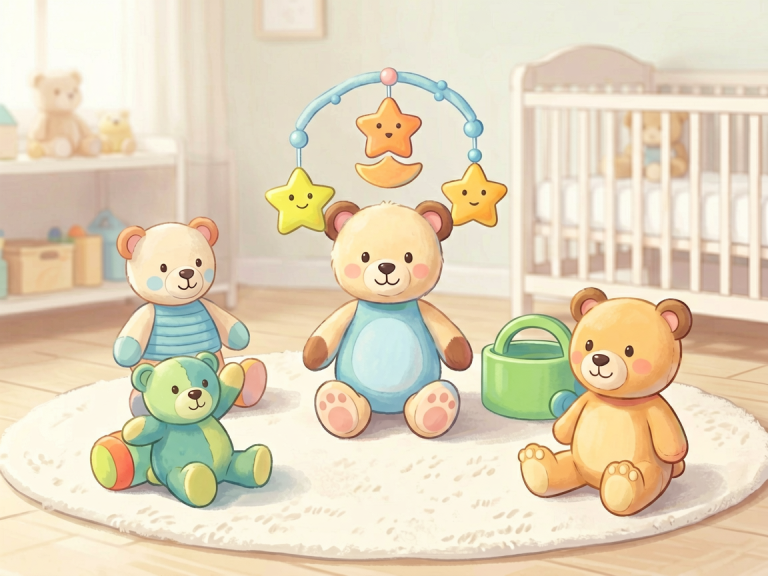
- Soft plush dolls or comforters: A small, cuddly toy that has a familiar scent can be incredibly soothing for a newborn in new surroundings. Choose one with no small parts and a simple face. Some have a built-in “lovey” blanket that can be detached.
- Wrist or ankle rattles: Elastic bands with a small rattle or bell that can be worn on the baby’s wrist or ankle. They encourage movement awareness and are impossible for the baby to drop. However, ensure the elastic is not too tight and that the rattle is securely attached.
- Silicone teether rings or keys: Even if your newborn hasn’t started teething, they enjoy gnawing on soft silicone. These are easy to clean and can be chilled to provide numbing relief on a long flight.
Avoid toys with batteries, sharp edges, or parts that can be torn off. Also, skip plush toys that shed lint easily, as this can irritate a newborn’s airways.
Multi-Functional Toys: Getting More Value Out of Each Item
Because luggage space is limited, multi-functional toys are a smart investment. For example, a soft toy that can be used as a teether, a rattle, and a mirror all in one saves packing multiple items. A small activity blanket that folds up into a tiny bag can serve as a play mat on a hotel bed, a changing pad, and a cover for the stroller. Some toys come with a clip that doubles as a pacifier holder. Another clever idea: a cloth book that features a built-in crinkle page, a silicone teether corner, and a plastic ring for attaching to the diaper bag. These types of toys not only reduce clutter but also offer repeated novelty as the baby discovers different features over time.
Moreover, consider toys that can serve a dual purpose for parents. For instance, a small rattle that also clips onto a diaper bag strap can be quickly grabbed when you need to distract the baby during a diaper change. A crinkle book with a strap can be hung from a car seat handle, keeping it accessible but out of the baby’s reach until you want it. Every travel toy should earn its keep, either by stimulating the baby or by making your life easier.
Age-Appropriate Features: Avoiding Overstimulation and Fatigue
Newborns have short wake windows—often just 45 to 60 minutes. During travel, they may be overtired or overstimulated from the novelty of the journey. The toys you choose should adapt to this fragile state. Avoid toys that require active participation, such as those with buttons to press or levers to pull. Newborns have no capacity for intentional play; they respond to sensory input passively. A toy that makes unpredictable or loud noises could cause crying or agitation.
Instead, look for toys that promote calm engagement. A mobile-like toy that clips to the car seat canopy with high-contrast shapes that rotate slightly with the car’s motion can be mesmerizing without being intense. Soft toys that you can gently shake or dangle near the baby’s face, allowing them to track movement, are excellent for developing visual focus. Remember that sometimes the best travel toy for a newborn is a simple black-and-white card held up by a parent. Do not feel pressured to buy a whole arsenal of toys. Rotate just two or three during the trip to prevent monotony, but also know that the baby may be perfectly content staring out a window or sleeping.
Tips for Packing and Using Travel Toys Effectively
Even the best toy is useless if it’s buried at the bottom of a suitcase. Here are practical strategies for maximizing the benefit of your travel toys:
- Pack a separate “activity pouch” that you keep within arm’s reach in the car or carry-on. Include 2–3 toys, a pacifier, and a small blanket. This pouch should be accessible without digging through bags.
- Introduce new toys gradually. If you buy new toys for the trip, show them to the baby a few days before departure so they are not completely foreign. A familiar toy is more comforting.
- Use toys for routine transitions. Attach a soft rattle to the stroller when you are walking through a busy terminal—it helps the baby associate the toy with the motion and stay calmer.
- Sanitize between uses. Carry a small pack of baby-safe wipes and wipe down toys after they fall on the floor, especially in public transportation. For cloth toys, bring a spare in case one gets soaked with drool.
- Don’t over-rely on toys. Sometimes the best comfort is your face, voice, or a gentle rock. Toys are tools, not substitutes for parental interaction. Use them to bridge gaps—when you need to buckle your seatbelt, hand the baby a crinkle book.
Conclusion
Choosing travel toys for newborns is a careful balancing act between safety, developmental appropriateness, portability, and practicality. There is no single perfect toy that works for every baby, but by prioritizing non-toxic materials, small sizes, washable fabrics, and gentle sensory features, you can assemble a small collection that turns a potentially stressful journey into an opportunity for connection and discovery. Remember that less is often more: a newborn’s world is already full of new wonders during travel, and the toys you choose should serve as gentle guides, not loud distractions. With the right toys in hand, you can travel with confidence, knowing that your little explorer has the tools to stay curious, calm, and content.