Building for Focus: The Best Building Toys to Enhance Attention Span in Children
Introduction: The Crisis of Distraction and the Promise of Play
In an era dominated by fast‑paced digital media, instant gratification, and endless notifications, the ability to sustain focused attention has become a rare and precious skill. Parents, educators, and child development experts increasingly worry about the shrinking attention spans of modern children. While many interventions focus on limiting screen time or practicing mindfulness, one of the most effective and enjoyable tools for cultivating deep focus lies in a humble category of playthings: building toys. These three‑dimensional, hands‑to objects demand planning, patience, problem‑solving, and sustained mental engagement. Unlike passive entertainment, building toys require the child to become an active architect of their own experience. This article explores the best building toys specifically chosen for their capacity to train and extend a child’s attention span. We will examine how different types of construction sets engage the brain, why they work better than many digital alternatives, and which specific products stand out as champions of concentration. By the end, you will have a clear roadmap for choosing the right building toy for your child’s age, interests, and developmental stage.
## The Science of Attention and Why Building Toys Matter
Attention span is not a fixed trait; it is a muscle that can be strengthened through repetitive, focused practice. Neuroscientists distinguish between two types of attention: *bottom‑up* attention, which is captured by bright colors, loud sounds, or sudden movements (the kind exploited by many video games and TV shows), and *top‑down* attention, which is voluntary, goal‑directed, and effortful. Building toys predominantly engage the latter. When a child sits down to follow a set of instructions or to create an original structure, they must override the temptation to quit, maintain a mental model of the goal, and inhibit distractions. This process activates the prefrontal cortex, the brain region responsible for executive functions such as planning, impulse control, and working memory.
Furthermore, the tactile nature of building toys strengthens neural connections in ways that screen‑based activities cannot. Manipulating physical objects provides rich sensory feedback—the weight of a block, the snap of a Lego brick, the resistance of a magnetic tile—which anchors the child in the present moment. This sensory grounding is a natural antidote to the fragmented, hyper‑connected world. The best building toys for attention span are those that strike a balance between challenge and achievability, offering just enough complexity to prevent boredom without causing overwhelming frustration. They also encourage a state of “flow,” a psychological term for complete immersion in an activity, where time seems to disappear and effort feels effortless. Experiencing flow regularly is one of the most effective ways to lengthen a child’s ability to concentrate.
## Criteria for Selecting the Best Building Toys for Attention Span
Before diving into specific recommendations, it is important to establish the criteria that make a building toy particularly effective at promoting sustained focus. These criteria include:
- Open‑endedness vs. Structured Goals – Some toys offer free‑form construction with no predetermined outcome, while others come with detailed instructions and specific challenges. Both types have merits. Free play fosters creativity and independent decision‑making, but may sometimes lead to aimless wandering. Structured builds, on the other hand, provide a clear endpoint that encourages children to see a complex task through to completion. The best toys often offer both options within a single set.
- Gradual Complexity – A toy that is too simple will be abandoned quickly; one that is too difficult will cause frustration and disengagement. High‑quality building toys allow for incremental skill development, with pieces that can be combined in ways of increasing difficulty. This scalability ensures that the child remains in the zone of proximal development—challenged but not defeated.
- Self‑Correcting Feedback – When a child builds a tower that collapses or a car that won’t roll, the toy itself provides instant feedback. This natural consequence teaches resilience and the value of sustained effort, as the child must retrace their steps, identify the error, and try again. This cycle of failure, analysis, and success is a powerful training ground for attention.
- Minimalist Design – Toys with too many flashy lights, sounds, or moving parts can be overstimulating and undermine the very focus we aim to cultivate. The best building toys are often quiet, simple in their materials (wood, plastic, magnets), and rely on the child’s imagination to bring them to life. Less distraction means deeper concentration.
- Age‑Appropriate Challenges – A set designed for a 3‑year‑old will not hold the attention of an 8‑year‑old, and vice‑versa. We must match the toy to the child’s cognitive and motor abilities to ensure engagement.
With these criteria in mind, let us now examine the top contenders.
## Classic Wooden Blocks: The Timeless Foundation of Focus
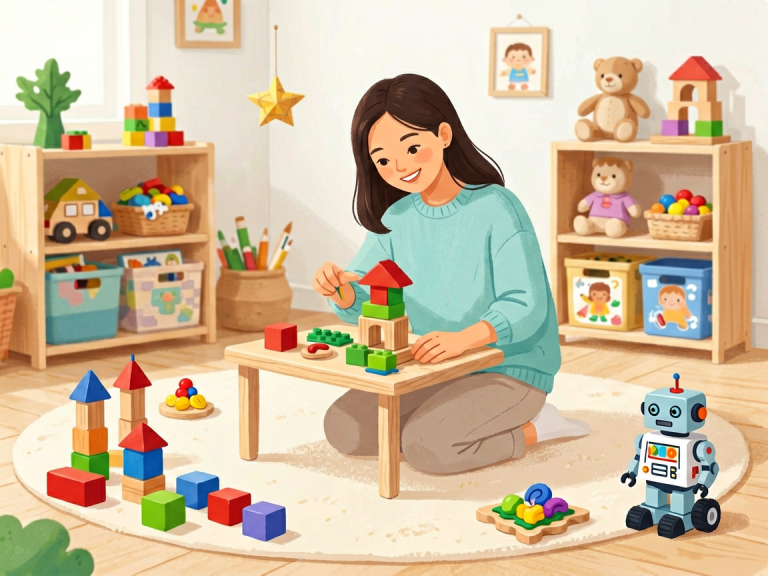
It may seem almost too obvious, but the humble wooden block remains one of the most effective tools for building attention span in young children. Unlike modern plastic construction sets that click into predetermined positions, simple wooden blocks offer no built‑in constraints. A child must decide where to place each block, balance it carefully, and adjust for gravity. This requires continuous visual‑spatial evaluation and fine motor control. A study published in the journal *Early Childhood Research Quarterly* found that preschoolers who engaged in block play showed significant improvements in their ability to sustain attention during structured tasks compared to peers who engaged in other free play.
The best wooden blocks for attention span are those that come in a variety of shapes (cubes, cylinders, arches, triangles) and are large enough to be handled comfortably by small hands. Sets like the *Melissa & Doug Standard Unit Blocks* or the *Grimm’s Large Wooden Building Set* are excellent examples. Because there are no instructions, the child’s mind must generate its own goals—building a tower, a castle, a bridge. This self‑directed goal setting is a powerful attention‑training exercise because it forces the child to hold a mental image in mind while executing a series of physical actions. The absence of a pre‑determined “finish line” also means that a session can last anywhere from ten minutes to an hour, depending on the child’s level of absorption. Parents can further extend focus by introducing simple challenges: “Can you build a tower that is taller than you? Can you make an arch that a toy car can drive under?” These prompts gently nudge the child deeper into a state of concentrated play.
## Magnetic Tiles: The Modern Marvel for Visual‑Spatial Concentration
In recent years, magnetic building tiles have surged in popularity—and for good reason. Brands such as *Magnatiles*, *PicassoTiles*, and *Connetix* have become staples in both homes and classrooms. These transparent, colorful tiles connect easily via strong magnets embedded in the edges, allowing children to quickly construct 2D patterns and 3D structures. The appeal of magnetic tiles for attention span lies in their rapid feedback and the high level of precision required to create stable forms.
Unlike wooden blocks, magnetic tiles reward careful alignment. If a tile is placed slightly off‑angle, the structure may wobble or collapse. This encourages the child to pay close attention to the alignment of each piece, fostering what developmental psychologists call “visual attention to detail.” Moreover, magnetic tiles are particularly effective for children aged 3 to 7 who are developing their spatial reasoning. When a child builds a cube, then a pyramid, then a castle with a drawbridge, they are constantly planning several steps ahead. They must hold a model of the future structure in their mind while simultaneously carrying out the current action. This dual process is an advanced form of attentional control.
One of the greatest strengths of magnetic tiles is their ability to facilitate collaborative building. Two children working together on a large structure must negotiate, share ideas, and coordinate their actions—all of which require sustained mutual attention. Research indicates that social play that demands joint focus can improve a child’s ability to concentrate even when alone, as they internalize the habit of staying on task. For parents seeking a toy that grows with the child, magnetic tiles are an excellent investment: toddlers simply connect them to form flat shapes, while older children construct elaborate mansions, rockets, and geometric sculptures. The open‑ended nature of the play ensures that attention spans are stretched in different ways over the years.
## LEGO: The Gold Standard for Structured Focus and Problem‑Solving
No discussion of building toys would be complete without LEGO. Since its invention in 1958, LEGO has become synonymous with constructive play. For attention span, LEGO sets offer a unique combination of structured instructions and unbounded creativity. The classic boxed sets—from the *LEGO City* series to the more complex *Technic* and *Creator Expert* lines—require children to follow step‑by‑step diagrams, often involving dozens or hundreds of pieces. This process demands intense sustained attention over an extended period. A child building a 1,200‑piece LEGO Star Wars Millennium Falcon must focus for several hours, sometimes over multiple days. The satisfaction of clicking the final piece into place provides a massive dopamine reward, reinforcing the value of patience and perseverance.
The benefits of LEGO for attention extend beyond following instructions. Many children eventually tire of following the manual and begin to deconstruct and rebuild according to their own designs. This phase is where the true cognitive growth occurs. Free‑form LEGO building requires mental flexibility and the ability to maintain a coherent plan without external guidance. It also teaches the skill of “chunking”—breaking a large project into manageable sub‑steps, which is a fundamental strategy for managing attention over long periods. Additionally, LEGO’s clutch power (the friction that holds bricks together) provides immediate feedback: if a brick is not pressed firmly, the structure will be weak. This forces the child to attend to the quality of each connection, cultivating a meticulous, focused mindset.
For younger children (ages 3–5), larger DUPLO bricks serve the same purpose, albeit with shorter build times. As children grow, moving to standard LEGO and eventually to LEGO Technic (which includes gears, axles, and motors) increases the cognitive load and extends the attention‑sustaining challenge. It is worth noting that LEGO sets with many small, specialized pieces can sometimes be overwhelming for children with shorter attention spans. In such cases, parents should start with smaller sets (100–200 pieces) and gradually increase the difficulty. The key is to match the build time to the child’s current capacity and then stretch it by 10–15 minutes per session.
## K’NEX and Construction Rods: Engineering Focus Through Mechanical Logic
While LEGO excels in creating static structures and figurines, K’NEX and similar rod‑and‑connector systems take building into the realm of mechanical engineering. K’NEX pieces include rods of varying lengths, connectors, wheels, gears, and pulleys. The classic *K’NEX Education* sets and the *K’NEX Thrill Rides* series allow children to build functioning roller coasters, Ferris wheels, and bridges. The attention span demands of K’NEX are different from those of LEGO: instead of stacking bricks, the child must understand how linear rods and angled connectors create structural integrity. A small error in connector placement can cause the entire mechanism to fail, which trains the child to double‑check each step.
Moreover, K’NEX builds often involve moving parts. After constructing a model, the child can test it—for instance, manually turning a crank to see if a gear train works. This adds an element of cause‑and‑effect experimentation that motivates prolonged engagement. A child who builds a K’NEX motorized car must concentrate not only during assembly but also during troubleshooting: “Why does the wheel wobble? Is the axle too short?” This iterative testing sharpens attentional control because the child must hold multiple variables in mind simultaneously.
For children who are already adept at basic block play but struggle with prolonged focus, K’NEX offers a fresh challenge that reignites motivation. The recommended age range is typically 7 and up, though simpler K’NEX sets exist for ages 5–6. The tactile feedback of snapping rods into connectors is satisfying and encourages precision. Parents should note that K’NEX pieces are smaller and can be difficult for very young children to manipulate, so fine motor readiness is a prerequisite.
## Strawbees and Flexible Construction: Creativity and Adaptability
A less conventional but equally powerful building toy for attention span is Strawbees—flexible plastic connectors and straws that can be joined in almost any angle. Unlike rigid bricks, Strawbees allow for bending, twisting, and pivoting structures. This flexibility means that a structure is never truly “locked”; it can be adjusted and transformed in real time. For children who get easily frustrated by the collapse of a rigid tower, Strawbees offer a more forgiving medium. The ability to adapt a design on the fly teaches flexible thinking and sustained engagement, because the child must continuously re‑evaluate the stability of their creation.
Strawbees sets often come with suggested projects—a catapult, a bridge, a geometric dome—but the real magic is in free exploration. Because the connectors are lightweight and modular, children can build very large structures without the weight constraints of wood or plastic. Building a human‑sized geodesic dome with Strawbees requires hours of concentrated teamwork, as each new strut must be carefully placed to maintain symmetry. This kind of play is particularly beneficial for children aged 6 to 12, who are developing abstract reasoning and the ability to hold complex spatial relationships in mind.
Furthermore, Strawbees can be used to create movement: adding a rubber band creates a catapult, while attaching a straw to a pinwheel demonstrates wind energy. These interactive elements extend the play session beyond pure construction and into scientific exploration, further motivating the child to maintain focus in order to see the final outcome.
## Meccano and Metal Construction: Precision and Patience for Older Children
For older children (ages 10 and up) who have already developed a baseline attention span, Meccano sets offer a more demanding and more rewarding experience. Meccano consists of metal strips, plates, nuts, bolts, and tools. Building a Meccano model—such as a crane, a motorcycle, or a working robot—requires careful reading of detailed instructions, fine motor dexterity, and the ability to tighten small screws with a screwdriver. This is a slow, deliberate process that can take many hours or even days to complete. The attention span required is immense, but the payoff is a functional, often motorized model that the child can proudly display.
The key to Meccano’s success in building attention span is the need for sequential, meticulous work. A missed hole or a loose bolt can cause the entire structure to fail later. This forces the child to adopt a methodical approach: check each step, ensure alignment, and tighten thoroughly. Meccano also teaches the value of persistence, as the early stages of a build feel tedious but are essential for later structural integrity. For a child who is used to instant results from digital games, Meccano can be a powerful tool for learning to delay gratification. Parents should supervise younger users to ensure safety with small metal parts, but the concentration benefits are well worth the effort.
## How to Integrate Building Toys into a Daily Routine for Maximum Attention Gains
Even the best building toy will not improve attention span if it is used sporadically or in a distracting environment. To maximize the benefits, parents and educators should create a “focus‑friendly” play setting. This includes:
- Designating a clutter‑free zone – Remove competing toys, tablets, and noise. The building surface should be flat and well‑lit.
- Setting a timer – For children who struggle to stay engaged, start with short, timed sessions (15–20 minutes) and gradually increase them. The timer provides a clear expectation that helps the child commit to the task.
- Offering guided challenges – Sometimes a child doesn’t know where to start. Provide a clear, achievable goal: “Build a tower that is exactly 12 inches high” or “Create a bridge that can hold this small apple.”
- Allowing uninterrupted time – Avoid checking in or correcting the child mid‑build. Let them encounter and solve problems on their own, even if they make mistakes. The learning is in the process.
- Celebrating completion – Acknowledge the effort, not just the end product. “I noticed you worked on that for a whole hour without giving up!” reinforces the value of sustained attention.
Conclusion: The Enduring Power of Hands‑On Construction
In a world that constantly pulls our attention in a thousand directions, building toys offer a sanctuary for the mind. From the simple stacking of wooden blocks to the intricate assembly of a Meccano crane, these activities train the brain to focus, plan, and persist. They are not quick fixes; they are tools for building a habit of concentration that will serve a child for a lifetime. The best building toys for attention span are those that challenge without overwhelming, that allow for both freedom and structure, and that produce a tangible, satisfying result. By consciously choosing and integrating these toys into daily play, we can help the next generation reclaim the deep, joyful focus that is essential for learning, creativity, and fulfillment.