Building Beyond Blocks: The Best Building Toys for Developing Gross Motor Skills
Introduction
In the age of digital screens and sedentary play, the importance of physical activity for children’s development cannot be overstated. Among the many types of play that nurture a child’s body and mind, building toys hold a special place. Traditionally associated with fine motor skills—the precise movements of fingers and hands required to stack small blocks—building toys are often overlooked for their potential to strengthen gross motor skills. Gross motor skills involve the large muscles of the torso, arms, and legs, enabling actions such as crawling, walking, jumping, balancing, and coordinating whole-body movements. These foundational abilities are crucial not only for sports and physical play but also for everyday tasks like sitting at a desk, carrying a backpack, or navigating a playground.
When we reimagine building toys as instruments for whole-body engagement, a new world of opportunities emerges. Large interlocking blocks, oversized foam bricks, magnetic tiles that require reaching and stretching, and modular climbing structures all invite children to lift, carry, push, pull, balance, and climb. These activities engage the core, strengthen the legs and arms, and improve spatial awareness and coordination. In this article, we explore the best building toys specifically designed to promote gross motor skills, explaining why each one works and how parents, educators, and caregivers can use them to foster healthy physical development. By the end, you will have a clear roadmap for selecting toys that turn construction play into a full-body workout disguised as fun.
The Importance of Gross Motor Skills in Early Childhood
Gross motor development begins in infancy and continues through early childhood, forming the bedrock for more complex physical abilities. A child’s ability to sit up independently, crawl across a room, walk up stairs, and eventually run, jump, and throw all depend on the strength and coordination of large muscle groups. Research shows that children with well-developed gross motor skills tend to have better body awareness, fewer injuries, and higher self-confidence during physical play. Moreover, there is a strong link between gross motor competence and cognitive development: movements that require planning, sequencing, and spatial reasoning—such as navigating an obstacle course or balancing a stack of large blocks—activate the same neural pathways used for problem-solving and executive function.
Unfortunately, modern lifestyles often limit opportunities for large-muscle exercise. Long hours in car seats, strollers, and confined indoor spaces reduce the time children spend running, climbing, and lifting. This is where building toys can step in. Unlike passive entertainment, the *act* of building—especially with oversized or heavy components—forces children to squat, stretch, reach overhead, push with their legs, and stabilize their core. Each time a child lifts a large foam block or carries a bucket of magnetic tiles across the room, they are practicing the very movements that build muscular strength, endurance, and coordination. By choosing toys that demand full-body engagement, we turn everyday play into a targeted physical workout that feels like pure joy.
What Makes a Building Toy Great for Gross Motor Skills?
Not all building toys are created equal when it comes to gross motor development. The key factors that distinguish a gross-motor-friendly building toy from a fine-motor one are size, weight, and the nature of the required actions. Here are the critical criteria:
- Scale and Weight: Toys that are large and relatively heavy—yet safe for a child to handle—encourage lifting with both arms, carrying while walking, and pushing or pulling across the floor. For example, a set of giant cardboard bricks (each roughly the size of a shoebox but hollow) can be stacked into a wall taller than the child, requiring them to raise their arms overhead and sometimes stand on tiptoes.
- Whole-Body Postures: A good gross-motor building toy invites children to change body positions frequently. Squatting to pick up a block, twisting to place it, lunging to reach a high spot, and even crawling through a tunnel made of blocks—all of these movements strengthen different muscle groups and improve balance.
- Stability and Challenge: The best toys offer a balance of stability (so children feel safe) and challenge (so they have to use their muscles and coordination). For instance, soft foam blocks that are lightweight may not provide enough resistance for strength-building, whereas large wooden unit blocks—though excellent for fine motor—can be too heavy for toddlers to lift repeatedly. The ideal toy has a slight friction or weight that requires effort but does not frustrate.
- Multi-Purpose Components: Toys that can be reconfigured into different structures—towers, bridges, tunnels, ramps—encourage varied movements. A child might need to crawl under a low arch, step over a wall, or balance while carrying a block across a wobbly path. This variety prevents repetitive strain and keeps the brain engaged in motor planning.
- Open-Ended Design: Like all great building toys, those for gross motor skills should allow for creative, child-directed play. When children decide what to build and how to move, they naturally challenge themselves at their own developmental level, building confidence along with muscle.
With these criteria in mind, let us turn to the specific building toys that excel at fostering gross motor development.
Top Building Toys for Gross Motor Development
1. Giant Foam Blocks and Oversized Construction Sets
One of the most effective categories of gross-motor building toys is oversized foam blocks. Products like the *B. toys – Building Blocks* or *Tegu Giant Blocks* (which are actually smaller but can be combined into large structures) offer lightweight yet substantial pieces that children can easily lift, carry, and stack. However, the true stars are extra-large foam building sets such as *Step2 – Up & Down Roller Coaster* (which combines blocks with a ball track) or *The Block Set – Large Cardboard Bricks* that mimic real construction.
Why they work: The sheer size of these blocks forces children to use their entire body. To pick up a foam brick measuring 12 x 6 x 4 inches, a toddler must squat using their legs, engage their core, and lift with both arms. Carrying it across a room strengthens arm and shoulder muscles while improving balance. Stacking the blocks into a tower that reaches above the child’s head requires them to stretch upward, sometimes balancing on one foot or standing on a low stool. Moreover, these blocks can be arranged into tunnels, ramps, and low walls that invite crawling, stepping over, and even rolling. The soft foam material ensures safety—falls are cushioned—so children can experiment with risk-taking without injury.
2. Modular Climbing and Building Systems
Toys that double as both building components and climbing structures are exceptional for gross motor development. Examples include *Pikler triangles* (which can be adjusted into different angles and combined with ramps), *Nugget Comfort play couches* (which can be reconfigured into forts, slides, and climbing walls), and *Wooden climbing cubes* from brands like *Kinderfeets* or *EverEarth*. While not traditional “building toys” in the sense of blocks, they are modular and allow children to construct their own obstacle courses, forts, and climbing challenges.
A child using a modular climbing set must engage in a variety of movements: climbing up a slanted ramp (using arms and legs), balancing on a narrow beam, lifting a soft play cushion to create a platform, and crawling through a tunnel formed by arranging the pieces. These activities specifically target core strength, coordination, and proprioception—the sense of where one’s body is in space. For example, when a child builds a “castle” from couch cushions and foam mats, they must lift heavy cushions overhead, push them into place, and then navigate the resulting structure, often by climbing over walls or jumping onto soft surfaces. This kind of play is unstructured yet deeply physical, and it encourages children to push their physical limits in a safe environment.
3. Magnetic Tiles and Large Connecting Systems
Magnetic building tiles like *Magnatiles* or *PicassoTiles* are typically associated with fine motor play because of their small, flat pieces. However, when used on a larger scale—for example, by connecting many tiles to create a life-sized box or a dome—they can involve gross motor movements. Some manufacturers now produce *giant magnetic tiles* that are larger (approximately 6 x 6 inches) and thicker, making them easier for little hands to manipulate while still requiring whole-arm movements.
Even with standard magnetic tiles, creative play can incorporate gross motor skills. Children often build tall towers on the floor, necessitating reaching, squatting, and careful balancing. They might build a long wall and then walk along it, pretending to be a tightrope walker. Alternatively, they can create a three-dimensional structure large enough to crawl inside—a “house” or “cave” made of magnetic panels. The key is to encourage children to build at floor level and to use the structures for active play, not just as static displays. Parents can prompt, “Can you make the tower so tall that you have to stand on your tiptoes to put the last tile on?” This transforms a fine-motor toy into a gross-motor challenge.
4. Heavy-Duty Cardboard and Plastic Construction Kits
Reusable, large-scale construction kits like *Straws and Connectors* (from *Tinkertoy* or *Creativity for Kids*) or *Gear building sets* with oversized pieces also promote gross motor skills when used in a whole-body manner. These require children to push connectors together, which involves arm strength and hand-eye coordination, but the more significant gross motor benefit comes from the structures themselves. For example, building a “tent” out of connecting rods and fabric panels involves stretching, pulling, and sometimes lying down to attach lower pieces. Similarly, large plastic gear sets (like *Learning Resources Gears! Gears! Gears!*) that are mounted on a base can be turned into a vertical maze that children must reach to adjust.
One particularly effective option is *The Construction Fort Building Kit* (often found as “Fort Builder” or “Fort Magic”), which uses large plastic rods and fabric panels that children can assemble into play structures large enough to enter. Building a fort requires carrying the rods, connecting them with clips (which often require two hands and body weight to snap together), and draping fabric overhead—a true full-body workout. Moreover, once the fort is built, children naturally crawl inside, sit, and then often dismantle and rebuild, repeating the process. This cycle of construction and deconstruction provides repeated opportunities for lifting, stretching, and balancing.
How to Incorporate These Toys into Play for Maximum Gross Motor Benefit
Selecting the right toy is only half the battle; the way children play with it determines how much gross motor skill development occurs. Here are practical strategies to maximize the physical benefits:
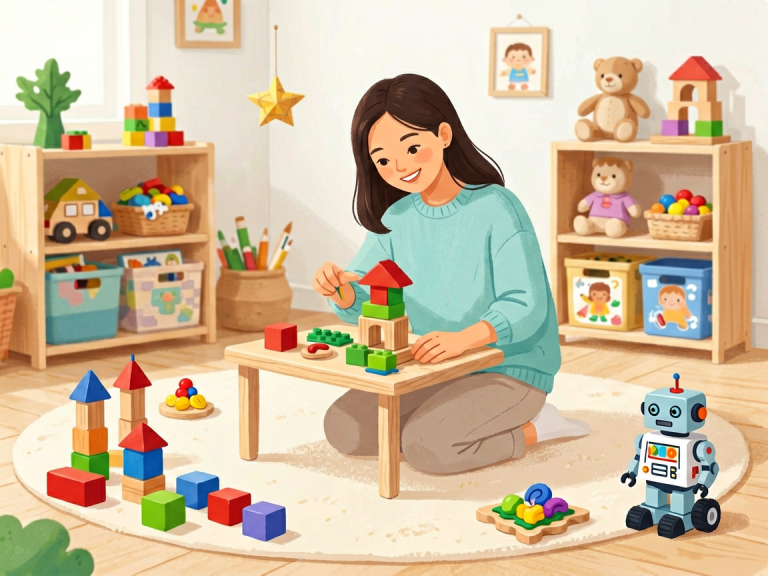
- Encourage floor-based play from the start. Rather than having children build on a table, have them work on the floor or on a large mat. This forces them to squat, kneel, and shift positions constantly. For toddlers, this also helps with transitioning from crawling to standing.
- Create obstacle courses. Use building blocks to design low walls to step over, towers to walk around, tunnels to crawl through, and ramps to slide down. Challenge children to navigate the course without knocking anything over—this combines balance, coordination, and motor planning.
- Turn building into a team activity. When two or more children build together, they often need to carry large blocks across a room, lift them overhead to pass them to a friend, or coordinate their movements to balance a structure. This adds social interaction and encourages bigger, riskier movements.
- Incorporate heavy work. Some building toys, like dense foam blocks or wooden planks, provide what occupational therapists call “heavy work”—activities that give deep pressure to joints and muscles, which is calming and organizing for the nervous system. Allow children to push a cart full of blocks, drag a heavy fabric sheet, or lift a large bucket of connectors.
- Praise the process, not the product. Gross motor development happens through the *act* of building, not the finished structure. Celebrate when a child tries to lift a heavy block, even if the tower falls. This encourages perseverance and physical experimentation.
Conclusion
Building toys are often pigeonholed as tools for creativity and fine motor development, but their potential to enhance gross motor skills is enormous—especially when they are scaled up for whole-body engagement. From giant foam blocks that demand squats and overhead reaches to modular climbing systems that turn a living room into a gym, the best building toys for gross motor skills transform construction into a dynamic, full-body activity. They invite children to lift, carry, crawl, stretch, balance, and problem-solve with their entire physique. By choosing toys that are large, stable enough to bear weight, and open-ended in their design, parents and educators can provide the physical challenges that children need to build not only castles but also strong, coordinated bodies. In a world where movement is increasingly limited, these building toys offer a joyful, effective way to keep children active, healthy, and growing—one block at a time.