Building Connections: The Best Building Toys for Social Skills
In an age where screens dominate children’s attention and digital communication often replaces face-to-face interaction, parents and educators are increasingly searching for tools that foster genuine social development. Building toys—those timeless sets of blocks, bricks, and connectors—have long been celebrated for their cognitive benefits, but their role in cultivating social skills is often overlooked. Yet, when children gather around a pile of colorful plastic or wooden pieces, something remarkable happens: they begin to negotiate, collaborate, share ideas, resolve conflicts, and celebrate collective achievements. This article explores the best building toys specifically chosen for their ability to nurture social skills, and explains how each type of toy creates unique opportunities for interpersonal growth.
Why Building Toys Are Ideal for Social Development
Before diving into specific product recommendations, it is important to understand the inherent qualities of building toys that make them such powerful tools for social learning. Unlike many solitary activities, building with others requires constant communication. Children must articulate their visions, listen to peers, compromise on design decisions, and distribute tasks fairly. The open-ended nature of most building toys means there is no single “right” answer, which naturally invites discussion and creative problem-solving. Moreover, building projects are tangible; they produce a physical result that children can point to and say, “We made this together.” This shared ownership builds a sense of community and pride that strengthens social bonds.
Research in developmental psychology supports these observations. Studies have shown that cooperative play with construction materials enhances perspective-taking abilities—the capacity to understand another person’s point of view. When a child tries to fit a block into a structure designed by a friend, they must mentally adopt that friend’s spatial reasoning. Similarly, the need to verbalize instructions (“Put the red one on top of the green one, but not too tight”) improves language skills and teaches children to be clear and patient communicators.
Classic Wooden Blocks: The Foundation of Cooperative Play
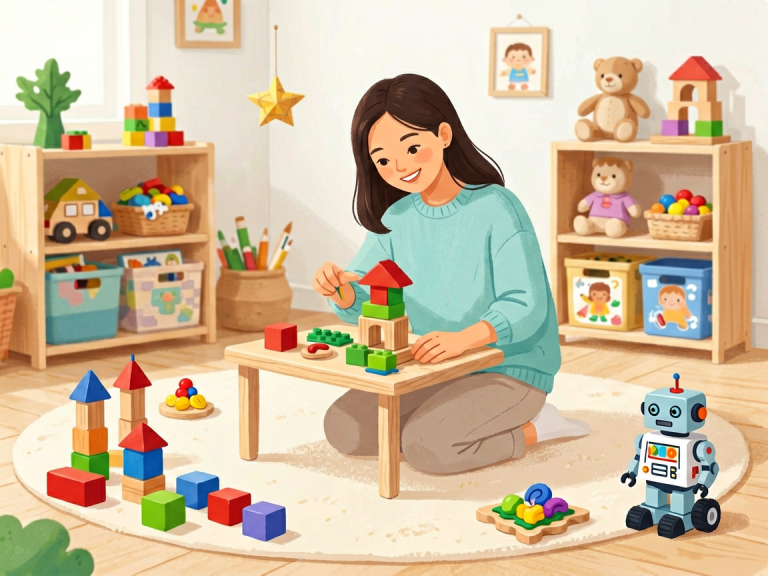
Wooden unit blocks remain one of the most effective building toys for social skill development, particularly for younger children aged two to six. Unlike modern plastic bricks that click together with precise interlocking mechanisms, wooden blocks rely on gravity and balance. This inherent instability means that children must work together to stabilize their structures, holding pieces in place while a partner adds another block. The physical necessity of teamwork is immediate and intuitive.
For example, two preschoolers building a castle from wooden blocks quickly learn that if they both try to place a block on the same side at the same time, the tower will topple. They must coordinate their movements, take turns, and develop non-verbal cues such as nodding or pointing. The simplicity of wooden blocks also reduces competition; there are no rare or special pieces that one child might hoard, so sharing becomes natural. Many educators recommend sets with a variety of shapes—rectangles, triangles, cylinders, arches—to encourage children to discuss geometry and structural logic together. Melissa & Doug’s standard unit block set is a classic choice, but any high-quality, unpainted hardwood set will serve the same purpose.
LEGO and Compatible Brick Systems: Teaching Negotiation and Role Assignment
For children aged four to twelve, LEGO bricks and other interlocking brick systems are arguably the most versatile building toys for social skills. The structured nature of bricks—they only connect in specific ways—actually promotes a different kind of social interaction than wooden blocks. Because LEGO builds can be complex and detailed, children often naturally assign roles: one child becomes the “designer” who draws a plan, another is the “builder” who searches for pieces, and a third is the “assembler” who snaps them together. This role-playing teaches delegation, trust, and accountability.
Moreover, LEGO sets often come with instructions for specific models, which can become a source of social friction—and therefore a learning opportunity. When two children want to build different models from the same set, they must negotiate whose idea to pursue first, or how to combine elements of both. Parents who observe this process can guide children toward compromise, such as building half the model together and then modifying it together. The recent LEGO Classic Creative boxes, which contain a huge assortment of basic bricks without specific instructions, are particularly good for collaborative free play because they force children to invent their own shared goals.
Another important aspect is that LEGO allows for large group projects. A community of children can work on a single massive structure—a castle, a spaceship, a city—over several sessions. This long-term collaboration builds patience, persistence, and the ability to give and receive feedback. When a child adds a poorly placed piece that weakens the structure, the group must discuss how to fix it without assigning blame. This is a microcosm of real-world teamwork.
Magnetic Building Tiles: Encouraging Turn-Taking and Visual Communication
Magnetic tiles, such as Magna-Tiles or PicassoTiles, have exploded in popularity in recent years, and for good reason. These translucent, magnet-edged squares and triangles allow children to build three-dimensional structures that are both sturdy and easy to modify. The magnetic connection is forgiving—pieces can be attached and detached with little effort—which reduces frustration and allows for rapid experimentation. From a social skills perspective, magnetic tiles excel at teaching turn-taking and visual communication.
Because magnetic tiles are visually appealing and create satisfying “click” sounds, children are naturally drawn to cooperative building. However, the very ease of use can lead to disagreements: one child might want to build a tall tower, while another prefers a flat geometric pattern. The solution lies in the toy’s transparency. Children can literally see through the tiles to understand what their partner is trying to achieve, which fosters empathy. A child who wants to add a roof to a house can hold the tile above the structure and ask, “Does this fit here? Can you help me hold it?” This simple act of asking for assistance builds social confidence.
Magnetic tiles are also ideal for parallel play that gradually merges into collaborative play. Two children might start building separate structures on the same mat, then one child’s tower accidentally touches the other’s fence. Rather than an argument, this often sparks a discussion: “Hey, maybe we can connect them!” The magnetic edges make it trivial to join two separate creations, teaching children that collaboration can enhance instead of diminish their individual work. For families, a large set of 100 or more pieces allows multiple children to work simultaneously without running out of materials.
Interlocking Plastic Gears and Moving Parts: Fostering Communication and Problem-Solving
Toys that incorporate moving parts—such as gears, pulleys, axles, and wheels—add an extra layer of social complexity. K’NEX, Geomag Mechanics, and similar construction sets require precise coordination because a gear train must be aligned correctly to function. This means that children cannot simply pile pieces together; they must discuss cause and effect, sequence steps, and test their assumptions together.
Consider a group of three children building a working crane with a K’NEX set. One child might focus on the base, another on the arm, and the third on the pulley system. They must constantly communicate: “Does the small gear fit on this shaft?” “No, we need the larger one, but it’s being used for the base. Can we swap?” This forces children to articulate their reasoning and justify their choices. When the crane fails to lift a weight, the group must engage in collective problem-solving, asking “Why didn’t it work?” and “What could we change?” This process teaches children to listen to alternative ideas and to value the input of others.
Furthermore, gear-based toys often have a trial-and-error component that reduces ego involvement. When a mechanical structure fails, no single child is to blame; the group can laugh together and try again. This resilience-building is crucial for social development, as it helps children learn that mistakes are part of collaboration, not personal failures.
Open-Ended Construction Kits with Connectors: Promoting Leadership and Empathy
Toys like Strawbees, ZOOB, or Plus-Plus offer a different kind of building experience. These kits use simple connectors (tubes, snap-together joints, or interlocking puzzle-like pieces) that allow for highly organic, curving, or abstract forms. Their open-ended nature means there are no prescribed outcomes, which can be intimidating for some children but liberating for others. In a social setting, this openness often reveals natural leadership tendencies.
For example, a child who is normally shy might become the “architect” of a group project because they have a strong visual imagination. Other children may gravitate toward the role of “engineer” who figures out how to make the structure stand. The flexible connectors allow for easy modification, so the group can pivot quickly when someone suggests a change. This fluidity teaches children to be flexible in their thinking and to respect the contributions of peers with different strengths.
Empathy also develops during these projects. When one child struggles to attach a connector, another may offer help. When a child’s idea is rejected by the group, they learn to handle disappointment and to rephrase their suggestion. The social dynamics of open-ended building are rich and unpredictable, making it one of the best tools for emotional intelligence.
Conclusion: Choosing the Right Toy for Your Group
No single building toy is universally “best” for social skills; the right choice depends on the ages, personalities, and social dynamics of the children involved. For toddlers and preschoolers, simple wooden blocks provide the most direct, physical lessons in cooperation. For elementary-aged children, LEGO bricks and magnetic tiles offer structured yet flexible opportunities for negotiation and role assignment. For older children or those who enjoy mechanical challenges, gear-based kits teach precise communication and collective problem-solving. And for any age, open-ended connector sets encourage leadership and empathy.
Ultimately, the most important factor is not the toy itself, but how adults facilitate the play. Parents, teachers, and caregivers can enhance social learning by asking open-ended questions (“How did you decide to build that together?”), by modeling respectful communication, and by allowing children to resolve minor conflicts without immediate intervention. When used thoughtfully, building toys become more than just playthings—they become bridges to stronger friendships, better communication, and a deeper understanding of what it means to work together. In a world that increasingly demands collaboration, these simple blocks and bricks may be the most valuable social skills curriculum we can offer our children.