The Best Building Toys for Creative Thinking: Unlocking Imagination Through Hands-On Construction
In an age dominated by screens and passive entertainment, the humble building toy remains one of the most powerful tools for nurturing creative thinking in children—and even in adults. Unlike many digital games that offer predetermined outcomes, building toys provide an open-ended canvas where imagination is the only limit. But with so many options on the market—from classic wooden blocks to high-tech magnetic kits—which ones truly foster the kind of divergent, original thought that defines creativity? This article explores the best building toys for creative thinking, examining how each type engages cognitive flexibility, spatial reasoning, problem-solving, and the courage to experiment. By understanding what makes a toy “creativity-friendly,” parents, educators, and lifelong learners can make informed choices that turn playtime into a workshop for the mind.
1. The Core Qualities of a Creativity-Boosting Building Toy
Before diving into specific products, it is essential to define what makes a building toy effective for creative thinking. Not all construction sets are created equal. The most powerful ones share several common traits.
Open-endedness is paramount. A toy that dictates exactly what to build—like a predetermined model with step-by-step instructions—does little to spark original thought. Instead, the best toys allow for infinite variations. Second, physical manipulation matters. The act of touching, fitting, and balancing pieces engages tactile and kinesthetic learning, which strengthens neural connections in ways that digital simulations cannot. Third, feedback loops—the immediate, physical consequence of an action (a tower falls if unbalanced; a bridge holds weight if well-designed)—teach iteration and resilience. Finally, low barriers to entry ensure that frustration does not block creativity. Pieces should be easy to handle, connect, and disconnect, allowing the builder to focus on ideas rather than mechanics.
With these criteria in mind, let us explore the top contenders across different ages, budgets, and complexity levels.
2. Classic Wooden Blocks: The Timeless Foundation of Imagination
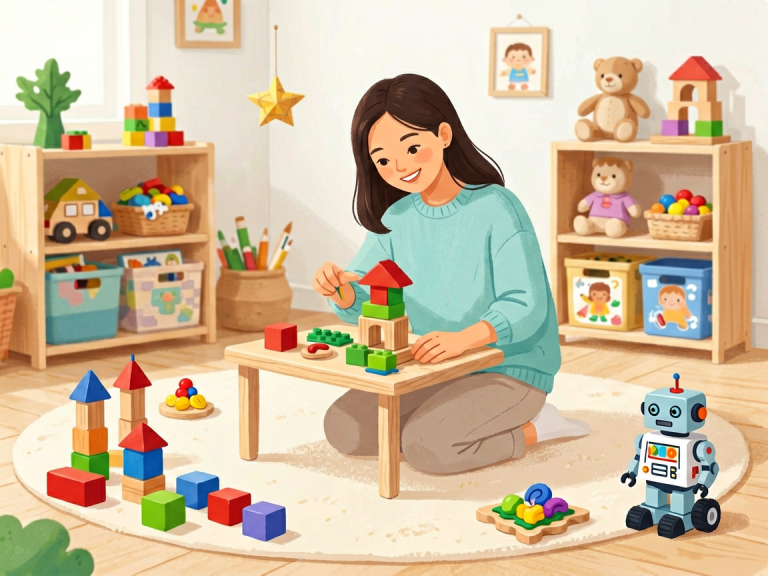
No list of creative building toys is complete without the original: simple wooden blocks. Often dismissed as too basic or old-fashioned, these plain cubes, cylinders, and arches actually embody the purest form of open-ended construction. A child given a set of unpainted, differently shaped blocks must engage every part of the creative process: planning a structure, testing stability, and revising when gravity intervenes.
What makes wooden blocks exceptional for creative thinking is their lack of constraints. Unlike interlocking bricks that click neatly into place, wooden blocks rely solely on friction and weight distribution. This demands a deeper understanding of physics and geometry. A tower of blocks can be stacked in countless arrangements—some symmetrical, some asymmetrical—and each attempt teaches the builder about center of mass and equilibrium. Moreover, the neutral aesthetic (no colors, no characters) forces the imagination to supply context. A single block can be a castle wall, a car, a spaceship fuel tank, or a person. This symbolic play is a hallmark of creative cognition.
I recall watching a four-year-old transform a dozen blocks into a “dinosaur hospital” with separate wards for legs, tails, and teeth. The blocks themselves held no dinosaur imagery; the entire narrative emerged from the child’s mind. This is the essence of creative thinking: generating novel associations and representations from a simple set of tools.
3. Magnetic Tiles: Translucent Geometry Meets Kinetic Creativity
If wooden blocks represent organic, tactile exploration, magnetic tiles represent a leap into structured spatial play. Brands like Magna-Tiles, PicassoTiles, and their competitors have become staples in classrooms and homes because they merge safety with high cognitive value. The tiles—usually translucent squares, triangles, and rectangles with embedded magnets—snap together on any edge, allowing for quick, stable construction of 2D and 3D forms.
The primary cognitive benefit here is visual-spatial reasoning. Building a cube or a castle with magnetic tiles requires the builder to mentally rotate shapes, understand symmetry, and plan in three dimensions. But beyond geometry, magnetic tiles encourage experimentation with light and color. Because they are translucent, structures can be combined with windows, flashlights, or sunlight to create stained-glass effects. This interplay between form and light triggers aesthetic thinking—a key component of creativity.
Another advantage is the ease of revision. Unlike bricks that require prying apart, magnetic tiles can be detached in seconds. This low friction makes children more willing to try radical ideas. They can build a bridge, then instantly transform it into a rocket ship. The iterative process is rapid, so creative flow is rarely interrupted by frustration.
A study from the University of Cambridge found that children who played with magnetic tiles showed higher levels of divergent thinking on standard creativity tests than those who played with more prescriptive toys. The reason is clear: the tiles invite infinite variations while rewarding structural intuition.
4. Interlocking Bricks: The LEGO® Paradox of Creativity
LEGO® bricks are arguably the most famous building toy on the planet. Yet they occupy a curious position in the creativity debate. On one hand, a giant bin of basic bricks allows for virtually unlimited creativity. On the other hand, the vast majority of LEGO sets sold today are themed kits with detailed instruction booklets that guide the builder toward a specific model—a spaceship, a medieval castle, or a Harry Potter scene.
The key to using LEGO for creative thinking lies in choosing the right approach. A bag of simple, mixed bricks with no instructions promotes free-form building. But even themed sets can be harnessed creatively after the initial build: the pieces can be disassembled and recombined into original creations. The real strength of LEGO lies in its system of studs and tubes, which provides a consistent, reliable connection. This predictability frees the mind to focus on design rather than mechanics. Because the pieces stick firmly, builders can construct elaborate, stable structures that would collapse if made of blocks.
However, research suggests that children who always follow instructions may develop convergent thinking (finding the single “correct” solution) rather than divergent thinking. To maximize creativity, parents should encourage “deconstruction and rebuilding” sessions. For example, after building the official model, challenge the child to modify it—add wings, change the roof, or combine two sets into one. This shifts the mindset from consumer to creator.
I once observed a nine-year-old who owned a pirate ship set but never built it per the manual. Instead, she used the hull, masts, and treasure chest pieces to create a floating laboratory for her animal figurines. This is the highest use of a building toy: when the child’s vision transcends the original design.
5. Advanced Construction Systems: Gears, Pulleys, and Engineering Creativity
For older children and adults, building toys that incorporate mechanical principles—gears, axles, pulleys, and motors—take creative thinking to a new level. Systems like K’NEX, Meccano (Erector Set), and Fischertechnik allow builders to create not just static structures but moving machines. This introduces systems thinking, where a change in one part affects the whole.
Consider a K’NEX roller coaster set. While the instructions might show one configuration, a creative builder can design a new track layout with different loops, banks, and drops. This requires understanding centripetal force, friction, and momentum—concepts that become intuitive through hands-on play. The toy becomes a laboratory for engineering creativity.
Similarly, Fischertechnik kits often include sensors, computer interfaces, and programable controllers, blending the physical with the digital. This opens up computational creativity: writing code to make a robot arm pick up blocks or to create a conveyor belt sorter. Such toys prepare young minds for careers in STEM fields, but more importantly, they teach a creative problem-solving process: define a goal, prototype, test, fail, and improve.
The advanced nature of these toys means they often require adult guidance or teamwork, which adds a social creativity dimension. Collaborative building—where two or more people negotiate ideas, combine perspectives, and compromise—mimics the creative process in real-world innovation teams.
6. Loose Parts and Natural Materials: The Rawest Form of Creative Construction
Finally, it is worth remembering that the “best” building toy may not come from a store at all. The loose parts theory—popularized by architect Simon Nicholson—argues that the most creative play environments are those with variable, movable materials that can be combined in endless ways. Sticks, stones, pinecones, fabric scraps, cardboard tubes, rope, sand, and water are nature’s building toys.
When children construct with natural materials, they engage in adaptive creativity. A stick can become a lever, a bridge beam, or a flagpole. A pile of sand can be sculpted into a castle or dug into a tunnel system. There are no preset connectors, so the builder must innovate ways to join materials (tying, balancing, piling). This fosters a deep understanding of material properties and structural integrity.
In preschools that embrace “loose parts play,” teachers have observed remarkably complex, imaginative structures—makeshift tents, intricate roadways, and ecosystems for toy animals. The lack of commercial polish actually enhances creativity because there is no “right” way to use a pinecone. The child is the ultimate authority.
7. Digital Building Toys: The Virtual Frontier of Creativity
While this article focuses on physical toys, it would be remiss to ignore digital building environments like Minecraft, Roblox, and Tinkercad. When used intentionally, these virtual tools can powerfully augment creative thinking. Minecraft’s block-based world is essentially a digital version of LEGO, allowing construction on a massive scale with the added dimensions of physics, redstone circuits (logic gates), and multiplayer collaboration.
The advantage of digital building toys is undo history. You can experiment without consequence: blow up a structure, try a wild design that defies physics, and revert if it fails. This reduces fear of mistakes, a major barrier to creative risk-taking. Additionally, digital platforms often include scripting languages (like Minecraft’s command blocks or Roblox’s Lua) that combine building with programming, accelerating computational creativity.
However, digital toys also have drawbacks: reduced tactile feedback, potential for passive consumption (watching others build rather than building), and screen-time concerns. The best approach is a hybrid: use physical building toys for hands-on learning and digital ones for rapid prototyping and complex simulations.
Conclusion: Choosing the Right Tool for the Creative Mind
There is no single “best” building toy for creative thinking. The answer depends on the age, interests, and developmental stage of the builder. For toddlers, simple wooden blocks and large, safe magnetic tiles are perfect. For elementary children, interlocking bricks with open-ended challenges and basic mechanized sets provide rich stimulation. For pre-teens and teens, advanced construction systems and digital tools can unlock engineering and computational creativity. And for everyone, loose parts and natural materials offer a raw, unfiltered creative experience.
The common thread among all these toys is that they do not teach creativity—they invite it. They hand the builder a set of tools and say, “What will you make?” The act of creating from nothing is one of the most profound human experiences. Whether you are stacking wooden blocks, snapping magnetic tiles, or coding a virtual machine, you are exercising the same cognitive muscles: imagination, persistence, and the joy of bringing an idea to life. So next time you choose a building toy, forget about the flashy packaging or the promise of a perfect model. Choose the one that asks you a question, not the one that gives you an answer. That is the path to true creative thinking.
*(Word count: approximately 1,250 words)*