The Quiet Tower: Best Building Toys for a Calming Bedtime Routine
Every parent knows that the hour before bed can be either a serene gateway to sleep or a chaotic battlefield of energy, resistance, and last-minute demands. In my own journey as a parent and educator, I have discovered that the right building toys—when introduced thoughtfully—can transform this critical window into a peaceful, meaningful ritual. Building toys are not just about engineering or creativity; they are tools for quieting the mind, developing fine motor control through repetition, and creating a sense of accomplishment that soothes anxiety. In this article, I will explore the best building toys specifically curated for a bedtime routine, explain why each one works, and offer practical tips for integrating them without overstimulation.
The Science of Quiet Play Before Sleep
Before diving into specific toys, it is essential to understand why building activities are uniquely suited for bedtime. Research in child development shows that the transition from wakefulness to sleep requires a gradual decrease in sensory input and a shift from active, goal-oriented play to more repetitive, calming activities. Building toys provide a perfect middle ground: they engage the hands and mind just enough to prevent boredom, yet they do not trigger the adrenaline that comes with running, shouting, or competitive games. The act of stacking, connecting, or balancing pieces induces what psychologists call a “flow state”—a focused yet relaxed mental state that lowers cortisol levels and prepares the body for rest. Furthermore, the predictable structure of many building toys (such as interlocking bricks or magnetic tiles) offers comfort to children who thrive on routine, while open-ended blocks allow for gentle creative expression without the pressure of completing a complex project.
Magnetic Tiles: The Gentle Connectors
One of the most versatile and effective building toys for bedtime is the set of magnetic tiles—transparent, colorful squares and triangles that snap together with satisfying clicks. What makes these tiles exceptional for pre-sleep play is their low frustration factor. Children as young as three can successfully attach tiles without struggling with dexterity issues, and older children enjoy creating intricate 3D structures like castles, rockets, or simple houses. The magnetic connection is forgiving; if a tower collapses, it does so silently without the crash of wooden blocks, which startles a drowsy child. The soft, translucent colors also add a calming visual element. Dim the bedroom lights and let your child build a glowing lantern with a small LED candle inside—the effect is mesmerizing and instantly lowers the heart rate.
For a bedtime routine, I recommend limiting the set to about 40 to 60 pieces. Too many choices overwhelm the child and prolong play beyond the desired winding-down period. Start with a simple invitation: “Let’s build a flat star on the carpet tonight,” or “Can you make a gate for your favorite stuffed animal?” The act of placing tiles flat on the floor rather than stacking high reduces the risk of loud collapses and encourages a grounded, meditative rhythm. After ten to fifteen minutes, gently guide the child to leave the creation intact as a sleeping companion or to dismantle it together while counting the pieces—a perfect transition into teeth-brushing and story time.
Classic Wooden Unit Blocks: The Timeless Soothers
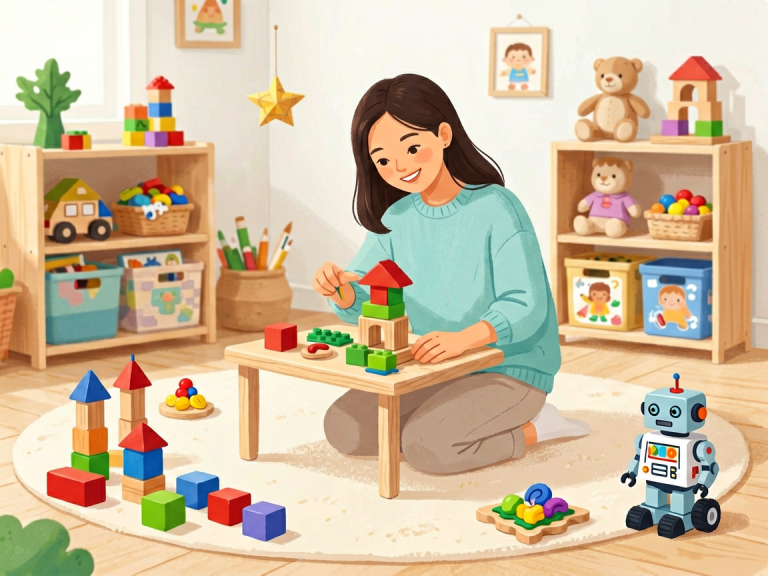
There is a reason why wooden unit blocks have been a staple in Montessori and Waldorf classrooms for over a century. Their heft, smooth texture, and natural grain provide a sensory experience that synthetic materials simply cannot replicate. For bedtime, choose a set of unfinished or lightly oiled hardwood blocks—avoid painted ones, as the bright colors can be stimulating. The muted tones of natural wood blend beautifully with a dimly lit room and encourage slow, deliberate movements. Children who are overstimulated by screens or noisy electronic toys often find deep calm in the weight of a solid maple block in their hands.
The key to using wooden blocks at night is to shift the focus from “building something impressive” to “building something peaceful.” Suggest themes like “a nest for the night” where the blocks form a low wall around a stuffed animal, or “a quiet road” where a single row of blocks leads to a small wooden car. Because unit blocks are non-interlocking, they require careful balancing, which naturally slows down the child’s movements and breathing. If a tower falls, treat it as a soft, gentle event: “Oh, the blocks decided to lie down for a nap too. Let’s help them get comfy.” This reframing reduces frustration and aligns with the sleep theme. Always clean up together while whispering or humming, turning the act of putting blocks away into a lullaby-like ritual.
LEGO Classic Bricks (Small Sets Only)
LEGO is often associated with high-energy imaginative play—spaceships crashing, rescue missions, and noisy minifigure dialogue. However, when used intentionally, LEGO bricks can be a powerful tool for bedtime calm. The trick is to select small, thematic sets that encourage repetitive building, such as the “LEGO Classic Bricks and Ideas” box (200 pieces), or even simpler “LEGO DOTS” kits that create mosaic patterns. Avoid large sets with hundreds of specialized pieces and complicated instructions, as these demand focused problem-solving and often lead to unfinished projects and disappointment.
For a bedtime routine, I suggest offering a single small container of basic bricks in a limited color palette—perhaps only blues and whites, or soft pastels. Limit the time to twelve minutes. The repetitive act of connecting two-by-two bricks into a flat surface (like a “night roof”) is almost hypnotic. Some children enjoy building a small bed for a minifigure, complete with a LEGO pillow and blanket. The crucial rule is: no building above chest height. Tall structures are unstable and require constant attention to prevent toppling, which creates anxiety. Keep everything low and wide. When the timer goes off, the child places the creation on a shelf or bedside table as a “sleep guardian,” and the bricks are not touched again until the next night. This consistency builds anticipation and helps separate “play” from “rest.”
Soft Building Blocks: The Safe and Silent Option
For toddlers and very young children (ages 1 to 3), soft building blocks made from foam, fabric, or silicone are ideal for bedtime. These blocks make no sound when they fall, can be chewed (safely) during teething, and are gentle on sensitive skin. The best sets come in muted earth tones or pastel colors, often with textures like velvet or ribbed surfaces that invite tactile exploration. Because soft blocks cannot be stacked very high, they encourage floor-based play like sorting, nesting, and knocking down gently—activities that are inherently non-stressful.
Incorporate soft blocks into a “relaxation pyramid” routine: start with three blocks on the floor, then add two more, then one, then ask the child to place a small stuffed animal on top. This simple counting game combines math readiness with physical calmness. Alternatively, use the blocks to create a “sleep cave” by forming a low ring around a child’s favorite book. The blocks become the walls that protect the reading area, and after the story, the blocks are slowly dismantled one by one as the child names each color or texture. This gradual deconstruction mirrors the descending energy of the evening and signals that sleep is approaching.
Bristle Blocks (Stickle Bricks): A Unique Sensory Experience
Bristle blocks, also known as “Stickle Bricks,” are covered with soft plastic bristles that interlock when pressed together. They offer a distinct sensory input—the gentle prickling sensation on the fingertips—that can be deeply grounding for children who are sensory seekers or who struggle with anxiety. Unlike LEGO, bristle blocks are forgiving: they simply stick together without requiring precise alignment, which reduces frustration. They also make a soft brushing sound rather than a loud click, preserving the quiet atmosphere.
For bedtime, present a small basket of bristle blocks (around 30 pieces) and invite the child to build a “soft creature” that will watch over them as they sleep. Because the bristles grip easily, children can create spiky balls, little hedgehogs, or abstract sculptures that feel wonderfully organic. The process of pulling them apart is as satisfying as pressing them together—and the “rip” of the bristles is quiet enough not to disturb siblings. I recommend setting a peaceful intention: “Let’s build something that feels cozy, like a little nest.” After five minutes of building, gently transition to cleanup by saying, “Now let’s unstick each piece and tuck them into the bag for the night.” This ritual of unsticking is itself a form of progressive muscle relaxation for small hands.
How to Structure a 20-Minute Bedtime Building Routine
No matter which building toy you choose, the magic lies in the structure of the routine. Here is a sample timeline that works well for children aged 3 to 8:
- 0–2 minutes: Set the scene. Dim the lights, turn off screens, and lay a soft mat or rug on the floor. Place the chosen toy in a single basket or tray. Say, “Tonight we are going to build something quiet for our sleep time.”
- 2–12 minutes: Build freely. Sit beside your child, but do not direct their play. Occasionally make a soft comment like, “That tower looks so steady,” or “I love how those two colors go together.” Avoid asking questions that demand answers (“What are you making?”). Instead, state observations.
- 12–15 minutes: The winding-down phase. Announce gently, “In three minutes, we will take apart our creation and get ready for our story.” Use a soft timer or simply say, “When this song ends, we clean up.” Play lullaby music in the background.
- 15–18 minutes: Cleanup. Dismantle the structure together slowly. Count the pieces aloud if using magnetic tiles or bricks. Put them back into the box or bag with deliberate, unhurried movements. This step is critical—it signals closure and teaches the child that sleep follows play.
- 18–20 minutes: Transition. After cleaning up, move directly to teeth brushing and pajamas. The building activity should end at least 10 minutes before lights-out to allow for a story or cuddle time without rushing.
What to Avoid for Bedtime Building
Not all building toys are suitable for the pre-sleep window. Avoid anything with bright flashing lights, loud mechanical sounds, or digital components. Battery-powered building sets that sing songs or require app interaction overstimulate the brain and disrupt melatonin production. Also steer clear of sets with very small pieces that pose choking hazards for younger children, as the stress of supervision counteracts calmness. Finally, avoid competitive building challenges like “who can build the tallest tower” or “race against the clock.” Bedtime is not the moment for performance; it is the moment for connection and stillness.
Conclusion: The Tower That Grows in the Dark
In a world that constantly pushes children toward faster, brighter, louder experiences, the quiet act of stacking, clicking, and balancing small pieces before bed becomes a revolutionary act of care. The best building toys for a bedtime routine are not necessarily the most advanced or expensive; they are the ones that invite slow hands, soft sounds, and open-ended calm. Whether you choose magnetic tiles that glow in dim light, wooden blocks that smell like earth, or bristle bricks that tickle the fingers, the true value lies not in the product but in the ritual you create around it. Each night, as your child places the final block and gazes at their little tower, they are not just building a structure—they are building a bridge to restful sleep. And in that bridge, you will find the deepest comfort of all: the knowledge that you have given your child the gift of peace, one piece at a time.