Building the Future, One Block at a Time: The Transformative Power of STEM Toys for Kids
Introduction: Beyond Play – The New Classroom
In an age where artificial intelligence reshapes industries and climate change demands innovative solutions, the skills our children need for tomorrow are fundamentally different from those of the past. Parents and educators alike are searching for tools that not only entertain but also educate, nurture curiosity, and build critical thinking. Enter STEM toys—a category of playthings designed around Science, Technology, Engineering, and Mathematics. Far from being just another fad, STEM toys represent a paradigm shift in how children learn. They transform abstract concepts into tangible experiences, turning a child's bedroom into a mini laboratory, an engineering workshop, or a coding studio. This article explores the profound impact of STEM toys on childhood development, offers a roadmap for choosing the right ones, and argues that these toys are not merely luxuries but essential investments in our collective future.
Why STEM Toys Matter: Cultivating the 21st-Century Mindset
Traditional toys—dolls, action figures, puzzles—have their place, but STEM toys are purpose-built to develop a specific set of cognitive muscles. The modern world demands problem-solvers who can analyze data, think algorithmically, and iterate on failures. STEM toys foster exactly these traits.
First, they teach resilience through trial and error. When a child builds a bridge out of magnetic tiles and it collapses, they do not cry; they redesign. This process—hypothesize, test, fail, adjust, succeed—is the essence of the scientific method. A 2021 study from the University of Cambridge found that children who regularly engaged with open-ended construction toys showed a 23% higher persistence rate in challenging tasks compared to those who used only passive toys. Second, STEM toys break down the intimidating wall between "subjects." A child learning about gears in a robotics kit simultaneously absorbs principles of physics (torque), mathematics (gear ratios), and engineering (structural integrity). This interdisciplinary approach mirrors how real-world problems are solved—not in silos, but through integration. Finally, STEM toys democratize access to complex fields. A seven-year-old who programs a simple LED to blink using a Snap Circuits kit gains the same foundational understanding of circuits that once required high school physics. Early exposure plants seeds that can grow into lifelong passions.
A Taxonomy of STEM Toys: From Blocks to Code
The term "STEM toy" encompasses a vast spectrum, ranging from simple wooden blocks to sophisticated programmable drones. Understanding the categories helps parents match toys to a child's age, interests, and developmental stage.
1. Building and Engineering Kits
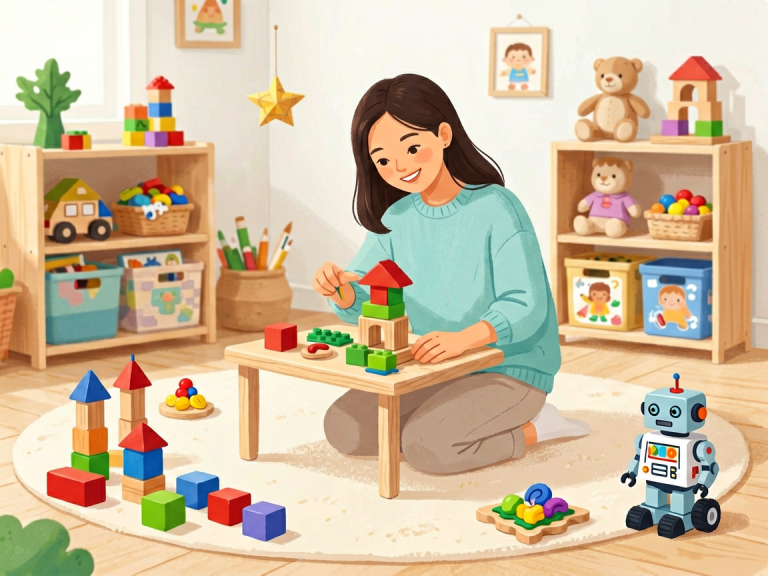
These are the classic workhorses of STEM play. Magnetic tiles (e.g., Magna-Tiles), LEGO Technic, and K'NEX allow children to construct three-dimensional structures, vehicles, and machines. The key here is mechanical reasoning. As children connect beams, axles, and gears, they internalize concepts like stability, leverage, and motion. Advanced kits, like Meccano or Fischertechnik, include motors and solar panels, introducing renewable energy mechanics. For younger children (ages 3–6), large interlocking blocks develop fine motor skills and spatial awareness. For older children (ages 8+), kits with detailed instructions for building a working crane or a hydraulic arm teach sequential logic and blueprint reading.
2. Science and Chemistry Sets
From microscopes to crystal-growing labs, these toys ignite a sense of discovery. The best ones do not merely provide a recipe; they encourage inquiry. For example, a "crime scene" forensic kit asks children to analyze fingerprints and pH levels to solve a mystery. A chemistry set with safe, non-toxic materials lets kids create slime, volcano eruptions, or chromatography art. The critical component here is experimentation documentation. Parents should encourage children to write down what they used, what happened, and why they think it occurred. This simple habit mirrors true scientific reporting. Brands like Thames & Kosmos and National Geographic offer age-appropriate kits that align with school curricula but present learning as an adventure rather than a chore.
3. Coding and Robotics Toys
Perhaps the fastest-growing category, these toys teach computational thinking without screens—or with carefully designed screen interactions. For preschoolers, coding robots like Botley or Code-a-Pillar use physical tiles or buttons to sequence commands, teaching the concept that a series of steps produces an outcome. For older children, programmable robots like LEGO Mindstorms, Sphero, or mBot introduce block-based coding (similar to Scratch) and eventually Python or C++. The magic happens when the code becomes tangible: a child writes a loop that makes a robot dance, and they see the immediate cause-and-effect. These toys also nurture debugging skills—the patience to find an error, retrace steps, and fix it. In a world where digital literacy is as fundamental as reading, early coding toys provide a gentle, playful on-ramp.
4. Mathematics and Logic Games
STEM is not just about gadgets. Board games like Prime Climb, Gravity Maze, or Set teach number sense, pattern recognition, and logical deduction. Puzzles like tangrams or 3D brainteasers enhance geometric reasoning. Even simple card games that involve probability (e.g., "Guess the Number") build number fluency. The key advantage of these toys is that they are low-tech and high-engagement. A family game night with a math-based board game fosters conversation, strategy, and even friendly competition—all while stealthily reinforcing mathematical thinking. For children who struggle with abstract math, these tactile games convert numbers into visual, manipulable objects.
How to Choose the Right STEM Toy: A Practical Guide
With thousands of options on the market, selection paralysis is real. The best STEM toy is not the most expensive or the trendiest; it is the one that matches the child's current zone of proximal development—challenging enough to engage, but not so hard that it frustrates. Here is a four-step framework:
1. Follow the Child's Curiosity
A child obsessed with dinosaurs will thrive with a paleontology excavation kit that introduces sedimentary layers and fossil identification. Another child who loves cooking might enjoy a molecular gastronomy set that explores emulsions and pH. Forcing a child into a "perfect" STEM toy that does not align with their interests is counterproductive; the goal is to extend existing passions, not replace them.
2. Prioritize Open-Ended Over Prescriptive
Toys that have one "right" answer (e.g., a kit that builds only a specific model) have limited replay value. Seek toys that allow multiple configurations. For instance, a set of magnetic rods and balls can become a bridge, a molecule, or a star—depending on the child's imagination. Open-ended toys foster divergent thinking, while prescriptive kits teach convergent thinking. Both are valuable, but open-ended toys provide long-term growth.
3. Consider the "Grit" Factor
STEM learning often involves frustration. A good toy includes failure as a feature, not a bug. Look for kits that have "challenge cards" or "expansion packs" that increase difficulty over time. Brands like KiwiCo and LittleBits design their products with progressive complexity, so a child can start with a basic circuit and later add sensors, motors, and microcontrollers. This scaffolding builds confidence and a growth mindset.
4. Balance Digital and Physical
Some STEM toys rely heavily on tablets or smartphones. While apps can be powerful, excessive screen time is a concern. The ideal STEM toy integrates screens minimally—perhaps for programming only while the physical construction and play remain hands-on. For children under eight, screen-free options (e.g., wooden gear sets, marble runs, simple snap circuits) are generally preferable. For older children, a hybrid approach (like a robot that is coded via a tablet but then moves in the real world) offers the best of both worlds.
The Broader Impact: STEM Toys as Social and Emotional Catalysts
Beyond academic benefits, STEM toys profoundly influence social and emotional development. Collaboration is often built into these toys: building a large structure requires teamwork, negotiating roles, and sharing ideas. A 2022 study from the American Journal of Play observed that children constructing a marble run together used more complex language (e.g., "if we add a slope here, the marble will accelerate") than children playing with individual toys. Communication also improves as children explain their reasoning to peers or parents.
Moreover, STEM toys can break gender stereotypes. Historically, engineering and coding have been male-dominated fields, but inclusive toy design is changing that. Pink construction sets and robot kits with diverse characters help normalize these interests for all genders. Research from the International Journal of Gender, Science and Technology found that girls who played with STEM toys from an early age were 40% more likely to express interest in STEM careers later. The message is clear: a toy is never just a toy; it is a mirror that reflects a child's potential.
Conclusion: Planting Seeds for Tomorrow's Innovators
STEM toys are not a magic bullet—they cannot replace quality education, parental involvement, or a nurturing environment. But they are powerful catalysts. They transform the abstract into the concrete, the daunting into the playful, and the passive into the active. When a child builds a robotic hand that actually grips a pencil, or designs a paper airplane that flies farther than anyone else's, they experience a moment of agency that says, "I can understand the world, and I can change it."
As we look toward a future that demands creativity, adaptability, and technical literacy, the humble STEM toy becomes a small but mighty tool. It sits on living room floors, not in sterile classrooms. It invites children to ask "why" and "what if" without fear. In every snapped-together LEGO brick, every flashing LED, every successful code, we see the flicker of a future scientist, engineer, or inventor. So the next time you see a child lost in the intricate world of a building set or coding robot, remember: they are not just playing. They are building the future—one block, one idea, one discovery at a time. And that is the most profound lesson of all.