Building Young Minds: The Best STEM Gifts for 4-Year-Olds
When a child turns four, a remarkable transformation begins. Their curiosity becomes relentless, their questions multiply, and their fingers seem magnetically drawn to anything that can be taken apart, stacked, or spun. This is the golden age of cognitive development, a window when foundational skills in science, technology, engineering, and mathematics (STEM) can be introduced not as dry subjects, but as joyful discoveries. Choosing the right gift for a four-year-old is therefore about more than entertainment—it is about planting seeds that will grow into analytical thinking, creative problem-solving, and a lifelong love for learning. In this article, I will explore the very best STEM gifts for four-year-olds, each selected for its ability to engage young minds, encourage hands-on exploration, and respect the developmental limits of a preschooler. From magnetic building sets to simple coding robots, these gifts are guaranteed to turn playtime into a laboratory of wonder.
1. Magnetic Building Tiles: The Foundation of Spatial Reasoning
At four years old, children are just beginning to understand how shapes fit together and how three-dimensional objects are constructed. Magnetic building tiles—such as Magna-Tiles, PicassoTiles, or similar brands—are arguably the single most versatile STEM gift for this age group. These translucent, colorful squares, triangles, and rectangles contain strong magnets along their edges, allowing children to effortlessly snap them together to form towers, houses, geometric patterns, and even simple structures like bridges or rockets.
What makes magnetic tiles exceptional for STEM learning is their ability to teach spatial awareness, geometry, and basic engineering principles through completely open-ended play. A four-year-old experimenting with these tiles will intuitively discover that a square-based pyramid is more stable than a single tall column, that a triangle can reinforce a corner, and that symmetry creates pleasing patterns. They are also excellent for teaching early math concepts like counting, sorting by color or shape, and recognizing two-dimensional versus three-dimensional forms. Unlike many toys that prescribe a specific outcome, magnetic tiles offer infinite possibilities, nurturing creativity and persistence as children attempt to build increasingly complex structures. Furthermore, the magnetic “click” provides satisfying sensory feedback, and the tiles are durable, easy to clean, and safe for small hands. For parents looking to gift one item that will grow with a child for years, magnetic tiles are an unmatched investment.
2. Simple Coding Robots: Introducing Sequencing Without Screens
Technology is often the most intimidating aspect of STEM for parents of preschoolers, but the right tool can make “coding” as natural as telling a story. The best entry point for four-year-olds is a screen-free coding robot, such as the Fisher-Price Code ‘n Learn Kinderbot, the Learning Resources Botley the Coding Robot, or the more affordable Code-a-Pillar. These robots use physical buttons, segments, or arrow cards to allow children to program a sequence of movements—forward, backward, turn left, turn right—without needing to read or understand any computer language.
For a four-year-old, the core concept of coding is about sequencing and logical order. When a child places a series of command blocks in a row, then presses “go,” and watches the robot follow those instructions exactly, they are learning that actions have predictable consequences. They are also developing problem-solving skills: if the robot crashes into a wall, the child must debug the sequence, changing the order of commands to achieve a different path. Many of these toys include simple challenges, such as navigating a maze or reaching a target, which encourage planning and trial-and-error. The screen-free aspect is crucial, as it maintains the tactile, social, and active nature of play that four-year-olds need. Moreover, these robots are typically robust, with large buttons and cheerful sounds that keep a child engaged without overwhelming them. By gifting a coding robot, you are not pressuring a child to become a programmer—you are giving them a playful introduction to cause and effect, order, and systematic thinking.
3. Early Engineering Kits: Gears, Levers, and Linkages
Four-year-olds love to understand how things work—why does a door swing? What makes a wheel spin? Engineering kits designed for this age capitalize on that curiosity by offering oversized, safe components that demonstrate simple machines. The Learning Resources Gears! Gears! Gears! sets are a classic example: they include colorful plastic gears, cranks, axles, and interlocking bases that children can connect to create spinning contraptions. As they turn one gear, they observe how it drives another, learning about motion transfer, direction change, and the relationship between gear sizes.
Other excellent options include the Thames & Kosmos Kids First Engineering Kit, which uses chunky plastic pieces to build a seesaw, a wheelbarrow, a crane, and more, all while teaching the concepts of levers, pulleys, and wheels. What makes these kits appropriate for four-year-olds is that they require no reading and little adult guidance—the parts snap together easily, and the instructions are often pictorial or minimalist. The focus is on exploration, not perfection. A child might build a “machine” that doesn’t work perfectly, then experiment with adding or removing pieces until it does. This process embodies the engineering design cycle: ask, imagine, plan, create, test, improve. Additionally, manipulating these components strengthens fine motor skills and hand-eye coordination. For a four-year-old who loves to tinker, an engineering kit turns the living room floor into a workshop where creativity and physics meet.
4. Science Exploration Kits: Magnifying Glasses, Bugs, and Simple Experiments
Science at age four should be messy, sensory, and awe-inspiring. The best science gifts are not elaborate chemistry sets but simple tools that encourage observation and experimentation. A high-quality children’s magnifying glass with a large, shatterproof lens is an essential starting point. Paired with a backyard nature collection (leaves, rocks, bugs), it transforms a walk into a scientific expedition. Similarly, a bug-catching kit with a vented container and tweezers allows a child to safely examine insects, learning about anatomy and behavior. For slightly more structured play, consider a set like the Learning Resources Primary Science Lab Set, which includes realistic but safe lab tools: beakers, test tubes, a dropper, and activity cards for simple experiments like making a tornado in a bottle or exploring sinking and floating.
The true value of these kits lies in the questions they provoke. “Why does the water turn blue when I drop the food coloring?” “Why does this rock feel rough and that one smooth?” A four-year-old’s brain is wired to ask “why,” and science tools provide the means to find answers through hands-on exploration. Parents can guide these discoveries without lecturing—simply asking, “What do you think will happen if we put the leaf in the water?” encourages hypothesis testing. Moreover, many science kits now include non-toxic, taste-safe slime or dough recipes, which combine sensory play with early chemistry concepts like mixing, viscosity, and color blending. For a thoughtful STEM gift, a simple science exploration kit promises hours of wonder and the cultivation of a scientific mindset: observe, ask, test, conclude.
5. Math Manipulatives: Counting Bears, Pattern Blocks, and Number Games
Mathematics for a four-year-old should be physical, visual, and playful. Abstract numbers mean little without concrete objects to count. Therefore, a set of math manipulatives—like counting bears in different colors and sizes, pattern blocks, or linking cubes—is a powerful gift that builds number sense, classification, and pattern recognition. The classic set of rainbow-colored counting bears comes with small plastic cups and activity cards that prompt the child to sort bears by color, compare large and small, or create simple addition problems (“How many bears are there if we put two red bears with three blue bears?”).
Pattern blocks, which feature shapes like hexagons, trapezoids, triangles, and rhombuses, take math into geometry and spatial relations. A four-year-old can create a picture of a flower or a bird by matching shapes, simultaneously learning about symmetry, fractions (two triangles make a rhombus), and problem-solving when a piece doesn’t fit. Linking cubes, such as MathLink Cubes from Learning Resources, snap together to form towers, trains, or patterns, allowing children to physically see quantities increase and decrease. These manipulatives align with the Montessori approach of “concrete before abstract,” ensuring that when a child eventually faces a worksheet with numbers, they will have a rich bank of tactile experiences to draw from. The best part is that they are infinitely re-playable; a child can use them for counting one day and for building a pretend castle the next. Combining math with open-ended construction makes learning feel like a game.
6. Wooden Building Blocks and Architecture Sets
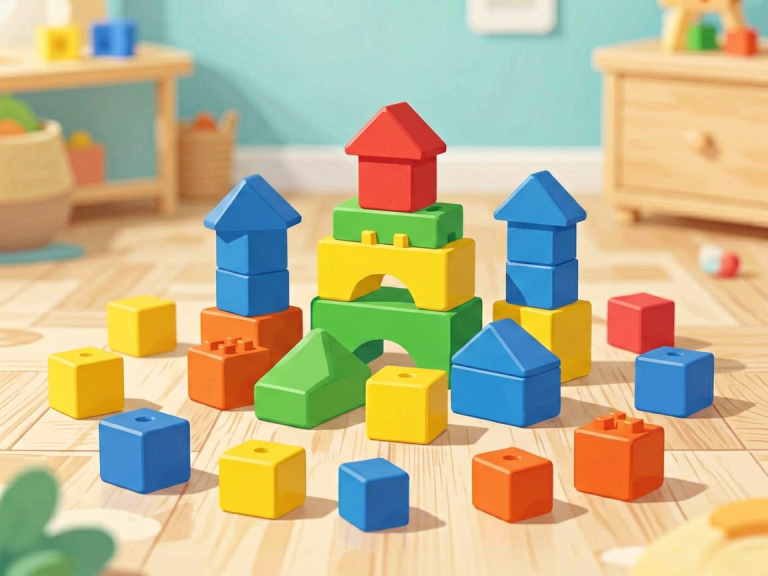
While magnetic tiles are modern and sleek, there is an enduring value in classic wooden blocks. A high-quality set of unit blocks (such as those from Melissa & Doug, or a more natural set like Guidecraft’s) offers a different kind of STEM challenge. Wooden blocks are heavy, have no magnets to guide them, and rely entirely on friction and precise stacking. For a four-year-old, this adds a layer of physics that magnetic tiles do not: balance, weight distribution, and an understanding of gravity. A child trying to build a tall tower from wooden blocks quickly learns that a slightly misaligned block can cause the entire structure to topple, teaching patience and precise hand control.
Some architecture sets add an engineering twist by including notched beams, wheels, and wooden nuts and bolts, allowing for the construction of more complex models like bridges or carts. The Discipline of having to align two pieces and physically twist a bolt to secure them develops fine motor skills and introduces the concept of fasteners and structural integrity. Unlike many modern toys that beep and flash, wooden blocks are quiet, natural, and open-ended. They encourage deep focus and imaginative storytelling (the tower becomes a castle, the bridge a train track). Moreover, they will easily last through multiple children and generations. For a four-year-old who loves to build, a set of wooden blocks is a timeless gift that supports spatial reasoning, creativity, and engineering intuition.
7. Subscription STEM Kits: A Gift That Keeps on Giving
For a more sustained impact, consider a subscription box tailored to preschoolers. Companies like KiwiCo (specifically their Panda Crate for age 0-4 or Koala Crate for ages 3-4), Little Passports (Early Explorers), or MEL Science for Kids offer monthly deliveries of hands-on projects. These kits are designed by educators to introduce a new STEM concept each month—such as the physics of ramps, the biology of seeds, or the chemistry of baking soda and vinegar. Each crate includes all materials, a picture-based instruction booklet, and often a short story or additional activity sheet.
The beauty of a subscription is that it removes the burden of research from parents while keeping the child’s engagement fresh. A four-year-old’s interests can shift rapidly, and a new kit arriving each month ensures that the novelty factor remains high. Furthermore, these subscriptions are curated to be age-appropriate: the parts are large, materials are non-toxic, and the activities typically take 20–30 minutes, which matches a preschooler’s attention span. The skills learned range from fine motor (pouring, gluing, folding) to cognitive (following steps, making predictions). Gifting a six-month or twelve-month subscription is essentially giving the child a series of ongoing playful learning experiences that build confidence and curiosity. It also subtly teaches the value of delayed gratification and anticipation.
8. Water and Sand Play Tables: Physics Through Sensory Exploration
Finally, one should not underestimate the STEM potential of water and sand. A well-designed water table or sand table offers a rich environment for learning fluid dynamics, volume, measurement, and even basic engineering. When a four-year-old pours water from one container to another, they are intuitively grasping the concept of conservation of volume—that the same amount of water can take different shapes. Adding cups, funnels, sieves, and water wheels turns this into a physics lab where children can observe how water flows, how currents spin wheels, and why some objects float while others sink.
Sand tables provide similar opportunities: scooping, dumping, building with wet sand (which requires understanding the right moisture-to-sand ratio), and digging tunnels that collapse if the structure is not sound. Many modern tables include both water and sand compartments, or interchangeable trays. For indoor use, kinetic sand (a moldable, non-drying sand) is a fantastic alternative that stays clean and offers the same tactile and engineering benefits. These sensory experiences are critical for brain development in early childhood because they integrate multiple senses—touch, sight, sound—while teaching cause and effect. A four-year-old cannot learn about buoyancy from a textbook, but they can learn it by dropping a rubber duck and a rock into a bucket of water.
Conclusion: Choosing Gifts That Cultivate Wonder
Selecting the best STEM gift for a four-year-old is not about finding the most technologically advanced gadget. Rather, it is about choosing toys and tools that respect the way young children learn: through their hands, through trial and error, and through joyful repetition. The gifts described in this article—magnetic tiles, coding robots, engineering kits, science exploration tools, math manipulatives, wooden blocks, subscription boxes, and sensory play sets—all share common qualities. They are open-ended, allowing a child to explore at their own pace. They are safe and durable, designed for the roughness of preschool play. And they encourage questions, not answers. When a gift sparks a child to ask “what happens if I do this?” it has achieved its highest purpose.
As you shop for the perfect present, remember that a four-year-old’s brain is a sponge, and the interactions they have with these toys will shape their problem-solving approach for years to come. Look for toys that grow with the child, that can be used in multiple ways, and that invite adult-child interaction. The best STEM gift is one that a parent and child can explore together, discussing why the bridge fell down or how the robot turned right. In those moments of shared discovery, the seeds of a future engineer, scientist, or mathematician are planted. So give the gift of curiosity—it is the one present that will never stop giving.