The Unplugged Genius: Why Screen-Free Building Toys Are Essential for Childhood Development
Introduction: The Digital Dilemma
In an era where children’s playrooms are increasingly dominated by glowing screens, virtual reality headsets, and app-controlled robots, a quiet but powerful counter-movement is gaining momentum. Screen-free building toys—those humble sets of wooden blocks, magnetic tiles, interlocking plastic bricks, and metal construction kits—are experiencing a remarkable resurgence. Parents, educators, and child development experts are rediscovering what generations before us intuitively knew: that the simple act of stacking, connecting, and constructing with physical objects is not merely a pastime, but a profound catalyst for cognitive, social, and emotional growth. This article explores the multifaceted benefits of screen-free building toys, examines the diverse landscape of such products, and argues that in a hyper-connected world, these unplugged tools are more vital than ever.
The Cognitive Architecture: How Building Toys Shape Young Minds
Spatial Reasoning and Problem-Solving
When a child picks up a wooden block and attempts to balance it atop another, they are engaging in an intricate dance of spatial reasoning. Unlike digital building games, where physics is approximated by code, real-world building toys demand an intuitive understanding of gravity, balance, weight distribution, and structural integrity. A recent study published in the journal *Child Development* found that preschoolers who regularly played with construction toys performed significantly better on spatial visualization tests than those who engaged primarily with screen-based activities. This is not surprising—every time a toddler’s block tower collapses, they must analyze why it fell, adjust their strategy, and try again. This iterative process of hypothesis, failure, and refinement is the essence of scientific thinking.
Furthermore, screen-free building toys encourage divergent thinking. A single set of interlocking bricks can become a castle, a spaceship, a bridge, or a dinosaur—limited only by the child’s imagination. Contrast this with many digital construction games, which often come with predetermined goals, rigid physics engines, and built-in rewards that can actually stifle creativity. The open-ended nature of physical building materials forces children to generate their own problems and solutions, a skill that directly translates to real-world innovation.
Executive Function and Self-Regulation
Building complex structures requires sustained attention, planning, and impulse control—core components of executive function. A child constructing a multi-story tower must inhibit the urge to haphazardly stack blocks and instead deliberate on placement, symmetry, and load-bearing capacity. This deliberate practice strengthens the prefrontal cortex, the brain region responsible for goal-directed behavior. Studies on Montessori education, which heavily emphasizes hands-on, screen-free manipulatives, consistently show that children develop stronger executive function skills compared to peers in more passive learning environments.
Moreover, the tangible feedback provided by physical building toys is crucial for developing frustration tolerance. When a digital game character fails, the child can simply restart with the tap of a button. But when a carefully constructed bridge of wooden planks collapses, the child must physically gather the scattered pieces, confront the mess, and begin again. This embodied experience of failure and recovery teaches resilience in a way that pixels cannot replicate. It also provides a natural lesson in cause and effect—the child learns that their actions have concrete, irreversible consequences, a lesson that is often obscured in the forgiving digital realm.
The Social Scaffolding: Collaboration and Communication
Building Together: The Lost Art of Cooperative Play
One of the most underappreciated benefits of screen-free building toys is their ability to foster genuine, face-to-face interaction. Unlike multiplayer video games, where communication often occurs through headsets and on-screen avatars, physical building projects require children to negotiate, share, and problem-solve in real space. A group of children building a city with cardboard boxes and plastic connectors must verbally coordinate: “You hold this corner while I tape it,” “We need a shorter piece here,” “Let’s make the tower taller on this side.” These interactions build essential social skills—turn-taking, active listening, conflict resolution, and empathy.
Research from the University of Cambridge’s Play in Education, Development and Learning (PEDAL) center indicates that cooperative building play significantly enhances a child’s ability to understand another’s perspective. When two children disagree on where a block should be placed, they must articulate their reasoning and consider alternative viewpoints. This cognitive flexibility is a precursor to advanced social competence. In contrast, many digital building games isolate players in individual screens, or worse, subject them to the toxic anonymity of online lobbies.
The Role of Adult-Child Bonding
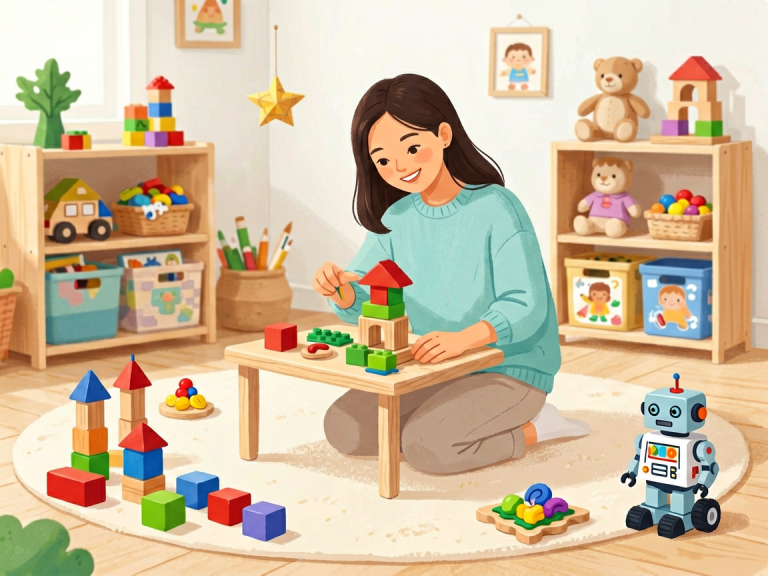
Screen-free building toys also offer a rare opportunity for meaningful intergenerational connection. A parent helping a child snap together a magnetic geodome is not merely supervising—they are engaging in a shared creative process. The tactile nature of these toys invites conversation, storytelling, and gentle guidance. A 2022 study in *Journal of Family Psychology* found that families who engaged in regular hands-on construction play reported higher levels of parental warmth and child cooperation. This is partly because the activity is inherently collaborative rather than competitive. There are no high scores, no “game over” screens, no digital distractions—only the quiet satisfaction of a shared creation.
For children with attention deficits or anxiety, the sensory grounding provided by building toys can be particularly therapeutic. The weight of a wooden block, the click of a plastic connector, the texture of a metal girder—these physical sensations anchor the child in the present moment, reducing the overstimulation that often accompanies digital play. Occupational therapists frequently recommend building toys for children with sensory processing disorders precisely because they provide rich, predictable, and controllable sensory input.
The Diversity of Screen-Free Building Toys: A World of Possibilities
Classic Wooden Blocks and Unit Blocks
The original building toy, simple wooden blocks, remain a cornerstone of early childhood education. Their warmth, weight, and lack of predetermined connectors allow for infinite combinations. The Froebel gifts, designed by the founder of kindergarten, were precisely this kind of open-ended material. Today, brands like Melissa & Doug and Grimm’s produce beautifully crafted sets that encourage symmetry, pattern recognition, and small-motor control. For very young children, these blocks offer a safe introduction to construction play without small parts.
Interlocking Plastic Systems: From LEGO to Plus-Plus
While LEGO bricks are the undisputed giant of the building toy world, they are not the only option. The genius of LEGO lies in its system of stud-and-tube connections, which allows for both stability and easy disassembly. However, many parents worry about the creeping influence of themed sets (like Star Wars or Harry Potter) that prescribe what the child should build rather than inspiring open-ended creativity. For this reason, educators often recommend classic brick boxes rather than licensed sets. Other notable systems include Plus-Plus (a Danish toy made of interlocking plastic shapes that can form 2D mosaics or 3D structures), K’NEX (rods and connectors for making working machines), and Magna-Tiles (translucent magnetic shapes that click together). Each system offers a unique tactile experience and develops different aspects of spatial reasoning.
Magnetic and Construction Kits
Magnetic building toys, such as Magformers and Geomag, introduce children to the invisible force of magnetism. Building a tower of magnetic rods and steel balls requires understanding polarity—a concrete physics lesson. Meanwhile, more advanced construction kits like Meccano or Erector Set use real nuts, bolts, and metal strips to create functional mechanical devices like cranes and vehicles. These kits teach fine motor skills, tool usage, and basic engineering principles. For older children, they can be a gateway to more serious STEM hobbies like robotics and model building.
Natural and Repurposed Materials
Not all screen-free building toys come from a box. Logs, sticks, stones, and sand are the original building materials. Forest schools and outdoor classrooms emphasize “loose parts” play—the idea that the most creative constructions come from found objects. Indoors, parents can provide cardboard tubes, empty containers, fabric scraps, and bottle caps. This approach not only reduces plastic waste but also teaches children to see potential in everyday objects. A toilet paper roll becomes a bridge pillar; a scrap of felt becomes a roof. The cognitive leap required to repurpose materials is a higher-order thinking skill.
The Battle Against Screen Fatigue: Why Now More Than Ever
The Neuroscience of Screen Time vs. Hands-On Play
The American Academy of Pediatrics recommends no more than one hour per day of high-quality screen time for children aged 2-5, yet studies show the average child exceeds this by a wide margin. Prolonged screen exposure has been linked to delayed language development, reduced attention spans, and increased irritability. Screen-free building toys offer a necessary counterbalance. When a child constructs a physical object, their brain engages not only visual and auditory centers but also touch, proprioception (body awareness), and kinesthetic learning. This multisensory activation creates stronger neural pathways. Furthermore, the physical world provides a natural “attention reset”—after 20 minutes of block play, a child’s eyes have refocused, their body has moved, and their mind is ready for the next challenge.
The Economic and Environmental Argument
Screen-free building toys are also remarkably sustainable. A high-quality set of wooden blocks can last for decades and be passed down through multiple children. Compare this to a tablet, which may become obsolete in three years and contain hazardous materials. Many building toy companies now use sustainable wood, recycled plastics, and non-toxic paints. From a financial perspective, a single investment in a versatile building system can provide years of entertainment, while digital subscriptions and in-app purchases drain family budgets. The return on investment—in terms of both cognitive development and environmental impact—is overwhelmingly positive.
Conclusion: Building a Future Without Screens
The resurgence of screen-free building toys is not a nostalgic retreat to a pre-digital past. It is a forward-looking recognition that the most advanced technology a child can interact with is their own imagination. When we hand a child a set of blocks, we are giving them permission to think in three dimensions, to collaborate without a filter, to fail safely, and to create something uniquely their own. In a world that increasingly prizes passive consumption, these toys demand active creation. They remind us that the best building material for a child’s mind is not silicon, but wood, plastic, metal, and the infinite possibilities of the human hand.
As we navigate the complexities of the digital age, let us not forget the profound power of the unplugged. Let us stack, connect, and build—not just structures, but better brains, stronger bonds, and a more balanced future for our children. The tower of learning begins with a single block.