Building Little Scientists: The Transformative Power of Science Toys for Preschoolers
Introduction: The Wonder Years
The preschool years—roughly ages three to five—are a golden window of cognitive, sensory, and motor development. During this period, children are naturally curious, asking endless “why” and “how” questions about the world around them. They observe leaves falling, water freezing, magnets sticking, and shadows shifting. This innate drive to explore is the foundation of scientific thinking. Yet, for many parents and educators, the word “science” conjures images of lab coats, beakers, and complex equations—far removed from the messy, joyful reality of a four-year-old’s playroom. Enter science toys for preschoolers: carefully designed playthings that channel a child’s curiosity into structured discovery, building critical thinking, fine motor skills, and a lifelong love of learning. This article delves into why these toys matter, how to choose them wisely, and what specific types offer the richest developmental benefits.
Why Science Toys Matter More Than You Think
It is easy to dismiss a set of plastic magnifying glasses or a simple color-mixing kit as mere entertainment. However, research in early childhood education consistently shows that hands-on, exploratory play is the most effective way for preschoolers to grasp fundamental concepts. Science toys do not just teach facts; they teach *process*: observation, prediction, experimentation, and revision. When a toddler drops a ball repeatedly to see how it bounces, they are conducting a primitive physics experiment. When they pour water from one cup to another, they explore volume and conservation. Quality science toys formalize these instincts, offering guided but open-ended experiences.
Moreover, these toys nurture vocabulary growth. Words like “absorb,” “float,” “magnet,” “life cycle,” and “reaction” become part of a child’s active lexicon through tangible experience, not rote memorization. Social skills also benefit: preschoolers who work on a simple sinking-and-floating activity together learn to share observations, debate outcomes, and collaborate. In an era where screen time dominates, science toys offer a tactile, sensorimotor counterbalance that supports brain development in ways digital apps cannot replicate. Finally, exposing children to science early helps combat gender and cultural stereotypes about who “belongs” in STEM fields. A girl who builds a circuit with a light bulb at age four is far more likely to see herself as a future engineer.
How to Choose the Right Science Toys: Key Principles
Not every toy labeled “educational” or “science” is valuable. Parents and teachers should apply a few guiding principles when selecting science toys for preschoolers.
1. Open-Ended Over Prescriptive
A toy that can be used in multiple ways—like a set of wooden blocks, a water table, or a collection of colorful magnets—invites creativity and repeated discovery. Conversely, a toy that does one specific thing (e.g., a plastic volcano that only erupts with baking soda and vinegar) may lose its appeal after a few uses. The best science toys allow the child to drive the investigation, not the other way around.
2. Sensory Richness
Preschoolers learn through their senses. Toys that involve texture, motion, sound, and even smell engage multiple neural pathways. For instance, a simple sand and water table lets children experiment with pouring, sifting, and digging—all while developing scientific concepts like states of matter and cause and effect.
3. Safety and Durability
Young children explore with their mouths as much as their hands. All materials should be non-toxic, BPA-free, and free of small parts that pose choking hazards. Durable construction is also critical because preschoolers are not gentle: a toy that breaks the first time it is dropped will frustrate rather than educate.
4. Age-Appropriate Challenge
A good science toy straddles the line between too easy and too hard. If a toy requires abstract reasoning beyond a child’s developmental stage, it will cause frustration. If it offers no challenge, boredom sets in. For example, a simple gears set that requires matching colors and turning cranks is perfect for a three-year-old, while a more complex gears kit with chains and pulleys suits a five-year-old.
Categories of Science Toys That Spark Discovery
Below are some of the most effective categories, each targeting specific domains of early scientific understanding.
1. Nature and Observation Tools
Magnifying glasses, bug viewers, binoculars designed for small hands, and simple microscopes that magnify at 10x to 40x are staples. These tools encourage children to examine the details of leaves, insects, rocks, and fabrics. They foster patience and attention to detail. For example, a preschooler who watches a caterpillar crawl under a magnifying glass learns about insect anatomy and movement in a deeply personal way. Adding a nature journal (even just blank paper and crayons) turns observation into documentation—a core scientific practice.
2. Simple Physics and Engineering Sets
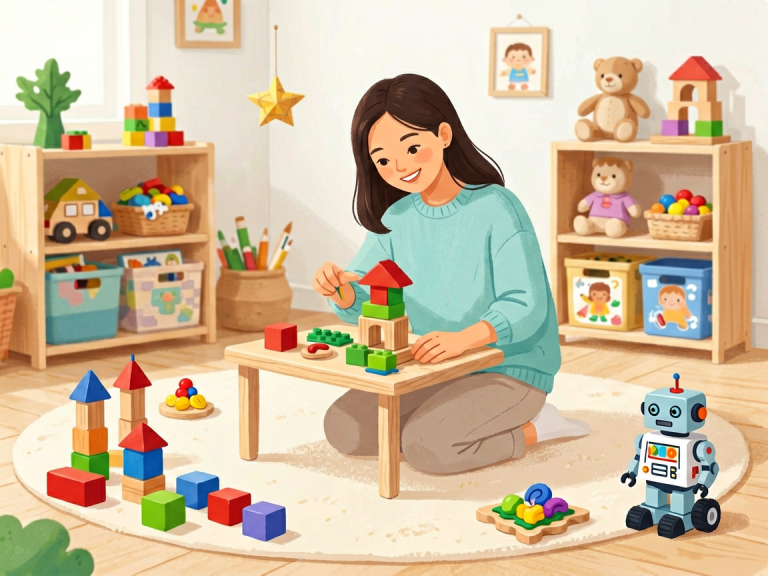
Building blocks, magnetic tiles, ramps, and marble runs are physics laboratories in disguise. When a child builds a tower that falls because the base is too narrow, they are learning about stability and gravity. When they adjust the angle of a ramp to make a marble roll faster, they explore slope and momentum. Sets like Magna-Tiles or wooden unit blocks are classics because they combine geometry, balance, and cause-and-effect. More specialized options include gear sets (e.g., Learning Resources Gears! Gears! Gears!) that teach mechanical linkages.
3. Water and Sensory Play
Water tables, pipettes, sieves, funnels, and floating/sinking kits provide endless opportunities for experimentation. Children can test whether a cork, a rock, or a plastic boat floats. They can mix colored water to learn about primary and secondary colors. Using a turkey baster or syringe (without the needle) develops hand strength while demonstrating air pressure and displacement. These activities also introduce concepts like absorption (sponges versus plastic) and surface tension.
4. Early Chemistry and Color Mixing
Pre-packaged kits for making playdough, slime, or “volcanoes” are popular, but the simplest chemistry toy is a set of non-toxic food coloring, droppers, and clear cups. Letting a child mix yellow and blue to make green is a profound lesson in combination and change. Baking soda and vinegar reactions never get old—but rather than a pre-formed volcano, offer the raw materials and let the child experiment with different amounts. Just ensure strict supervision, as some children may try to taste the mixture.
5. Light, Shadow, and Magnets
Flashlights, color paddles (translucent plastic sheets), and prisms introduce children to light behavior. A simple activity like shining a flashlight through a red paddle to see a red shadow on the wall teaches about filters and wavelengths. Magnetic toys—magnetic wands, horseshoe magnets, and magnetic chips—let children explore attraction, repulsion, and polarity. A set of magnetic “fishing” toys can also teach which metals are magnetic and which are not (e.g., aluminum versus steel).
6. Living Things and Life Cycles
Caterpillar-to-butterfly kits, ant farms, and planting seeds in clear cups are excellent introductions to biology. Observing a seed sprout roots and shoots over two weeks teaches patience and the basic needs of plants (water, light, soil). Hatching ladybugs or butterflies gives a child a front-row seat to metamorphosis. These experiences build empathy for living creatures and a sense of responsibility.
The Role of Adults: Guiding Without Directing
A science toy in the hands of a preschooler is powerful, but the presence of a thoughtful adult multiplies its value. Parents and teachers should adopt a “Socratic” approach: ask open-ended questions instead of giving answers. For example, when a child is playing with a ramp and a car, an adult might say, “What do you think will happen if we make the ramp higher?” or “Why did the car stop there?” This encourages prediction and explanation. It is also vital to normalize “failure.” If a child’s tower collapses, rather than saying “That didn’t work,” say, “Wow, look what happened! Why do you think it fell? What could we do differently?” This reframes mistakes as data—a core scientific mindset.
Additionally, adults should document the child’s discoveries. Taking photos, writing down their dictated observations, or creating a simple “science journal” together validates their work and creates a record for future reflection. Over time, this routine builds confidence and a sense of identity as a “scientist.”
Conclusion: Planting Seeds for a Lifetime of Inquiry
Science toys for preschoolers are not luxury items or educational gimmicks. They are essential tools that transform curiosity into competence. By choosing toys that are open-ended, sensory, safe, and appropriately challenging, parents and educators give children the gift of discovering the world on their own terms. Through play, a preschooler learns that science is not a collection of facts to memorize but a way of thinking: ask questions, try things, make mistakes, and try again. The child who grows up with a bin of magnets, a water table, and a magnifying glass does not just learn about physics or biology—they learn that they are capable of understanding the universe. And that is the most valuable lesson of all.