Stitching Science: The Best STEM Toys for Kids Who Love Crafts
Introduction: Where Creativity Meets Curiosity
For decades, parents and educators have treated STEM (Science, Technology, Engineering, and Mathematics) and crafts as two separate worlds. On one side, you have the logic-driven realm of robotics kits, coding games, and chemistry sets. On the other, the tactile, expressive universe of knitting needles, glue guns, and fabric scraps. But what if the two could merge? Increasingly, toy manufacturers and educational designers are creating STEM toys specifically for children who love crafts—products that weave scientific principles into hands-on, artistic activities. These toys not only satisfy a child’s desire to create something beautiful but also build critical thinking, spatial reasoning, and problem-solving skills. For kids who would rather sew a circuit than program a robot, the emerging category of craft-infused STEM toys offers the perfect bridge between imagination and innovation.
Why Crafts and STEM Are a Natural Pair
Many people assume that STEM education is purely analytical, but in reality, the most groundbreaking scientists and engineers have always been creative thinkers. Leonardo da Vinci was both an artist and an inventor. Today’s aerospace engineers use principles of design and aesthetics alongside physics. Children who love crafts already possess a valuable skill set: they understand patterns, materials, geometry, and sequential steps. A child who follows a knitting pattern is essentially executing a coded sequence. A child who mixes paints learns about chemical reactions and color theory. STEM toys that build on these existing interests can transform a young crafter into a confident, curious learner.
Moreover, craft-based STEM toys often lower the intimidation factor. A child who feels anxious about math or science may eagerly engage with a project that involves making a bracelet, building a model, or designing a piece of jewelry. The hands-on, tangible results provide immediate feedback, reinforcing concepts without the pressure of tests or grades. This approach aligns with the "maker movement," which emphasizes learning by doing and celebrates failure as part of the creative process.
Top Categories of STEM Toys for Craft-Loving Kids
1. Sewable Circuits and E-Textiles
Perhaps the most exciting intersection of crafts and STEM is the world of sewable electronics. Kits like the LilyPad Arduino, Sew Electric, or the popular Jewelbots allow children to sew conductive thread through fabric to create light-up patches, sound-producing plushies, or even wearable tech. These toys teach basic circuitry, conductivity, and programming logic, all while producing a soft, portable piece of art. Kids can design their own patterns, choose colors of LED lights, and experiment with switches and sensors. The act of sewing becomes a lesson in parallel circuits and resistance. For a child who already loves embroidery or fashion design, this is a revelation—the dresses and accessories they make can now blink, buzz, or respond to touch.
2. Paper Engineering and Pop-Up Mechanics
Paper crafts are often dismissed as simple, but when combined with STEM principles, they become sophisticated lessons in geometry, force distribution, and structural engineering. Kits like Papercraft Robots or Klutz's Paper Circuits teach children to fold, cut, and assemble paper into moving machines. For instance, a child can build a paper crane that flaps its wings using a simple cam mechanism, or create a pop-up card that relies on parallel folds and angles. These projects develop fine motor skills and an intuitive understanding of how changes in shape affect function. Kids learn that a small shift in a fold can determine whether a structure stands or collapses—a foundational concept in engineering.
3. Chemistry-Inspired Craft Kits
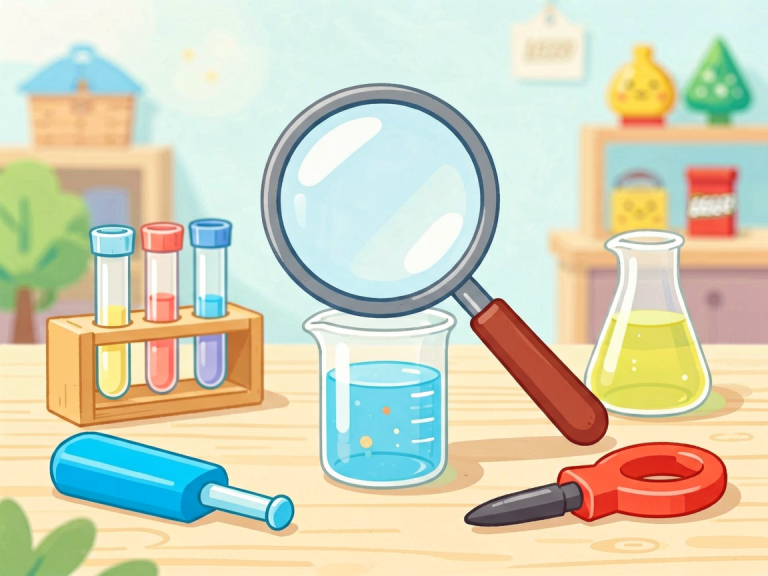
For young artists who love mixing colors, making slime, or growing crystals, chemistry-based craft kits transform the kitchen table into a laboratory. Brands like National Geographic and Thames & Kosmos offer kits that allow children to create their own lip balms, bath bombs, or scented candles while learning about pH, emulsions, and exothermic reactions. A child making bath bombs learns that the fizz comes from a reaction between citric acid and baking soda. A child creating tie-dye shirts discovers how molecular bonds break and reform with different dyes. These projects satisfy the craft lover's desire for a beautiful end product while embedding real scientific vocabulary and process thinking.
4. 3D Printing Pens and Modeling Tools
3D printing pens, such as the 3Doodler, have revolutionized craft-based STEM play. Instead of programming a computer to print a model, children can draw in three dimensions, building structures layer by layer. This merges the freedom of doodling with the precision of additive manufacturing. Kids can design jewelry, architectural models, or even functional objects like phone stands. The process teaches spatial reasoning, material properties (plastic cooling rates, adhesion), and design iteration. For craft-oriented children who love sculpture or model-building, a 3D printing pen is a natural evolution of their hobby.
5. Woodworking and Mechanical Craft Kits
Traditional woodworking meets engineering in kits like those from Makeblock or Eitech. Children can build moving wooden models—cars, cranes, or even clocks—using pre-cut pieces, gears, and axles. These projects teach mechanical advantage, torque, and the relationship between gear sizes. A child who loves assembling model airplanes or dollhouse furniture will find these kits appealing because they result in a functional, often kinetic, piece of art. The precision required to sand, glue, and align parts builds patience and attention to detail, skills essential for both crafts and STEM careers.
How to Choose the Right STEM Craft Toy for Your Child
Not every craft-loving child will fall in love with every STEM craft toy. The key is to match the product to their existing interests and developmental stage. For a child who adores jewelry making, look for a beading kit that incorporates binary code or color-coded circuits. For a child who loves painting, consider a kit that uses UV-sensitive paint to teach about light waves. For a child obsessed with building forts, a structural engineering kit with foam blocks and connectors might be ideal.
Age appropriateness matters too. Younger children (ages 4–7) benefit from large, chunky pieces and simple cause-and-effect relationships, such as a magnetic building set or a light-up craft project using pre-cut felt. Older children (ages 8–12) can handle more complex tools like sewable circuits or 3D pens, as well as kits that require reading instructions and troubleshooting. Teenagers may enjoy programming micro:bit boards to control their fabric creations or designing multi-step mechanical models.
Another consideration is the balance between open-ended creativity and guided instruction. Some children thrive with freeform tinkering, while others prefer step-by-step projects that produce a specific outcome. The best STEM craft toys offer both: a clear starting point but room for personalization. For example, a sewing circuit kit might include instructions for a basic light-up patch but encourage the child to design their own pattern or add multiple lights.
The Long-Term Benefits of Combining Crafts and STEM
When children engage with STEM toys that feel like crafts, they develop a growth mindset that carries into academic and professional life. They learn that science is not a distant, abstract subject but a tool they can use to create things they love. This sense of agency is powerful. Studies have shown that hands-on, project-based learning improves retention and enthusiasm, especially among girls and underrepresented groups who may feel alienated by traditional STEM education.
Furthermore, craft-inspired STEM play fosters resilience. A child who stitches a circuit wrong and must re-thread or re-solder learns to troubleshoot without fear. A child who builds a paper machine that collapses learns to analyze why it failed and try again. These experiences build the kind of perseverance that engineers and scientists need every day.
Finally, integrating crafts with STEM nurtures a holistic thinker—someone who can design, build, test, and beautify. The world needs innovators who are not only technically competent but also empathetic, design-conscious, and creative. By giving craft-loving children STEM toys that speak their language, we are raising a generation that will see no conflict between art and science, only endless possibilities.
Conclusion: The Best of Both Worlds
The next time a child chooses a ball of yarn over a robot kit, or a set of markers over a microscope, do not view it as a rejection of STEM. Instead, see it as an invitation. The toy industry has responded with a rich array of options that meet craft-loving kids exactly where they are. From sewable circuits that make stuffed animals light up to chemistry-based candle-making kits, these STEM toys for kids who love crafts prove that creativity and logic are not opposites—they are partners. So, hand your young crafter a conductive thread, a 3D printing pen, or a bag of crystal-growing ingredients, and watch as they stitch, glue, and build their way into a future that is as beautiful as it is brilliant.