The Power of Play: How Math Toys for Toddlers Build Foundations for Lifelong Learning
Introduction
In the early years of a child’s life, every rattle, block, and puzzle is more than just a source of entertainment—it is a tool for discovery. For toddlers, the world is a vast, exciting place full of patterns, quantities, shapes, and sizes waiting to be explored. This is where math toys for toddlers step in, not as mere distractions, but as carefully designed instruments that nurture the budding mathematical mind. Far from the intimidating equations and rigid drills of later schooling, these toys harness the natural curiosity of young children, transforming abstract concepts into tangible, playful experiences. Research in early childhood development consistently shows that foundational math skills—such as number sense, spatial awareness, and pattern recognition—are strong predictors of later academic success. Yet, many parents and caregivers underestimate the power of a simple set of stacking cups or a colorful abacus. In this article, we will delve deep into the world of math toys for toddlers, exploring why they matter, what types are most effective, how to choose them wisely, and how to turn playtime into a rich mathematical adventure. By the end, you will see that a toddler’s playroom is actually a laboratory for learning, and the right toys can ignite a lifelong love for numbers and logic.
Why Math Toys Matter for Toddlers
Building Early Number Sense
Before a toddler can count to ten, they must develop an intuitive understanding of quantity. Math toys like counting bears, number puzzles, and stacking rings introduce the concept of “how many” in a hands-on way. When a child picks up a ring and places it on a peg, they are not just practicing fine motor skills—they are subconsciously registering that each ring corresponds to a single unit. This one-to-one correspondence is the bedrock of counting. Toys that require matching a numeral to a set of objects (e.g., a puzzle where the number “3” fits into a slot with three dots) help solidify this connection. Over time, repeated play builds a mental number line, allowing toddlers to grasp that “more” and “less” are not just words but measurable realities. Without such playful exposure, abstract numbers can remain hollow symbols.
Fostering Spatial Reasoning and Geometry
Spatial reasoning—the ability to visualize and manipulate objects in space—is a critical component of mathematics. Toddlers explore geometry every time they fit a square block into a square hole, or stack a triangular prism on top of a cylinder. Shape sorters, magnetic tiles, and building blocks are classic math toys that train the brain to recognize angles, symmetry, and dimensions. These experiences also lay the groundwork for understanding area, volume, and later concepts like fractions. When a toddler tries to balance two blocks of different sizes, they are intuitively comparing weights and lengths. Such play enhances their ability to mentally rotate objects, which researchers have linked to success in STEM fields. In short, a child who spends time with spatial toys is better equipped for geometry, engineering, and even art.
Encouraging Logical Thinking and Problem Solving
Math is not just about numbers; it is about patterns, sequences, and logical relationships. Toys like pattern blocks, simple board games, and sequencing cards require toddlers to observe, predict, and apply rules. For instance, a game that asks a child to continue a pattern of red-blue-red-blue teaches the concept of alternation and repetition. Similarly, a toddler struggling to fit a larger object inside a smaller container must experiment with size and order—a form of trial-and-error logic. These early problem-solving experiences boost cognitive flexibility and persistence, qualities that are invaluable in mathematics. Moreover, the frustration and eventual success of figuring out a puzzle builds resilience and confidence, showing the child that challenges can be overcome with thought and effort.
Types of Math Toys and Their Benefits
Building Blocks and Construction Sets
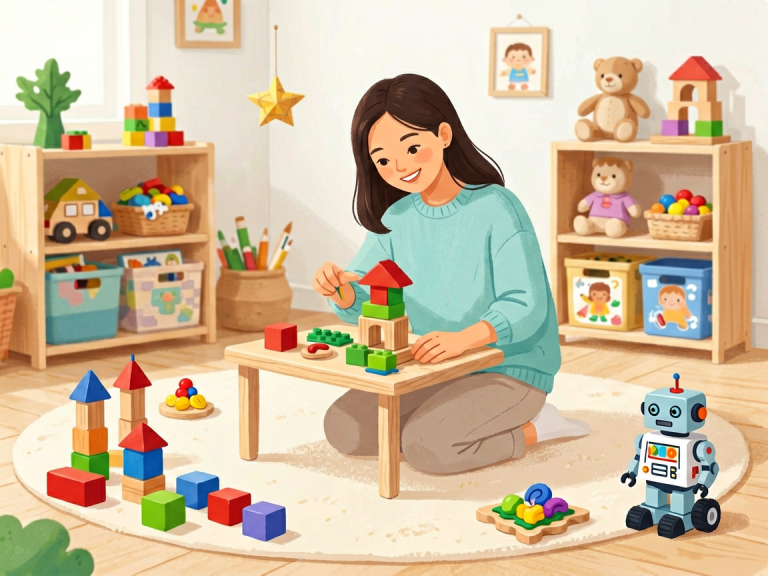
Perhaps the most versatile math toys for toddlers are building blocks. Simple wooden blocks, LEGO Duplo, or magnetic tiles offer endless opportunities for exploring size, weight, balance, and symmetry. When a toddler stacks blocks, they learn stability and equilibrium—they discover that a wide base supports a taller tower. When they sort blocks by color or shape, they practice classification. Construction sets that require connecting pieces (like snap-together cubes) also introduce the idea of addition and subtraction in a physical way: adding one more block to a tower, or removing one to make it shorter. These toys are open-ended, meaning they can grow with the child. A one-year-old might simply enjoy knocking down towers, while a three-year-old might build elaborate structures that require counting floors or matching symmetrical sides.
Counting and Number Recognition Toys
Dedicated counting toys, such as abacuses, counting bears, number rods, and puzzles, directly target early numeracy. An abacus, for example, allows a toddler to slide beads one by one, associating the movement of each bead with a number. Counting bears come in different colors and sizes, so children can sort, count, and compare. Number puzzles often have pieces that fit into corresponding slots, reinforcing the shape of each numeral. Some toys even combine auditory feedback—for instance, a toy phone that says “three” when pressed—which helps with auditory learning. The key is to choose toys that are tactile and engaging, not electronic screens that do the thinking for the child. Hands-on manipulation is crucial for neural connections in the developing brain.
Shape Sorters and Puzzles
Shape sorters are a staple for toddlers because they simultaneously teach shape recognition, spatial relationships, and problem-solving. A classic shape sorter has a cube with holes for a circle, square, triangle, and star. The toddler must rotate each piece to find the correct orientation—a primitive form of mental rotation. More advanced puzzles, like those with several interlocking pieces, introduce part-whole relationships. As the child fits the pieces together, they are learning that a whole can be broken into parts, a core mathematical idea. Puzzles that depict numbers or simple math scenes (e.g., a farm with five ducks) combine multiple concepts. These toys also develop hand-eye coordination, which is closely tied to cognitive development.
Measurement and Comparison Toys
Measurement is a fundamental mathematical concept that toddlers encounter daily: “Which cup is bigger?” “Who has more blocks?” Measurement toys include scales, measuring cups, nesting dolls, and stacking rings. A simple balance scale lets toddlers experiment with weight—placing a heavy block on one side and a light block on the other, they see the scale tip. Nesting dolls (matryoshka) teach size ordering: the largest doll contains smaller ones, demonstrating concepts of “bigger than” and “smaller than.” Stacking rings in order of diameter also reinforce seriation, the ability to arrange objects by a specific attribute. These toys allow toddlers to engage in direct comparison, a precursor to understanding units and standard measurement later in school.
Pattern and Sequence Toys
Pattern recognition is a high-level cognitive skill that underlies algebra and logic. Toys designed for this purpose include pattern boards with colored pegs, threading beads in repeating sequences, and simple dominoes or flashcards showing patterns. For instance, a toddler might be given a card that shows a pattern: green, yellow, green, yellow, and then asked to place the next bead. This activity strengthens working memory and the ability to generalize rules. Similarly, sequencing toys that depict steps of a story or a daily routine help toddlers understand order—first, then, last—which is foundational for mathematics and for following instructions. Many magnetic or felt boards come with pre-cut shapes that can be arranged into patterns, combining creativity with logic.
How to Choose the Right Math Toys for Toddlers
Age Appropriateness and Safety
The first consideration when selecting math toys is the child’s developmental stage. For infants and young toddlers (12–18 months), toys should be large enough to prevent choking hazards and made of safe, non-toxic materials. Simple stacking cups, soft blocks, and rattles with varied textures are ideal. For older toddlers (2–3 years), more complex toys like shape sorters, puzzles with fewer pieces, and counting toys with large pieces are appropriate. Always check manufacturer age recommendations. Additionally, avoid toys with small magnets or button batteries, as these pose serious risks. Safety should never be compromised for educational value.
Open-Ended vs. Closed-Ended Toys
Open-ended toys, like blocks, play dough, and loose parts (e.g., counting chips), allow for multiple uses and creative exploration. They encourage divergent thinking and adapt to the child’s changing interests. Closed-ended toys, like puzzles with a fixed solution, teach specific concepts but may have limited replay value. The best math toy collection includes a balance of both. For example, a shape sorter is closed-ended (the triangle only fits in the triangle hole), while a set of colored rings can be stacked in any order, or counted, or rolled. Parents should prioritize toys that grow with the child—ones that can be used for different activities over months or years.
Quality and Durability
Toddlers are notoriously rough on toys. Cheap plastic toys may break quickly, creating sharp edges or small parts. Invest in well-made wooden toys, sturdy fabrics, or high-quality plastic that can withstand drops, throws, and chewing. The tactile feel of natural materials also enriches sensory experience. Moreover, toys with clear, bright colors and simple designs are more effective than overly noisy or flashy ones that can overstimulate a toddler. Simplicity focuses the child’s attention on the mathematical property rather than on distracting bells and whistles.
Cultural and Inclusive Considerations
Mathematical concepts are universal, but the representation of numbers and shapes can vary. Choose toys that reflect diverse cultures and abilities—for instance, puzzles with different skin tones, or counting toys that include objects from various cultures. Additionally, consider toys that are accessible for children with disabilities. For example, large-grip puzzles for fine motor challenges, or high-contrast colors for visually impaired children. Inclusivity ensures that every child can benefit from early math play.
Tips for Engaging Toddlers with Math Toys
Follow the Child’s Lead
The most effective learning happens when the child is intrinsically motivated. Instead of directing play, observe what interests your toddler. If they are fascinated by stacking, provide more varied blocks. If they love to line up cars, use that to talk about “which car is first?” and “how many cars are there?” Encourage their natural curiosity by asking open-ended questions: “What happens if we put this block on top?” or “Can you find another one that is the same size?” This approach builds language skills alongside math.
Incorporate Math into Daily Routines
Math toys don’t have to be confined to playtime. Use them during everyday activities. When setting the table, let the toddler count the forks. When sorting laundry, ask them to match socks by size. When cooking, let them pour measuring cups of rice. These real-world applications solidify the concepts learned from toys. A simple set of plastic measuring spoons becomes a math toy in the kitchen. The key is to keep it playful and low-pressure—never force a counting lesson when the child is tired or cranky.
Encourage Exploration and Mistakes
Toddlers learn through trial and error. Let them experiment with math toys without immediate correction. If they put a square peg into a round hole, resist the urge to fix it. Instead, ask: “Does that fit? Let’s try another hole.” Mistakes are powerful learning opportunities. Celebrate their efforts and persistence rather than focusing on the “right” answer. This builds a growth mindset, where the child sees challenges as opportunities rather than failures. Over time, they will naturally discover the correct solutions through their own reasoning.
Use Language Richly
While playing with math toys, narrate what you see. Use mathematical vocabulary naturally: “You have two blue blocks and three red blocks—that’s five blocks altogether!” “This circle is round, and this triangle has three corners.” “Your tower is taller than the chair.” Such language exposes toddlers to terms like “more than,” “less than,” “equal,” “size,” and “shape.” Even if they don’t fully understand, the neural pathways are being laid. Research shows that the amount of math talk a toddler hears directly predicts their later math achievement. So don’t be shy—talk math!
Conclusion
Math toys for toddlers are far more than simple diversions; they are the building blocks of logical thinking, spatial intuition, and numerical confidence. From the humble stacking cup to the intricate pattern board, each toy offers a unique gateway into the world of mathematics—a world that, when introduced through play, becomes a source of joy rather than anxiety. By choosing age-appropriate, safe, and open-ended toys, and by engaging with children in thoughtful, language-rich interactions, parents and caregivers can lay a strong foundation for a lifetime of mathematical learning. The toddler years are a window of incredible neuroplasticity, and every moment of play is an investment in a child’s future. So next time you see your little one absorbed in fitting a triangle into its slot, remember: they are not just playing—they are thinking, reasoning, and growing into a young mathematician. Embrace the mess, the repetition, and the laughter, because in that small, colorful world, the seeds of genius are being sown.