Unlocking Early Numeracy: The Transformative Power of Math Toys for Preschoolers
—
Introduction
In the bustling playrooms of today’s early childhood settings, brightly colored blocks, counting bears, and shape sorters are more than just sources of entertainment. They are the silent architects of a child’s earliest mathematical thinking. For preschoolers—typically children aged three to five—the world is a vast landscape of patterns, quantities, and spatial relationships. Yet traditional approaches to teaching math often rely on worksheets and rote memorization, which can feel abstract and intimidating to young learners. This is where math toys step in as powerful allies. By blending play with purpose, math toys transform abstract concepts into tangible, hands-on experiences. They invite children to explore numbers, shapes, measurements, and logic in a natural, joyful way. This article delves into the profound role of math toys in preschool development, examines the most effective types, offers guidance on selection, and highlights long-term benefits that extend far beyond the classroom.
—
Why Math Toys Matter in Early Childhood Development
Building a Foundation for Number Sense
Number sense—the ability to understand, relate, and manipulate numbers—is one of the most critical predictors of future mathematical success. Research shows that children who engage in purposeful number play before kindergarten tend to perform better in arithmetic and problem-solving later in school. Math toys such as counting rods, bead frames, and number puzzles allow preschoolers to physically see and touch quantities. For example, when a child places five wooden ducks in a row and then adds two more, they are not just playing; they are internalizing the concept of addition. This kinesthetic learning bypasses the need for abstract symbols and builds an intuitive grasp of numeracy.
Encouraging Logical Reasoning and Problem Solving
Preschoolers are natural problem solvers. They want to know why blocks fall, how to fit a triangle into a square hole, or which set of objects is “more.” Math toys like pattern blocks, tangrams, and sorting games challenge children to compare, categorize, and predict outcomes. Each attempt—whether successful or not—strengthens their ability to reason logically. A child working with a balance scale, for instance, learns to hypothesize: “If I put more bears on this side, the scale will go down.” This trial-and-error process is the essence of scientific and mathematical thinking.
Fostering a Positive Emotional Connection to Math
Anxiety about mathematics often begins early. When children are forced into repetitive drills or feel pressured to produce correct answers, they may develop a lasting aversion. Math toys, by contrast, are inherently playful. There is no right or wrong way to explore a set of colorful unit cubes; there is only curiosity. This low-stakes environment encourages persistence, creativity, and a growth mindset. A child who knocks down a tower of counting blocks and rebuilds it learns that mistakes are stepping stones, not failures. Over time, this emotional safety fosters confidence and a genuine love for numbers.
—
Key Types of Math Toys for Preschoolers
Counting and Number Recognition Toys
At the heart of early math lies counting, and there is no shortage of toys designed to make this skill engaging. Number puzzles, where each numeral piece fits into a corresponding slot, help children associate the symbol “3” with the quantity of three dots or three objects. Count-and-snap beads, threading sets, and stacking rings also reinforce one-to-one correspondence. A particularly effective tool is the “counting tray” or “ten-frame board,” where children place small objects (like buttons or pom-poms) into compartments. This visual arrangement prepares them for base-ten concepts and subitizing—the ability to instantly recognize small quantities without counting.
Shape, Pattern, and Spatial Awareness Toys
Geometry for preschoolers begins with recognizing and manipulating shapes. Shape sorters, magnetic mosaics, and wooden pattern blocks allow children to identify circles, squares, triangles, and hexagons. More advanced toys, such as tangrams and Geoboards, encourage the creation of new shapes and designs. These activities develop spatial reasoning—a skill strongly correlated with later success in STEM fields. When a child rotates a puzzle piece to fit a gap, they are practicing mental rotation, a cognitive ability that supports geometry and engineering.
Measurement and Comparison Toys
Measurement seems abstract until it becomes physical. Toys like balance scales, measuring cups, and stacking towers with graduated sizes bring concepts of weight, length, and volume to life. For example, a simple bucket balance lets children compare the weight of a toy car versus a stuffed bear. They learn vocabulary such as “heavier,” “lighter,” “longer,” and “shorter.” Similarly, a set of nesting beakers or measuring spoons allows preschoolers to explore volume through pouring and comparing. These toys also introduce the idea of units, laying groundwork for future work with standard measurement.
Logic, Sequencing, and Early Coding Toys
Mathematical thinking is not limited to numbers; it also involves patterns, order, and rules. Logic toys such as sequencing cards, bead pattern kits, and simple board games teach children to recognize and extend patterns. More modern options include “coding” toys like programmable robots (e.g., Botley or Code-a-pillar) that use arrow commands to move along a path. While preschoolers may not understand computer code, they learn cause and effect, sequence, and conditional thinking. These are the same cognitive processes that underpin algebra and programming.
Dice, Dominoes, and Card Games
Often overlooked, classic games like dice, dominoes, and simple card games (e.g., “War” or “Go Fish”) are exceptionally rich in math potential. Rolling dice and counting pips reinforces subitizing and addition. Dominoes require matching numbers and recognizing patterns. Card games introduce comparing numbers (“Is this 5 greater than 3?”) and basic probability (“Will I draw a bigger number?”). These toys are portable, inexpensive, and easily integrated into family game nights, making math a social and enjoyable experience.
—
How to Choose the Right Math Toys for Your Child
Selecting math toys can feel overwhelming given the sheer variety. However, several guiding principles can help parents and educators make informed choices.
Age Appropriateness and Developmental Stage
A toy that captivates a four-year-old may frustrate a three-year-old or bore a five-year-old. For younger preschoolers (ages 3–4), focus on simple, concrete toys that emphasize counting to ten, shape recognition, and sorting by one attribute (e.g., color). Examples include chunky number puzzles, large stacking rings, and simple shape sorters. For older preschoolers (ages 4–5), introduce toys that require more complex thinking: pattern sets with multiple attributes, balance scales, and simple board games with dice. Always check the manufacturer’s age suggestions, but also observe your child’s individual readiness.
Open-Endedness vs. Targeted Learning
The best math toys strike a balance between guided learning and free exploration. Open-ended toys like unit blocks, loose parts (e.g., buttons, shells, or natural stones), and play dough with number cutters allow children to create their own math problems. Such toys foster creativity and adaptability. On the other hand, targeted toys like number puzzles or counting cards explicitly teach a specific skill. A well-stocked playroom includes both. For instance, a set of magnetic numbers can be used both for lining up in order (targeted) and for creating “number stories” (open-ended).
Quality, Safety, and Durability
Preschoolers are notorious for dropping, throwing, and occasionally chewing their toys. Choose math toys made from non-toxic materials with smooth edges. Wooden toys are often preferred for their durability and tactile warmth, but high-quality plastics are also acceptable if BPA-free. Avoid toys with small parts that pose choking hazards for children under three. Also consider whether the toy can be cleaned easily—a practical concern in group settings.
Interest and Engagement
No toy, no matter how educationally sound, will work if it does not capture a child’s attention. Observe your child’s natural inclinations. Do they love animals? Look for counting sets with animal figurines. Are they fascinated by vehicles? Choose number puzzles with trucks or trains. Many math toys now come in themed editions (e.g., dinosaur counting bears, unicorn pattern blocks) that tap into a preschooler’s passions. Engagement is the secret ingredient that turns a math toy from a lesson into an adventure.
—
Integrating Math Toys into Daily Play and Learning
The Role of the Adult: Facilitator, Not Instructor
Parents and teachers sometimes feel they must “teach” with math toys by demonstrating the correct use. However, research in early childhood education emphasizes the value of child-led play. Instead of saying, “Put the number 3 here,” try asking open-ended questions: “What do you notice about these blocks?” or “Can you find a way to make the scale balance?” This approach encourages exploration and verbal reasoning. Adults can also model mathematical language during play, saying things like, “I see you have more red bears than blue bears. Let’s count them together.”
Creating a Math-Rich Environment
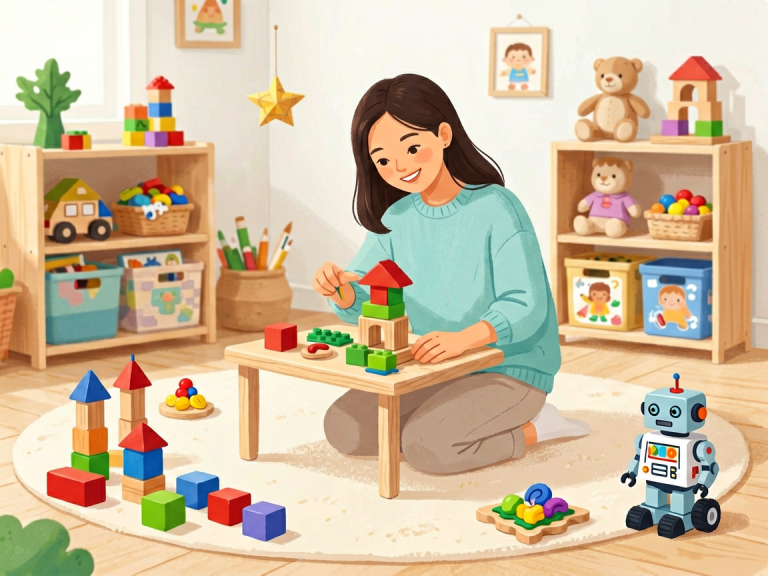
Integrate math toys naturally into the environment rather than storing them away in a labeled “math corner.” Place a basket of counting bears near the play kitchen for pretend cooking. Keep a set of pattern blocks on a low shelf in the living room so children can grab them spontaneously. Use a calendar with movable numbers during morning routines. The more math is woven into daily life, the less it feels like a separate subject. Even routine activities like setting the table (counting plates) or sorting laundry (matching socks) can be enhanced with math toys.
Combining Math Toys with Stories and Art
Math toys become even more powerful when paired with narrative or creative activities. After reading a counting book like *Ten Little Ladybugs*, provide a set of ladybug counters for children to reenact the story. Use pattern blocks to create illustrations for a class-made book about shapes. Let children use number stamps and ink pads to create their own counting posters. These cross-curricular connections deepen understanding and make math memorable.
Social Play and Cooperative Learning
Many math toys are marketed for individual use, but they can also be turned into collaborative games. A simple dice game becomes a cooperative challenge when two children work together to reach a total of 20. A set of wooden tangrams can be used for group puzzle-solving. Cooperative math play builds communication, turn-taking, and peer learning. It also reduces competition-based anxiety, allowing all children to participate at their own level.
—
The Long-Term Benefits of Early Math Play
Academic Readiness and School Success
The strongest argument for investing in math toys is their proven impact on later academic performance. A 2018 meta-analysis published in *Early Childhood Research Quarterly* found that children who engaged in structured number play before kindergarten scored significantly higher on math achievement tests in first grade. More importantly, these gains were not limited to number skills. Spatial reasoning, pattern recognition, and logical thinking transferred to reading comprehension and problem-solving in other subjects. Math toys, therefore, build a broad cognitive foundation.
Development of Executive Function Skills
Executive functions—including working memory, inhibitory control, and cognitive flexibility—are essential for goal-directed behavior. Math toys require children to hold a rule in mind (e.g., “I need two more blocks to match the card”), resist the urge to scatter pieces, and adapt when a pattern does not work. Over time, this mental workout strengthens neural circuits associated with self-regulation. Studies have linked early executive function skills to better outcomes in education, career, and even mental health.
Cultivating a Lifelong Growth Mindset
Carol Dweck’s research on mindset emphasizes that children who believe intelligence can be developed through effort are more resilient and successful. Math toys naturally promote a growth mindset because they involve trial and error. A child trying to build a symmetrical tower with unit blocks may fail many times before succeeding. Each failure is a learning opportunity. When adults praise effort (“You kept trying different ways to make it balance!”) rather than outcome (“You built a tall tower!”), children internalize the idea that persistence matters. This attitude carries into all future learning.
Strengthening Parent-Child Bonds
Finally, math toys offer a unique opportunity for quality interaction between caregivers and children. Sitting together on the floor, sorting colorful bears or rolling dice, creates moments of shared attention and joy. These positive associations with learning can counteract the pressure and stress that often accompany formal schooling. When parents actively engage with math toys—by asking questions, listening to explanations, and celebrating discoveries—they send a powerful message: math is a shared adventure, not a solitary chore.
—
Conclusion
Math toys for preschoolers are far more than colorful distractions. They are sophisticated tools that nurture number sense, spatial awareness, logical reasoning, and a positive attitude toward mathematics. From counting bears and shape sorters to balance scales and pattern blocks, each toy offers a unique entry point into the rich world of mathematical thinking. By choosing age-appropriate, open-ended, and engaging toys, and by facilitating play with thoughtful questions and enthusiastic participation, parents and educators can set the stage for a lifetime of numeracy. In a world that increasingly values analytical skills, the humble math toy may well be the most important investment we can make in a child’s future. So next time you see a preschooler stacking blocks or lining up toy cars, remember: they are not just playing—they are building the architecture of knowledge, one piece at a time.