The Power of Play: How Educational Math Toys Shape Young Minds
Introduction
Mathematics is often seen as a subject of abstract symbols, daunting formulas, and rigid rules—something that school-age children either love or dread. Yet long before a child picks up a pencil to solve equations, the foundations of mathematical thinking are being built through play. Educational math toys for kids are not merely distractions; they are powerful tools that transform abstract concepts into tangible, enjoyable experiences. From counting bears to geometric puzzles, these toys engage children’s natural curiosity and turn learning into a hands-on adventure. In an era where screen time dominates, thoughtfully designed math toys offer a tactile, interactive alternative that nurtures cognitive development, problem-solving skills, and a lifelong love for numbers. This article explores why these toys matter, the different types available, how to choose them for various ages, and the surprising benefits that extend far beyond arithmetic.
—
Why Math Toys Matter: Building Cognitive Foundations
The first years of a child’s life are a period of rapid brain development. During this time, neural connections are formed at an astonishing rate, and early exposure to mathematical concepts—such as counting, grouping, sorting, and pattern recognition—lays the groundwork for later success in STEM fields. Educational math toys capitalize on this critical window by making learning multisensory. When a toddler stacks rings from largest to smallest, he is not just playing; he is internalizing the idea of size ordering and spatial relationships. When a preschooler matches numbered pegs to holes, she is developing number sense and one-to-one correspondence.
Cognitive science supports this approach. Research shows that children learn best when they are actively engaged, and toys that encourage manipulation, trial and error, and discovery activate multiple areas of the brain simultaneously. For example, a simple abacus helps a child visualize addition and subtraction, bridging the gap between concrete objects and abstract symbols. Moreover, math toys reduce anxiety by removing the pressure of formal instruction. Instead of memorizing times tables, a child can explore multiplication through a set of interlocking cubes, building arrays and seeing patterns emerge naturally. This playful foundation fosters a growth mindset—the belief that mathematical ability can be developed through effort and practice—which is far more valuable than any single skill.
—
Types of Educational Math Toys: A World of Possibilities
The market today offers an impressive variety of educational math toys for kids, catering to different age groups, interests, and learning styles. Understanding the categories can help parents and educators choose the most effective tools.
Counting and Number Recognition Toys
These are the entry point for most children. Items like counting bears, number flashcards, and peg puzzles introduce numerals and quantities. A favourite is the “counting caterpillar” where each segment represents a number; children add or remove segments to practice addition and subtraction. Similarly, Montessori-style number rods help children grasp the concept of length and quantity simultaneously.
Shape Sorters and Geometric Puzzles
Long before formal geometry, children learn about shapes, angles, and symmetry through puzzles. Classic shape sorters require matching a triangle block to a triangular hole, reinforcing spatial awareness. More advanced sets, such as tangrams or pentominoes, challenge older children to recreate complex figures, laying the groundwork for understanding area, perimeter, and fractions.
Building and Construction Sets
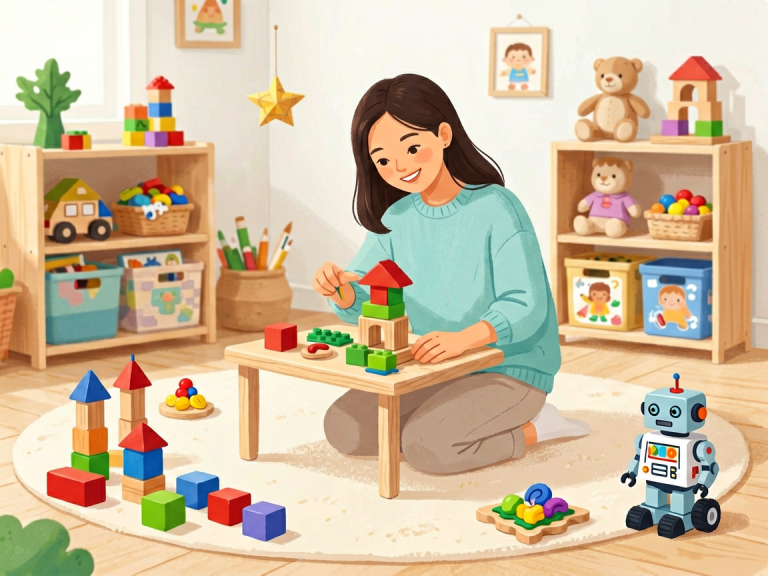
Blocks and construction toys are arguably the most versatile math toys. Simple wooden blocks teach counting, stacking, and balance. LEGO bricks, with their uniform studs, can be used to explore multiplication (e.g., a 2×4 brick has 8 studs) and fractions (how many 1×1 bricks fill a 2×4?). Magnetic tiles allow children to build 3D shapes and discover properties like edges, vertices, and faces.
Board Games and Card Games
Math board games like “Sum Swamp,” “Prime Climb,” or “Monopoly Junior” embed arithmetic into gameplay. Players must add, subtract, or multiply to advance, turning math practice into a social, competitive activity. Card games such as “War” (comparing numbers) or “24 Game” (reaching 24 using four numbers) sharpen mental calculation and strategic thinking.
Digital and Interactive Math Toys
While physical toys are invaluable, some digital tools offer unique benefits. Programmable robots like “Bee-Bot” or “Cubetto” teach sequencing and logic—both essential for mathematics. Tablet apps (when used in moderation) can provide adaptive challenges that adjust to a child’s skill level, reinforcing concepts through gamification. However, it is crucial to balance screen time with hands-on play to maintain tactile learning.
—
Choosing the Right Math Toys for Different Ages
Not all math toys are suitable for every age. Selecting developmentally appropriate options ensures that children remain challenged without becoming frustrated.
Ages 1–3: Sensory and Basic Concepts
Toddlers thrive on toys that engage their senses and introduce simple mathematical vocabulary. Look for textured number puzzles, stacking rings, nesting cups, and large sorting toys. At this stage, the goal is not mastery but exposure—allowing children to hear words like “more,” “less,” “big,” and “small” in context. Avoid toys with small parts that pose choking hazards.
Ages 3–5: Counting, Shapes, and Patterns
Preschoolers are ready for more structured play. Counting bears with cups, simple board games that involve dice, and pattern blocks encourage counting, matching, and sequencing. Magnetic number boards or felt sets allow them to compose and decompose numbers. At this age, cooperative games are better than competitive ones to reduce anxiety.
Ages 5–7: Beginning Operations and Logic
Kindergarten and first-grade children can handle addition and subtraction. Toys like the “MathLink Cubes” or “Numberblocks” sets help visualize operations. Simple balance scales introduce the concept of equality. Logic puzzles, “Rush Hour Jr.,” and basic tangrams develop spatial reasoning. Card games that require adding two dice totals are also excellent.
Ages 7–10: Fractions, Multiplication, and Strategy
Older elementary students can engage with more complex toys. Fraction circles, geoboards, and multiplication bingo games reinforce school concepts. Strategic board games like “Chess” or “Blokus” demand planning and pattern recognition. Math-themed escape room kits (with puzzles to solve) combine collaboration with problem-solving. At this stage, toys that encourage independent exploration and self-correction are particularly valuable.
—
The Hidden Benefits Beyond Numbers
While the primary goal of educational math toys is to teach mathematics, their benefits ripple far beyond the subject itself. These toys cultivate a range of transferable skills that are essential for academic and life success.
Problem-Solving and Critical Thinking
Most math toys require a child to plan, test hypotheses, and revise strategies. For example, figuring out how to fit a set of tangram pieces into a square demands logical reasoning and persistence. When a child fails, they learn to try a different approach—a core component of critical thinking.
Fine Motor Skills and Hand-Eye Coordination
Manipulating small pieces, stacking blocks, and inserting pegs strengthen the small muscles in hands and fingers. This is crucial for writing, drawing, and everyday tasks like tying shoelaces. Moreover, the precise movements required for assembling geometry sets improve coordination.
Patience and Resilience
Mathematics can be frustrating. A child who spends ten minutes trying to balance a set of blocks learns that success often follows multiple attempts. Educational math toys provide a safe space to experience failure and recover, building emotional resilience that will serve them well in school and beyond.
Language Development
As children play, they naturally describe what they are doing: “I need two more blue blocks,” “This triangle goes here,” “My tower is taller than yours.” This verbalization expands their vocabulary and introduces mathematical language in a natural context. Parents and caregivers can enhance this by asking open-ended questions like, “How many do you think will fit?” or “What shape comes next?”
Social Skills
Many math toys are designed for group play. Board games teach turn-taking, fair play, and how to handle winning or losing graciously. Collaborative building projects encourage communication and teamwork. These social interactions are just as important as the mathematical content.
—
Conclusion
Educational math toys for kids are far more than simple amusements; they are the building blocks of a mathematical mindset. By turning abstract concepts into concrete, enjoyable experiences, these toys ignite curiosity, build confidence, and develop skills that transcend the classroom. From the toddler who learns “one, two, three” with a counting bear to the 10-year-old who strategizes through a complex board game, every child can benefit from the thoughtful integration of play and learning. As parents and educators, our role is not to force numbers upon children but to provide them with the tools—colorful, tactile, and engaging—that allow mathematical understanding to grow naturally. In a world that increasingly values computational thinking, investing in quality math toys is an investment in a child’s future. So, the next time you see a child deeply absorbed in building a block tower or solving a puzzle, remember: they are not just playing. They are becoming mathematicians.