Nurturing the Tiny Scientist: The Best Toys for 2‑Year‑Olds Who Love Science
Introduction
At two years old, a child’s brain is a sponge, soaking up every cause‑and‑effect relationship, every texture, every sound. The toddler who repeatedly drops a spoon from the high chair is not being mischievous—she is conducting a physics experiment. The one who stares at the bubbles in the bath, poking them with a chubby finger, is exploring surface tension and air pressure. For parents and caregivers who notice this budding curiosity, finding the “best toys for 2‑year‑olds who like science” can feel both exciting and overwhelming. The market is flooded with flashy, battery‑powered gadgets, but true scientific learning at this age comes from open‑ended, sensory‑rich, and physically engaging materials. This article dives deep into carefully selected categories of toys that ignite a passion for discovery while respecting the developmental abilities of a two‑year‑old. Each section explains not only what to buy but *why* it works—because the best scientific toy is one that transforms a simple play session into a mini‑laboratory of wonder.
1. Sensory Exploration Kits: The Foundation of Observation
Science begins with the senses. For a two‑year‑old, understanding the world means touching, tasting (safely), smelling, hearing, and seeing. Sensory exploration kits designed for this age group provide controlled, safe opportunities to investigate properties like weight, temperature, texture, and sound.
1.1 Why Sensory Play Equals Scientific Thinking
When a toddler squeezes a squishy ball, compares a smooth rock to a bumpy pinecone, or listens to the rattle of beans inside a sealed container, she is forming hypotheses: “What happens if I press harder?” “Will this one roll?” These are the earliest forms of the scientific method—predict, test, observe, conclude. The best sensory toys for two‑year‑olds are those that invite repeated manipulation without predetermined outcomes. Examples include:
- Water and sand tables with scoops, funnels, and cups. Pouring water from a large cup into a small cup teaches volume and conservation—concepts that will later become formal physics.
- Texture boards or treasure baskets filled with natural objects (large pinecones, smooth stones, fabric swatches, wooden rings). Rotating these items keeps curiosity alive.
- Bubble kits with wands of different shapes. A two‑year‑old will quickly notice that a star‑shaped wand still produces round bubbles—a delightful early lesson in surface tension.
1.2 Top Picks for Sensory Science Toys
- *Melissa & Doug See & Spell Wooden Sensory Board*: While primarily a literacy toy, its textured letters and raised pegs offer tactile input; you can also hide small objects under cups to create a “mystery feel” game.
- *Learning Resources Jumbo Tweezers and Sorting Bowls*: Yes, a two‑year‑old can use large tweezers under supervision. Transferring pom‑poms or water beads (with close adult supervision for choking safety) teaches fine motor control and introduces the concept of “tools for observation.”
- *Boon Building Bath Pipes*: These colorful, interlocking pipes attach to bathtub walls. Water flows through them, and toddlers observe gravity, water pressure, and trajectory. It’s open‑ended fluid dynamics for little hands.
2. Cause‑and‑Effect Toys: The Cornerstone of Hypothesis Testing
No concept is more central to early science than cause and effect. When a two‑year‑old pushes a button and a light flashes, or knocks down a block tower and hears a crash, he learns that his actions produce specific results. The best toys in this category offer multiple, predictable effects that encourage repetition and variation—exactly what a budding scientist needs.
2.1 The Science of “What Happens If…?”
A two‑year‑old’s brain is wired to test variables. Toys that allow him to change one element at a time (e.g., using a different force, a different angle, a different object) help him build mental models. Avoid toys that only do one thing when one button is pressed; they teach a single connection. Instead, look for toys with multiple inputs and outputs.
2.2 Top Picks for Cause‑and‑Effect Exploration
- *Fisher‑Price Laugh & Learn Smart Stages Puppy*: This classic plush toy reacts to squeezing, tapping, and pulling. The app‑like learning system offers different phrases and songs depending on the action, subtly teaching that different actions yield different responses.
- *Hape Pound & Tap Bench with Xylophone*: When the toddler hammers a wooden peg, it strikes a musical note below. This combines auditory feedback, physical force, and visual alignment—a simple but profound lesson in mechanical energy transfer.
- *Ramps and ball tracks* (e.g., *Quercetti Klickity* or *Kid O Car Ramp*): A two‑year‑old can place a ball at the top and watch it roll down. More advanced sets have multiple lanes or obstacles. Rolling a ball repeatedly, changing the starting position or the ball’s weight (use a small wooden ball vs. a larger plastic one), teaches speed, momentum, and the effect of height on motion.
3. Simple Building and Construction Sets: The Birth of Engineering
Engineering is applied science, and two‑year‑olds are natural engineers. They stack blocks, fit rings on a post, and connect large Duplo bricks. The best construction toys for this age are large, safe, and allow for open‑ended creativity while also encouraging structural thinking.
3.1 Structural Understanding Through Play
When a toddler builds a tower and it topples, she experiences structural failure. She then modifies her design—placing a larger block at the base, or aligning edges more carefully. This is iterative design, the heart of engineering. Toys that encourage this process without frustration (i.e., pieces that are easy to connect and pull apart) are ideal.
3.2 Top Picks for Constructive Scientific Play
- *Mega Bloks First Builders Big Building Bag*: These extra‑large blocks fit together easily. Use them to build a “bridge” and drive a toy car under it, or a “ramp” by stacking blocks at a slant. Talk about why the car rolls faster on a steeper slope.
- *Magnetic tiles* (e.g., *Magnatiles Clear Colors 100‑Piece Set*): Magnetic building tiles are a science teacher’s dream. Two‑year‑olds can connect them with minimal frustration. They observe how magnets attract and repel; they build 3D structures that demonstrate stability; they shine a flashlight through translucent tiles to explore light and color mixing.
- *Fat Brain Toys Squigz*: These colorful, suction‑cupped silicone shapes stick to any smooth surface—windows, tables, bathtub walls. Pulling them apart requires force, teaching tension and adhesion. Kids experiment with how many can be linked before the suction gives way.
4. Nature and Observation Toys: Bringing the Outdoors Inside
A love of science often begins outdoors—watching ants march in a line, noticing the moon’s shape change, or feeling the wind on a kite. For two‑year‑olds, nature observation toys should be safe, simple, and not reliant on fragile instruments.
4.1 The Observation Toolkit
A real scientist uses tools to see more closely. For a toddler, this might mean a safe magnifying glass, a pair of plastic tweezers, or a bug viewer. The goal is to extend the senses without overwhelming them. Also consider toys that mimic natural phenomena, like a rainmaker tube or a kaleidoscope.
4.2 Top Picks for Nature‑Inspired Science
- *Educational Insights GeoSafari Jr. My First Microscope*: This is a true working microscope designed for 2‑plus. It has a large, sturdy base, low magnification, and a stage for flat specimens (leaves, fabric). The LED light illuminates the subject. Toddlers can peer at a leaf’s veins or their own fingerprint—an astonishing lesson in detail.
- *Butterfly garden or live insect kit* (with parental setup): While two‑year‑olds may not be patient enough to wait for metamorphosis, they can observe caterpillars eating leaves through the mesh habitat. Under supervision, they can watch a chrysalis form—a perfect real‑world biology lesson.
- *Lakeshore Learning Nature View Tubes*: These clear, sealed tubes let kids collect and observe natural treasures like a feather, a shell, or a small rock. The magnifying end allows close inspection. Rotating the tube shifts the items, teaching about movement and gravity.
5. Motion and Magnetism Toys: Invisible Forces Made Tangible
Two‑year‑olds are fascinated by things that move on their own or stick together without glue. Magnetism and gravity are “magic” until they become science. The best toys in this category make invisible forces visible and predictable.
5.1 Why Magnetic and Motion Toys Work
Magnetic toys offer a clear cause‑and‑effect that feels like magic: two pieces jump together or repel each other. A three‑ring ramps set shows a ball appearing from nowhere, then rolling away. These toys fuel questions: “Why does it stick?” “Where did the ball go?” The answers build intuitive knowledge of forces.
5.2 Top Picks for Force‑Based Play
- *Hape Early Explorer Magnetic Maze*: A wand beneath the board moves a magnetic pen across a maze of colored beads. The toddler must guide the beads through tunnels and past obstacles. This strengthens hand‑eye coordination and introduces the concept of magnetic attraction through direct manipulation.
- *Marble runs* with large, hollow tubes (e.g., *Hape Quadrilla*): While traditional marble runs are for older children, Hape’s large‑scale wooden blocks with smooth tracks allow two‑year‑olds to drop a marble at the top and watch it zigzag down. The sound of the marble hitting each level reinforces cause and effect.
- *B. toys – Whirly Wheel*: A simple, colorful plastic wheel on a base that spins when you push it. The toddler can spin it fast or slow, watch the patterns blur, and even try to stop it. This is a physics lesson in rotational inertia and friction.
6. Water and Fluid Dynamics Toys: Liquid Experiments Without the Mess (Usually)
Water play is arguably the richest scientific environment for a two‑year‑old. Pouring, squeezing, floating, sinking—these are experiments in density, displacement, and flow. The best water toys are those that allow for controlled mess and offer multiple variables.
6.1 The Nature of Water Science
A two‑year‑old learns that a sponge holds water and then releases it when squeezed. A plastic duck floats, while a stone sinks. A funnel allows water to pour into a narrow opening. These are elementary physics and chemistry lessons. The key is to provide tools that let the child vary one parameter at a time.
6.2 Top Picks for Water‑Based Scientific Play
- *Green Toys Submarine and Boat Set*: Made from recycled milk jugs, this set includes a submarine with a diver that moves up and down when filled with water. Toddlers can experiment with how much water makes the submarine sink or float.
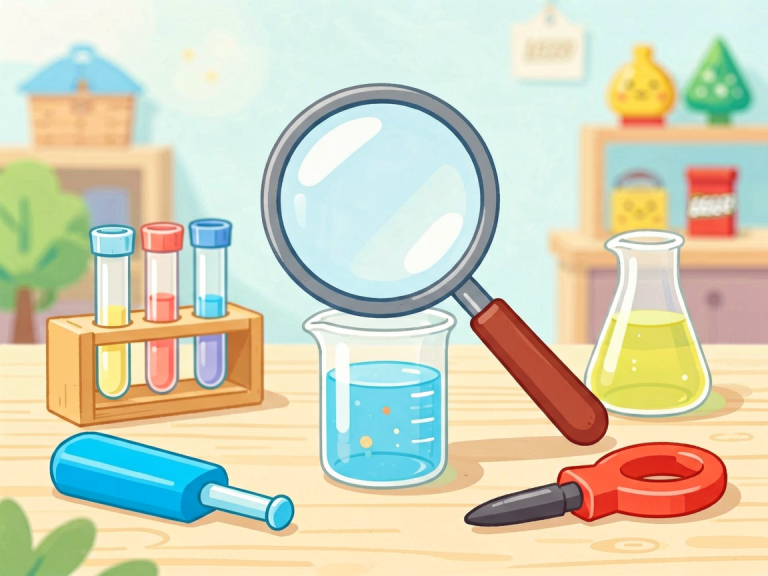
- *Learning Resources Primary Science Lab Set*: Includes large, safety‑tested test tubes, a stand, scoops, and a magnifying glass. Fill the tubes with colored water, let the toddler pour from one to another, and talk about “full,” “empty,” and “half.”
- *Nuby Float and Play Bubbles Bath Toy*: A set of floating, spinning water wheels that attach to the bathtub wall. When you pour water onto the wheel, it rotates and sprays droplets. This teaches the transformation of potential energy (water height) into kinetic energy (wheel spin).
7. Books and Puzzles That Frame Scientific Thinking
While not traditional “toys,” high‑quality board books and simple puzzles can reinforce a scientific mindset. Look for books that use real photographs, ask questions, or introduce simple concepts like growth, seasons, or animal habitats. Puzzles that show a life cycle or the inside of an apple are perfect.
7.1 How Reading Nurtures Scientific Curiosity
A book about a caterpillar becoming a butterfly gives language to the observations a toddler might make outside. A puzzle that shows the layers of the Earth (simplified) introduces the idea that things are not always what they seem on the surface. These materials support the hands‑on play described above.
7.2 Top Picks for Science‑Themed Books and Puzzles
- *“I Am a Little Scientist” board book series* (by Mandy Archer): Simple, sturdy books about a child exploring the world—magnetism, light, water.
- *Melissa & Doug Jumbo Blocks Puzzle – Farm Animals*: Large puzzle pieces that fit into a board; the pieces show a cow, pig, etc. Talk about what each animal eats or where it lives.
- *Crocodile Creek 12‑Piece Lifecycle Puzzle – Butterfly*: A floor puzzle showing the egg, caterpillar, chrysalis, and butterfly. The pieces are large and easy for tiny hands.
Conclusion
Choosing the best toys for two‑year‑olds who like science is not about buying expensive lab coats or microscopes. It is about selecting materials that invite exploration, reward curiosity, and allow for endless repetition. A two‑year‑old’s science lab is his kitchen floor, his sandbox, his bathtub. The toys we give him are simply tools that focus and enrich that natural experiment. From sensory bins that teach observation to magnetic blocks that reveal invisible forces, each toy on this list has been chosen to support developmental milestones while kindling a lifelong love of discovery. Remember: the most powerful scientific tool you can give a toddler is your attention and your willingness to say, “I wonder what will happen if we try this?” With the right toys—and the right mindset—you are not just buying playthings. You are raising a little scientist who will one day ask big questions about the universe.