The Best Toys for Newborns: A Comprehensive Guide for New Parents
—
Introduction
Welcoming a newborn into the world is a profound joy, but it also brings countless questions, especially for first-time parents. Among the most common queries is: “What toys are best for my newborn?” The market is flooded with brightly colored, technologically advanced, or heavily marketed infant products, making it easy to feel overwhelmed. However, the right toys for a newborn are surprisingly simple. At this stage, a baby’s brain is developing at an astonishing rate, forming neural connections based on sensory experiences. Toys are not just about keeping the baby entertained—they are tools that support visual, auditory, tactile, and motor development. Yet, safety is the foremost priority. This article will guide you through the developmental needs of newborns, the criteria for choosing suitable toys, the most beneficial types, and the toys you should avoid, ensuring you make informed decisions that foster healthy growth.
—
Understanding Newborn Development (0–3 Months)
Before selecting any toy, it is crucial to understand what a newborn can perceive and do. During the first three months, a baby’s vision is blurry and limited to a range of about 8–12 inches—roughly the distance to a caregiver’s face during feeding. High-contrast patterns, especially black and white, captivate their attention because their color vision is still immature. Newborns also have an acute sense of hearing; they are soothed by soft, rhythmic sounds and may startle at loud noises. Their sense of touch is highly developed, making textured objects comforting. Gross motor skills are minimal: newborns can wave their arms and kick their legs, but they cannot grasp objects intentionally until around 3–4 months. They also have a strong rooting reflex and enjoy mouthing objects, which is a natural way to explore. Understanding these limitations helps parents choose toys that align with the baby’s capabilities rather than overstimulating them. For example, a complex electronic toy with flashing lights may cause distress rather than delight. Simplicity, contrast, and gentle stimulation are the keys.
—
Key Criteria for Choosing Newborn Toys
When evaluating toys for a newborn, safety and developmental appropriateness are non-negotiable. The following criteria should guide every purchase:
- Safety first: The toy must be free of small parts that could pose a choking hazard. Avoid any detachable pieces, long strings, or ribbons (longer than 7 inches) that could wrap around the baby’s neck. All materials should be non-toxic, BPA-free, and phthalate-free since newborns often mouth toys.
- Ease of cleaning: Newborns drool, spit up, and explore with their mouths, so toys should be machine washable or easily wiped down with a mild cleaner.
- Sensory richness: Look for toys that engage one or more senses—high-contrast visuals, gentle sounds, varied textures, or soft scents (from natural fibers, not added fragrances).
- Age-appropriate complexity: The toy should not require fine motor skills the baby doesn’t yet have. For instance, a rattle should be lightweight and easy to hold (or to be held by an adult and shaken near the baby).
- Durability: Newborns are not yet rough, but toys may be subjected to repeated washing or chewing. Quality materials ensure longevity.
By keeping these criteria in mind, parents can quickly filter out inappropriate products and focus on items that genuinely benefit their baby.
—
Top Recommended Toy Types for Newborns
High-Contrast Visual Stimulation Toys
The most effective visual toys for newborns are those with bold, high-contrast patterns—black and white, or strong primary colors later on, but black-and-white is best in the first month. These can include:
- Black-and-white flashcards or accordion books: Simple geometric shapes (circles, stripes, checkerboards) arranged in a foldable book. Place them about 8–12 inches from the baby’s face during tummy time or while the baby is lying on their back. Study after study shows that these patterns enhance visual tracking and focus.
- High-contrast fabric blocks or soft cubes: Some have crinkly paper inside (adding an auditory element) or small mirrors (for self-recognition later). Ensure the material is soft and machine-washable.
- Contrast ceiling mobiles: A mobile with black-and-white shapes hanging over the crib can provide visual entertainment and help with eye coordination. Keep it at a safe distance (at least 12 inches) and remove once the baby can push up or grasp, around 4–5 months.
Auditory & Musical Toys
Newborns are comforted by familiar sounds, especially a parent’s voice. But gentle toys that produce soft, non-startling noises are also beneficial for auditory development.
- Soft rattles: Choose rattles made of fabric or silicone that make a gentle chime, not a harsh clank. A rattle that can be attached to a sock or wristband is ideal because a baby who hasn’t yet coordinated their hands may accidentally hit their own limb and trigger the sound, encouraging self-discovery.
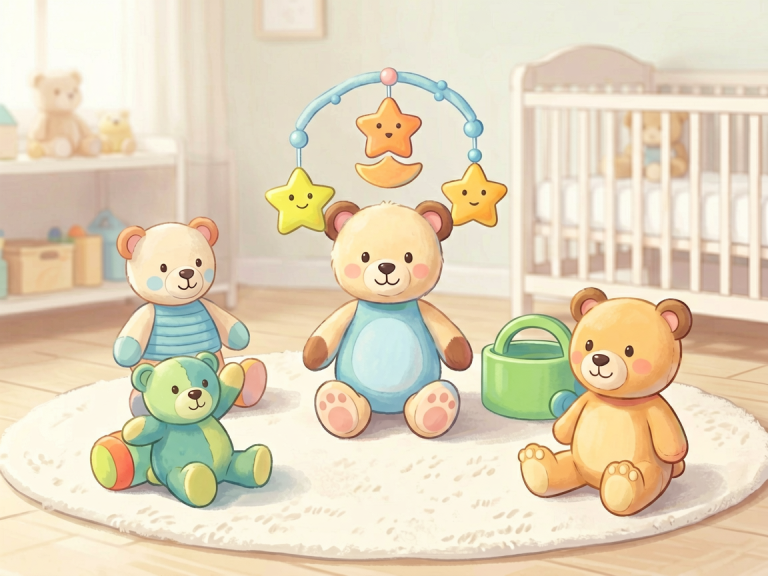
- Crib-safe music boxes: Wind-up or battery-operated music boxes that play a lullaby at a low volume help soothe a baby to sleep. Avoid musical toys with flashing lights, as visual stimulation can interfere with sleep.
- Crinkle toys: Soft fabric squares or stuffed animals with a crinkly inner layer produce a rustling sound when squeezed. They are lightweight and easy for a caregiver to manipulate near the baby’s ears (not too close).
Textured & Sensory Toys
The sense of touch is a primary learning channel for newborns. Providing a variety of surfaces—smooth, rough, bumpy, fuzzy—helps their developing brain categorize tactile information.
- Soft books with different textures: Cloth books often have tags, fur, satin, and corduroy patches. They are safe for mouthing and can be propped up during tummy time.
- Sensory balls or soft rattles with nubs: Ball-shaped toys with soft rubber bumps are easy for a tiny hand to grip (though the baby won’t actively hold for long). Caregivers can roll them over the baby’s arms and legs to provide gentle tactile input.
- Comfort blankets (lovies) with satin edging: A small, lightweight blanket made of a silky-soft material (like mimosa satin) can become a source of comfort when placed near the baby’s cheek during naps. Ensure it is small enough to avoid suffocation risks—generally, a 12-inch square is recommended, and the baby should always be supervised.
Activity Gyms & Play Mats
Play gyms are not just for tummy time; they provide a contained, safe space for visual and motor exploration. For newborns, the overhead toys should be simple and adjustable.
- Low-hanging, high-contrast toys: Many play gyms come with attachable toys that dangle. Look for ones that include a mirror, a soft rattle, and a crinkle element. The toys should be sturdy and securely attached.
- Play mats with built-in sensory features: Some mats have a water-filled area for gentle splashing or a musical piano that the baby can activate with kicks. However, for the first two months, these features may be too stimulating; choose a mat that is soft, padded, and easy to clean. Place the baby on their stomach for short periods (2–3 minutes per session) to strengthen neck and shoulder muscles while they gaze at the hanging toys.
Unbreakable Mirrors
Newborns are fascinated by faces, including their own. A baby-safe, unbreakable mirror made of acrylic (not glass) can be placed in the crib or on the floor during tummy time. Look for mirrors with rounded edges and a sturdy frame. They support visual development and early self-awareness, although babies won’t actually recognize themselves until around 18 months. Still, the reflection is engaging and encourages gazing.
Gentle Teethers (for the Older Newborn)
Though teeth typically appear around 6 months, some babies start teething as early as 3 months. Keep a couple of soft, chilled teethers on hand. Choose silicone or natural rubber teethers without liquid filling (to avoid leaks). The best ones for newborns are those shaped like rings or small animals that are easy to grasp. Avoid hard plastic teethers that could be too rigid.
—
Toys to Avoid for Newborns
Equally important is knowing what not to give a newborn. Some popular products can pose risks or simply be developmentally inappropriate.
- Toys with small parts or loose batteries: Anything that can fit through a toilet paper roll (approximately 1.25 inches) is a choking hazard for children under 3. Newborns may not actively grab small items, but older siblings might leave them within reach.
- Long strings, cords, or ribbons: Mobiles with long hanging cords or toys with pull-strings present strangulation risks. The American Academy of Pediatrics advises keeping any cords shorter than 7 inches.
- Electronic toys with loud sounds or flashing lights: These can overstimulate a newborn’s developing nervous system, leading to fussiness or disrupted sleep. The American Academy of Pediatrics recommends avoiding screen-based or electronic toys for children under 18 months, except for video calls. A simple rattle or music box is far superior.
- Stuffed animals with small plastic eyes or glued-on decorations: Many plush toys have features that can be pulled off and swallowed. Look for embroidered eyes and mouths instead.
- Activity centers or exersaucers: These are designed for older babies who can sit independently. Placing a newborn in a sit-in device too early puts unnecessary pressure on their spine and hips.
- Scented or aromatic toys: Added fragrances can irritate a baby’s sensitive skin or respiratory system. Stick to unscented toys made of natural materials.
—
How to Play with a Newborn
Selecting the best toys is only half the equation; how you use them matters even more. Newborns thrive on responsive, face-to-face interaction. A toy is simply a prop—the real magic happens when a caregiver engages the baby.
- Observe the baby’s cues: If the baby turns away, yawns, or fusses, they may be overstimulated. Stop the activity and provide calm, quiet time. A baby who is alert and looking at you is ready to play.
- Tummy time with toys: Lay the baby on a play mat for short periods (2–3 minutes, multiple times a day). Place a high-contrast toy just in front of them. The effort of lifting their head strengthens neck and shoulder muscles.
- Follow the baby’s gaze: If the baby is staring at a mobile, describe it in simple words: “Look at the black and white circle. It’s spinning slowly.” This builds language connections.
- Use your voice: Shake a rattle while singing a song, then stop and wait for the baby to react. They may coo or move their arms.
- Rotate toys: Newborns can become bored with the same toys. Rotate them every few days to maintain novelty. You don’t need dozens—just three or four well-chosen items are sufficient.
—
Conclusion
The best toys for newborns are not the most expensive or technologically advanced. They are simple, safe, and deliberately chosen to support the baby’s sensory and motor development during these crucial early weeks. High-contrast visuals, soft sounds, varied textures, and mirrors offer the right amount of stimulation without overwhelming the infant. Equally important is what you avoid: choking hazards, loud electronics, and items that restrict natural movement. Remember, the newborn’s favorite “toy” is actually you—the sound of your voice, the warmth of your hands, and the expression on your face. Use toys as tools to enhance these interactions, not replace them. By following the guidelines in this article, you can create a nurturing environment that encourages your baby’s growth while giving you peace of mind. Happy playing!