Introduction
Title: The Ultimate Toy Buying Guide for Newborns: Safe, Stimulating, and Developmentally Appropriate Choices for Your Baby’s First Months
—
Welcoming a newborn into the family is a joy unlike any other, and soon after the first coos and cuddles, parents naturally start thinking about toys. But for a baby who can barely lift their head, what toys are truly beneficial? In the first three months of life, a newborn’s world revolves around sensory exploration—they are learning to focus their eyes, respond to sounds, and discover their own hands and feet. The right toys can support these early milestones, providing gentle stimulation without overwhelming the baby. However, safety is paramount: any toy given to a newborn must be free of choking hazards, made from non‑toxic materials, and designed with the baby’s fragility in mind. This guide will walk you through every aspect of choosing toys for a newborn, from understanding development to picking specific categories, so you can make informed, confident purchases.
—
Understanding Newborns’ Developmental Needs
A newborn’s brain is developing at an astonishing rate. In the first few weeks, babies see best in high‑contrast black‑and‑white patterns because their color vision is not yet mature. They also rely heavily on sound—the familiar rhythm of a heartbeat or a soft lullaby can be deeply calming. Touch is another crucial channel; gentle, varied textures help build neural connections. Furthermore, newborns are beginning to track moving objects with their eyes, and they enjoy looking at faces (real or drawn). All toys should align with these abilities: they should be visually simple yet engaging, produce soft and pleasant sounds, and offer safe, tactile surfaces. Avoid toys that require complex manipulation or have many small, detachable parts—newborns have no grasping or intentional reaching abilities yet, so toys should be designed for passive observation or gentle interaction when placed in their hands.
—
Safety First: Non‑Toxic Materials and No Small Parts
Before any aesthetic or educational consideration, safety is the non‑negotiable criterion. Newborns explore the world with their mouths, so every toy must be made from non‑toxic, BPA‑free, and phthalate‑free materials. Look for certification labels such as ASTM (American Society for Testing and Materials) or EN71 (European standard). Avoid toys with small parts that could be bitten off or that fit entirely inside a toilet paper roll (a standard choking hazard test). Buttons, beads, squeakers, and glued‑on eyes are common dangers. Also, beware of long strings or ribbons that could become tangled around a baby’s neck—any cord longer than 7 inches (about 18 cm) should be avoided. For soft toys, ensure the seams are double‑stitched and that the filling is not easily accessible. Washability is another key factor: newborns drool, spit up, and explore with their mouths, so toys should be machine‑washable or easy to wipe clean. Always inspect new toys for sharp edges or loose parts, and follow age recommendations rigorously—toys marked “3+” are never suitable for a newborn.
—
Top Toy Categories for Newborns
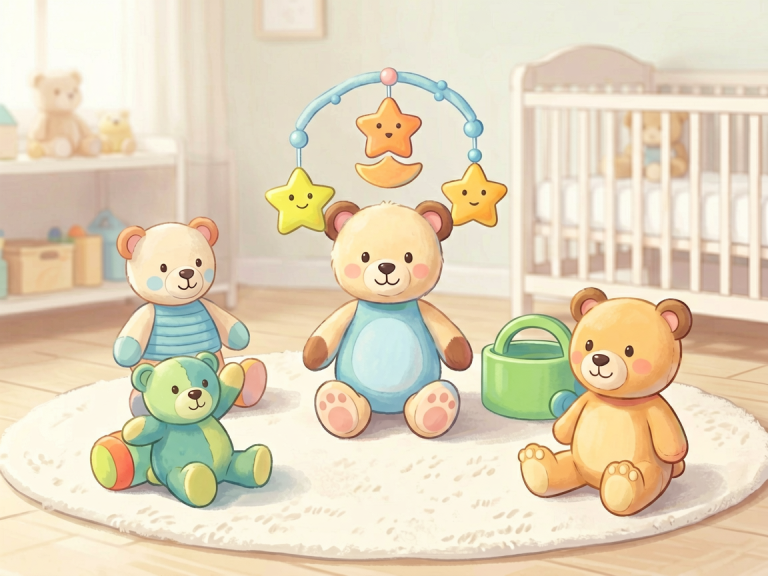
There are several proven types of toys that offer appropriate stimulation without overstimulating a newborn. High‑contrast black‑and‑white cards or books are excellent for visual development. Lay your baby on their back and hold a card about 8–12 inches from their face—they will stare intently, strengthening their eye muscles. Soft, crinkly fabric toys with different textures appeal to touch and hearing. Many of these come as small fabric squares with crinkle paper inside or attached tags. Baby gyms or activity mats with hanging toys provide a perfect environment for tummy time (supervised) and visual tracking. Choose ones with detachable toys so you can swap them out. Rattles and soft sound toys—those that produce a gentle jingle, chime, or soft rattle—help develop auditory awareness. Look for rattles with a large, easy‑to‑grasp ring or a handle that fits a tiny palm. Musical mobiles or crib soothers can be mounted on the crib (out of reach) and play lullabies while moving slowly. Sensory balls made of soft, bumpy silicone or fabric are safe for rolling and squeezing, though newborns will mainly look at them. Teething toys (like silicone rings) can also be used from around two months, but only those designed for the earliest teethers, with no small parts.
—
How to Choose the Right Colors and Patterns
Color selection is not just aesthetic—it directly affects a newborn’s ability to engage with a toy. For the first month, high‑contrast black, white, and red are most effective because a baby’s cones (color‑sensing cells) are still developing. Black‑and‑white stripes, checkerboards, spirals, and simple face patterns (like a smiley face with large features) capture attention best. Around six to eight weeks, babies begin to differentiate primary colors—red, blue, yellow—but still prefer bold, saturated hues rather than pastels. Therefore, consider toys with large, simple shapes in these colors. Avoid toys that are too busy or have tiny details, as a newborn’s visual acuity is about 20/400 at birth, so they can only see objects clearly within 8–12 inches. Soft, high‑contrast books with large images (e.g., a big red apple on a white page) are ideal. As the baby grows, slowly introduce more colors and patterns, but always keep the design uncluttered.
—
The Role of Sound in Newborn Toys
Hearing is one of the first senses to develop, and by the third trimester, a fetus can recognize their mother’s voice. After birth, newborns are soothed by repetitive, low‑frequency sounds—like a heartbeat, gentle shushing, or a soft lullaby. Musical toys for newborns should be calibrated to this preference: avoid loud, harsh, or high‑pitched noises that can startle them. Look for rattles that produce a soft tinkling or a gentle “sh‑sh‑sh” sound. Many parents also rely on white‑noise machines, but for toys, consider items that play classical music or simple melodies at a low volume. Some baby gyms come with detachable sound boxes that play Brahms’ Lullaby or nature sounds. Remember that sound‑producing toys should always be tested at home from the baby’s perspective—hold it near your own ear and assess if it is pleasantly soft. Also, be cautious with toys that have a battery compartment: ensure the screw is secure so a baby cannot access the batteries, which pose a swallowing and chemical hazard.
—
Textures and Tactile Stimulation
The sense of touch is critical for newborns, not only for comfort but also for building neural pathways. A variety of safe textures can be introduced from day one. Look for toys made of organic cotton, velvet, silk, fleece, corduroy, and even natural rubber. Many sensory toys incorporate multiple textures in one item—for example, a soft plush rabbit with a satin belly, a crinkly ear, and a knotted tail. When you place such a toy near your baby’s hands, they will instinctively grasp it (even if the grip is reflexive), giving them a new sensation. You can also use textured balls or rings during tummy time, placing them just out of reach to encourage reaching later on. Always ensure that loose fibers or “fuzz” cannot be pulled off. Wash all fabric toys before first use to remove any manufacturing residues, and check for any rough seams that could rub against delicate skin.
—
Avoiding Common Pitfalls
Many well‑intentioned gifts for newborns turn out to be unsuitable. The most common mistake is buying toys that are too advanced—busy little toys with many features, light‑up screens, or complex actions that a newborn cannot process. Overstimulation can lead to fussiness and disrupted sleep. Another pitfall is buying cheap plastic toys that may contain BPA or phthalates; always opt for reputable brands. Additionally, avoid toys that are too heavy—newborns have very weak neck muscles, and a heavy hanging toy on a baby gym could be dangerous if it falls. Do not attach toys to a crib with strings longer than a few inches, and never hang a toy directly over the baby’s face. Finally, ignore the hype around “educational” toys for newborns that claim to boost IQ. The most beneficial “toy” for a newborn is you—your face, your voice, and your gentle touch. Toys are supplements, not substitutes.
—
Conclusion
Selecting toys for a newborn is a delightful part of preparing for your baby’s arrival, but it requires thoughtful consideration of safety, development, and quality. By focusing on high‑contrast visuals, soft sounds, rich textures, and materials that are non‑toxic and washable, you can create a small collection of toys that support your baby’s emerging senses without overwhelming them. Remember that less is more: a few well‑chosen items—a black‑and‑white cloth book, a soft rattle, a safe activity mat—can provide weeks of engagement. And as your baby grows, you’ll gradually introduce more complex toys. Above all, let your newborn’s cues guide you: if a toy seems too stimulating, set it aside for a few weeks. The best toy is simply a loving parent who interacts, talks, and smiles. Happy shopping, and enjoy these precious early months of discovery together.