Choosing the First Playthings: A Comprehensive Guide on What to Look for in Toys for Newborns
The arrival of a newborn brings with it a wave of joy, wonder, and a sudden urge to fill the nursery with every adorable, colorful toy imaginable. Yet, selecting the right toys for a baby who cannot yet grasp, sit, or even focus clearly is a task that requires more thought than meets the eye. In the first few months of life, a baby’s brain is developing at an astonishing rate, forming over a million neural connections every second. The toys you choose—no matter how simple—play a subtle but significant role in shaping how your newborn experiences the world. But with countless options on the market, from plush rattles to black-and-white mobiles to electronic activity gyms, how do you separate the genuinely beneficial from the merely cute? This article provides a detailed, evidence-based exploration of what to look for in toys for newborns, covering safety, sensory development, material quality, and age-appropriateness. Each section will help you make informed decisions that support your baby’s growth while ensuring peace of mind.
Safety First: The Non-Negotiable Foundation
Before any consideration of color, texture, or educational value, safety must be the absolute priority. Newborns explore the world primarily through their mouths—a phenomenon known as oral exploration. Everything that comes within reach of their tiny hands will inevitably end up in their mouths. Therefore, the first thing to look for in any newborn toy is that it is free from small parts, sharp edges, and toxic substances.
Choking Hazard Prevention
The most critical safety rule is that all components of a toy must be larger than a newborn’s airway. According to the American Academy of Pediatrics, any toy or part of a toy that fits inside a toilet paper roll (approximately 1.25 inches in diameter) poses a potential choking hazard. For newborns, who lack the motor skills to deliberately push objects into their mouths but may accidentally bring them close, even sewn-on eyes, buttons, or bells on plush toys can become dangerous if they become detached. Look for toys where all features are embroidered, heat-sealed, or securely fastened. Avoid rattles with loose beads that could break free, and always check that the seams on stuffed animals are double-stitched.
Non-Toxic Materials
Newborns have delicate skin and immature immune systems, making them more susceptible to chemical irritants. Opt for toys made from BPA-free, phthalate-free, and lead-free materials. Natural materials such as organic cotton, untreated wood (finished with safe oils or water-based paints), and 100% food-grade silicone are excellent choices. Be cautious with brightly colored plastic toys from unknown manufacturers, as some may contain heavy metals in the paint or plasticizers that disrupt endocrine function. Look for certifications like the ASTM (American Society for Testing and Materials) label or the CE mark in Europe, which indicate that the toy meets rigorous safety standards. For textile toys, ensure they are flame-retardant without the use of harmful chemicals—sometimes “natural” flame resistance is achieved through tight weaving rather than chemical treatment.
Structural Integrity
A newborn toy should be sturdy and durable. Avoid toys that have small pieces that can be twisted off, magnets that may come loose, or parts that can be compressed into small shapes. Check that mobiles are securely attached to cribs or play gyms, with no dangling cords longer than 7 inches (to prevent strangulation). For hanging toys, use the “pinch test”: if you can pinch a part of the toy into a small enough shape to fit through a toilet paper roll, it is too small. Also, consider the weight of the toy—it should be light enough that if it accidentally falls on a baby, it will not cause injury.
Sensory Stimulation: The Building Blocks of Early Learning
In the first three months, a newborn’s senses are awakening, but they are not yet fully developed. Toys designed for this stage should provide gentle, appropriate stimulation that encourages neural development without overwhelming the baby.
Visual Stimulation: High Contrast and Simple Patterns
At birth, a baby’s vision is blurry—they can only see objects about 8 to 12 inches away, roughly the distance to a parent’s face during feeding. Their ability to distinguish colors is also limited; they perceive high-contrast patterns best, especially black and white, followed by primary colors like red and yellow. This is why black-and-white picture books, mobiles with bold geometric shapes, and stuffed toys with stark color contrasts are so popular for newborns. What to look for: toys that feature clear, bold patterns such as stripes, checkerboards, concentric circles, or faces (babies are naturally drawn to face-like patterns). Avoid overly complex or busy designs, which may cause visual confusion rather than engagement. As the baby grows toward 2–3 months, they begin to track moving objects, so a mobile that rotates slowly with high-contrast elements is ideal.
Auditory Stimulation: Gentle, Varied Sounds
Newborns startle at loud noises but are soothed by rhythmic, familiar sounds. The best auditory toys for newborns produce soft, gentle sounds—think a gentle rattle, a soft chime, or crinkly fabric. Look for rattles that are easy to grasp (even if the baby cannot yet hold them deliberately) and that produce a pleasant, not harsh, sound. Avoid toys that emit electronic noises at high volumes; instead, choose natural sound-makers like wooden rattles or bells encased in fabric. Also consider toys that mimic heartbeat sounds or white noise, which can be comforting. Importantly, the sound should be consistent and predictable—not jarring or unpredictable, as that can overstimulate a developing nervous system.
Tactile Stimulation: Variety of Textures
Touch is one of the earliest senses to develop, and newborns rely on it heavily for comfort and exploration. Look for toys that offer a range of textures: soft fleece, smooth wood, bumpy silicone, crinkly fabric, satin ribbons, and knotted teething rings. These tactile variations help the baby differentiate between surfaces and promote fine motor skills as they learn to grasp. A good example is a “sensory cube” or a “tummy time mat” with different fabric patches. However, ensure that any texture is not abrasive; a newborn’s skin is very sensitive. Also, avoid toys with loose fibers or shedding material, as those can be ingested or cause irritation.
Developmental Appropriateness: Matching the Toy to the Stage
Not all “baby toys” are suitable for newborns. Many toys labeled “0+ months” are actually designed for older infants. Understanding the developmental milestones of the first three months helps you choose toys that genuinely support growth rather than sit unused.
The First Month: Focus on Visual and Auditory Stillness
In the first four weeks, a newborn’s main activities are sleeping, eating, and being held. They cannot reach for or manipulate objects. The best toys at this stage are those that stimulate without demanding active participation. Examples: a black-and-white mobile placed above the crib (at least 12 inches away from the baby’s face), a soft music box with a slow lullaby, or a high-contrast picture card held by a parent during awake time. Look for toys that can be used during “tummy time” (which should start from day one under supervision) to encourage neck strength. A simple, unbreakable mirror (shatterproof acrylic) placed in front of the baby during tummy time helps them focus on their own reflection, which is visually engaging and supports self-awareness.
Months 2–3: Introduction of Grasping and Batting
Around six to eight weeks, babies begin to swipe at objects and may accidentally hold a rattle placed in their hand. By 3 months, they can actively grasp and shake a toy for a few seconds. What to look for: toys that are easy to grasp, with handles or rings (about 4–5 inches in circumference to fit a tiny hand). Rattles with clear, contrasty handles, soft plush rings with embedded crinkles or bells, and simple activity gyms with hanging toys at a reachable height are excellent. The hanging toys should be attached with flexible straps so the baby can bat at them without getting tangled. Avoid toys that require fine motor skills, like stacking rings or shape sorters—those come later, around 6–9 months.
Ease of Cleaning and Hygiene Maintenance
Newborns have underdeveloped immune systems, and their toys will inevitably be dropped on floors, into their mouths, and across various surfaces. The best toys for newborns are those that can be easily and thoroughly cleaned. Look for toys that are machine-washable (plush toys, fabric books) or can be wiped down with a mild soap solution (silicone teethers, plastic rattles, wooden blocks with sealed finishes). Avoid toys with crevices, holes, or porous surfaces that can trap dirt, mold, or bacteria. For example, wooden toys that are unfinished may absorb moisture and become a breeding ground for germs, so choose wood that is painted with a safe, non-toxic lacquer or oil. For plush toys, ensure they can withstand repeated machine washing without losing shape or color. Similarly, electronic toys should have sealed battery compartments and smooth surfaces that can be wiped clean.
Simplicity and Open-Ended Play Potential
One of the most surprising recommendations from child development experts is that simpler toys are often better for newborns than flashy electronic ones. An overly electronic toy with flashing lights, music, and moving parts can overstimulate a baby’s developing nervous system, leading to fussiness, disrupted sleep, or reduced attention span. In contrast, a simple rattle or a soft block encourages the baby to focus, explore, and interact at their own pace. Look for toys that have open-ended possibilities—a set of soft building blocks, for instance, can be used for grasping, teething, stacking (later), and even rolling. A simple scarf or a piece of crinkly fabric tied to a ring can provide hours of sensory exploration without the need for batteries. These toys also encourage parent-baby interaction, which is far more valuable than any electronic feature. A parent shaking a rattle, smiling, and talking to the baby creates the social engagement that is the true driver of early cognitive development.
Avoiding Overstimulation: Quality over Quantity
It is easy to accumulate a large stash of newborn toys, but research in developmental psychology suggests that less is more. When a baby is presented with too many toys at once, they can become overwhelmed and may not engage deeply with any single one. A classic study by the University of Toledo (2017) found that toddlers in a room with fewer toys played longer and more creatively than those with many options. While that study focused on older children, the principle applies to newborns: a few carefully chosen, high-quality toys are better than a cluttered play space. Rotate toys every few days to maintain novelty without overwhelming the baby. Watch for signs of overstimulation—turning away, fussing, arching the back, or frantic movements—and remove the toy if the baby seems distressed. The goal of newborn play is calm, focused exploration, not constant excitement.
Practical Examples of Ideal Newborn Toys
To put all these criteria into practice, here are specific toys that tick the boxes for safety, sensory value, and developmental appropriateness:
- High-Contrast Soft Books: Fabric books with bold black-and-white patterns, crinkly pages, and a small mirror. They are washable, safe to chew, and can be propped up during tummy time.
- Silicone Teether Rings: Made from food-grade silicone, with multiple textures (bumpy, smooth, ridged). Easy to grip, easy to clean, and free of BPA. Ideal for 2–3 months when teething begins.
- Wooden Rattle with Natural Finish: A simple wooden ring with embedded beads that produce a soft, natural sound. Ensure the beads are securely fixed and the wood is sealed with non-toxic wax.
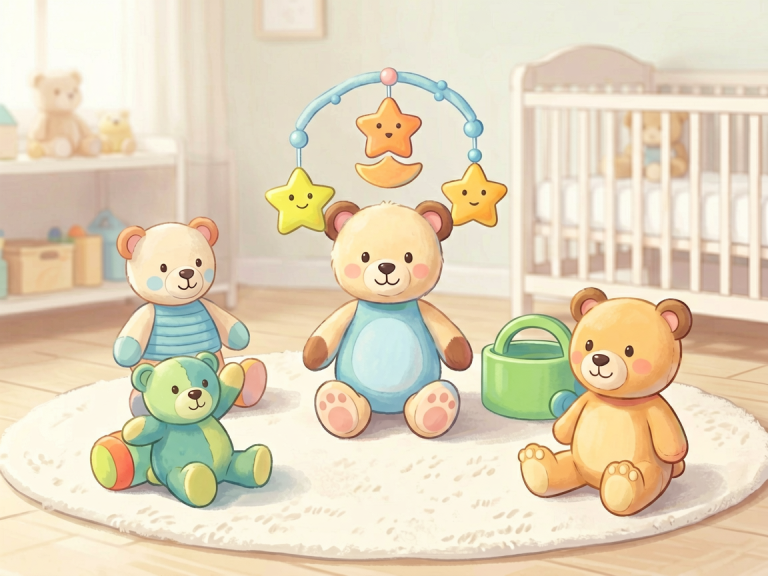
- Activity Gym with Removable Hanging Toys: A padded mat with an overhead arch that holds several high-contrast, crinkly, and rattling toys. The toys should be detachable for cleaning and repositionable. Ensure the arch is stable and the mat is thick enough for comfort.
- Unbreakable Mirror: A shatterproof acrylic mirror with a soft fabric frame. Can be placed on the floor during tummy time or attached to a crib at a safe distance. Supports visual tracking and self-awareness.
- Soft Plush “Lovey”: A small, lightweight security blanket with an animal head and soft edges. Ensure no small parts (embroidered eyes only) and that it is machine-washable. Provides comfort during sleep (though always follow safe sleep guidelines—no loose blankets until after 12 months, but a small lovey may be used under supervision).
Conclusion: Thoughtful Selection for a Precious Beginning
Choosing toys for a newborn is not about filling a room with plastic, flashing objects; it is about providing a safe, stimulating environment that respects the baby’s delicate developmental stage. The best toys are those that are simple, safe, easy to clean, and tailored to the newborn’s limited but rapidly growing abilities. By prioritizing high-contrast visuals, gentle sounds, varied textures, and opportunities for parent-child interaction, you create the foundation for a lifetime of learning and exploration. Remember that the most important “toy” for a newborn is actually a responsive caregiver—someone who talks, sings, holds, and plays with intention. Toys are merely tools that facilitate that connection. When you choose wisely, you give your newborn not just a toy, but a gateway to curiosity, comfort, and joy. So the next time you browse the baby aisle, pause, think, and choose with both your head and your heart. Your baby will thank you in coos, smiles, and the quiet wonder of early discovery.