Safe Toy Buying Tips for Newborns: A Comprehensive Guide for Parents
Bringing a newborn home is a joyous milestone, and choosing the right toys to support their development is an exciting part of early parenting. However, the market is flooded with colorful, noisy, and seemingly delightful options, and not all of them are safe for the most vulnerable members of your family. Newborns explore the world with their mouths, hands, and eyes, so every toy you introduce must meet stringent safety criteria. This guide provides evidence-based, practical tips to help you navigate toy shopping with confidence, ensuring that every plaything you select is not only engaging but also completely safe for your little one.
1. Prioritize Non-Toxic, BPA-Free Materials
Newborns have an instinctive urge to mouth everything, making material safety the single most important factor when buying toys. Always check that the toy is labeled “non-toxic,” “BPA-free,” “phthalate-free,” and “lead-free.” Plastics should be free of bisphenol A (BPA), a chemical linked to endocrine disruption, and phthalates, which are often used as softeners in PVC toys. Opt for toys made from natural materials like organic cotton, solid untreated wood (with a smooth finish and food-grade mineral oil), or 100% food-grade silicone. Avoid any toy that has a strong chemical smell, as this may indicate volatile organic compounds (VOCs). For fabric toys, look for OEKO-TEX Standard 100 certification, which guarantees the product is free from harmful substances. Remember, even a seemingly harmless teether can leach toxins if it is made from low-quality materials—choose brands that transparently publish their material safety data.
2. Avoid Small Parts, Loose Pieces, and Choking Hazards
The American Academy of Pediatrics (AAP) warns that toys for newborns must have no small parts that can fit inside a toilet paper roll—this is the common "choke test." A toy should be large enough that it cannot be swallowed or lodged in the airway. Check for eyes, noses, buttons, or any decorative elements that are glued or sewn on; they should be securely attached and not detachable with moderate pulling force. Avoid toys that contain small batteries (especially coin-cell batteries), magnets, or beads, as these can cause severe internal injuries if ingested. Even toys marketed for older infants may contain pieces that are hazardous for a newborn who is not yet sitting up. When in doubt, use a choke tube tester (available online or at pediatrician offices) or simply err on the side of caution—any removable component smaller than 1.25 inches in diameter is a red flag.
3. Check for Sharp Edges, Points, and Rough Surfaces
Newborn skin is delicate, and their movements are uncoordinated, making them prone to bumping into toys. Run your fingers along every edge, seam, and corner of the toy. It should be completely smooth with no burrs, splinters, or rough spots. For wooden toys, ensure the wood is sanded to a silky finish and that there are no cracks where splinters could break off. Plastic toys should have no sharp mold lines; manufacturers often flash-trim them, but leftover sharp edges can cause cuts. Stuffed animals should have embroidered eyes and noses instead of plastic ones, which can be pulled off and sharp. Also, avoid toys with long, pointed parts that could poke an eye or a soft spot on the skull.
4. Beware of Strings, Ribbons, and Long Cords
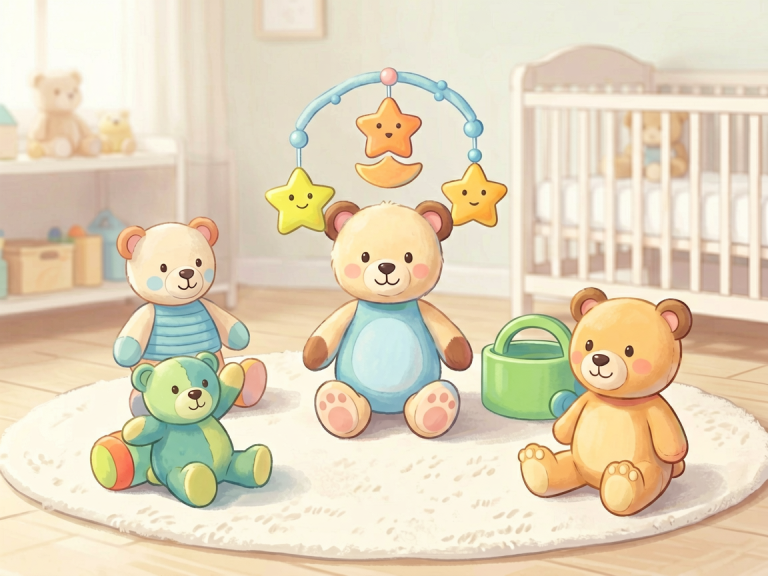
Strangulation is a silent but real risk for newborns. Any string, cord, ribbon, or loop longer than 7 inches (about the length of a standard paper clip) can become a noose if it wraps around a baby’s neck. This includes toys meant to be hung across a crib or stroller—the so-called “activity arches” and “stroller toys.” Always cut off or remove any decorative ribbons on soft toys, and never attach pacifiers or toys to a baby’s clothing with a long string. Even the elastic bands on some teether toys should be checked: they should be thick and too short to encircle a baby’s neck. Additionally, avoid toys that have loops or holes large enough for a baby’s head to pass through. For hanging mobiles, position them well out of reach (at least 12 inches above the baby’s head) and remove them once the baby begins to push up on hands and knees.
5. Select Age-Appropriate Toys with Clear Labels
Every reputable toy manufacturer includes an age recommendation on the packaging. For newborns (0–3 months), look for toys labeled “newborn,” “0+,” or “3m+.” These toys are designed with the developmental stage in mind: simple high-contrast patterns (black and white or bold primary colors), gentle sounds (rattles, crinkle paper, soft chimes), and soft textures. Avoid toys labeled “6m+” or “12m+” even if they seem safe, because they may contain parts that become detached after repeated use or require precise fine motor skills that a newborn does not have. Age labels are not just marketing—they are based on safety testing by accredited organizations like ASTM (American Society for Testing and Materials) and EN71 (European standard). Always read the label and follow the manufacturer’s warnings.
6. Ensure Easy Cleaning and Hygiene
Newborns have immature immune systems, and toys quickly become breeding grounds for bacteria, saliva, and milk residue. Choose toys that are machine washable or can be easily wiped clean with soap and water. Plush toys should have a removable and washable cover, or be made of materials that can be fully immersed in water without damaging internal components (e.g., sealed rattles inside fabric). Avoid toys with crevices, holes, or complex mechanical parts that trap moisture and mold. For electronic toys, check that the battery compartment is secured with a screw—not just a sliding latch—to prevent access to batteries, and that the toy is splash-resistant enough to be wiped down. Wash every new toy before giving it to your baby, and establish a regular cleaning routine: soft toys weekly in the washing machine (gentle cycle, hot water) and hard toys daily with a mild disinfectant or a vinegar-water solution.
7. Mind the Weight and Size of the Toy
A newborn’s muscles are undeveloped, and they cannot lift heavy objects. A toy that is too heavy can accidentally fall onto a baby’s face or chest, causing bruises, scratches, or even breathing obstruction. The general rule is that any toy placed in a crib or within a baby’s reach should be lightweight—ideally less than half a pound. Also, consider the size: a toy should be large enough not to be swallowed but small enough for a newborn to grasp (about 3–5 inches in diameter is ideal). Extremely large toys (like giant stuffed animals) can pose suffocation risk if they fall over the baby’s face, especially in the crib. For this reason, the AAP recommends keeping cribs completely free of soft toys, pillows, and blankets until at least 12 months of age; any toy placed in the crib during supervised play should be removed for sleep.
8. Avoid Loud Noises and Sensory Overstimulation
While rattles and musical toys are wonderful for auditory development, some toys produce sounds at dangerously high decibel levels that can damage a newborn’s sensitive hearing. A study published in *Pediatrics* found that some electronic toys emit sounds up to 110 dB, which is equivalent to a rock concert and can cause permanent hearing loss with prolonged exposure. Before buying, test the toy next to your ear: if it sounds uncomfortably loud to you, it is too loud for your baby. Look for toys with adjustable volume controls or those that produce soft, gentle sounds—shakers, bells, or crinkle paper are naturally low in volume. Additionally, avoid toys with flashing strobe lights or chaotic patterns, as overstimulation can cause stress, fussiness, and difficulty sleeping in newborns. Stick to simple, slow-moving mobiles and soft, contrasting colors.
9. Verify Safety Certifications and Recalls
Reputable toys will display safety certifications: look for the ASTM F963 label (for the United States), the CE mark (for Europe), or the AS/NZS ISO 8124 (for Australia/New Zealand). These indicate that the product has undergone rigorous testing for mechanical, physical, and chemical hazards. Before purchasing any toy, check the manufacturer’s website or the Consumer Product Safety Commission (CPSC) recall database to ensure the product has not been recalled due to defects, contamination, or injury reports. Be especially cautious with cheap, unbranded toys sold at discount stores or online marketplaces, as they may not meet any safety standards—stick to well-known brands that have a history of quality control and transparent safety policies.
10. Trust Your Instincts and Observe Your Baby
Finally, no certification can replace parental vigilance. After bringing a toy home, always supervise the first few times your baby interacts with it. Watch for signs of wear (loose threads, cracked plastic, fading colors) and discard any toy that becomes damaged. Each baby is unique—a toy that is safe for one may still present a risk if your baby has a tendency to roll or grasp aggressively. Observe your newborn’s reactions: if they seem overly frustrated, uninterested, or fearful of a toy, it may not be developmentally appropriate. The best toys for newborns are often the simplest: a soft scarf, a mirror, a set of wooden rings. When you shop, keep safety front and center, and remember that a well-chosen toy can spark joy and learning without compromising your baby’s well-being. By following these tips, you are building a foundation of safe, enriching play that will grow with your child.