Choosing Educational Toys for Newborns: A Guide to Stimulating Early Development
The first year of a baby’s life is a period of extraordinary growth. In just twelve months, a newborn who can barely focus on a face will learn to reach, grasp, sit, crawl, and perhaps even take those first wobbly steps. During this time, the brain forms neural connections at an astonishing rate—up to one million new connections per second. While loving interaction with caregivers is the single most important factor in healthy development, thoughtfully selected toys can enhance sensory exploration, motor skills, and cognitive understanding. However, the market is flooded with products labeled “educational,” many of which are inappropriate or even dangerous for newborns. Understanding how to choose educational toys for newborns requires knowledge of developmental milestones, safety standards, and the difference between genuine learning tools and mere distractions. This guide provides a comprehensive framework to help parents and caregivers make informed, enriching choices for their youngest learners.
—
Understanding Newborn Development: The First Year Milestones
To choose toys that are truly educational, one must first understand what a newborn is physically and cognitively capable of at each stage. Development is not linear, but general patterns help guide toy selection.
0–3 Months: The Sensory Awakening
Newborns enter the world with blurry vision—they can see best at a distance of about 8–12 inches, roughly the distance to a caregiver’s face during feeding. Their color perception is limited; high-contrast patterns like black-and-white or bold reds and yellows are most visible. They are reflexive, not intentional: they grasp objects placed in their palms (palmar reflex), startle at loud noises, and turn toward sounds. At this stage, educational toys should provide gentle auditory, visual, and tactile stimulation without overwhelming the immature nervous system.
3–6 Months: Grasping and Mouthing
Around three months, babies begin to intentionally bat at objects and attempt to grasp them. Hand-eye coordination improves, and everything goes into the mouth—this is how they explore texture, shape, and temperature. They also start to track moving objects with their eyes and may enjoy simple cause-and-effect (e.g., shaking a rattle produces sound). Toys should now be easy to hold, safe to chew, and varied in texture.
6–9 Months: Sitting and Manipulating
Once a baby can sit with support (or independently), they have more freedom to use both hands. They engage in transfer activities—picking up an object, passing it from hand to hand, and banging it. Object permanence begins to develop around 8–9 months, so peek-a-boo toys, activity boxes with doors, and simple puzzles become fascinating. Fine motor skills require toys with small (but safe) parts to manipulate.
9–12 Months: Mobility and Problem-Solving
Crawling, pulling to stand, and cruising transform the world. Babies become little scientists: they drop things repeatedly to see what happens, try to fit shapes into holes, and imitate actions. Educational toys at this stage should encourage movement (push toys, balls) and introduce basic problem-solving (stacking rings, shape sorters with large pieces).
—
Safety First: Essential Criteria for Newborn Toys
Before considering educational value, every toy must pass a rigorous safety check. Newborns have fragile immune systems, soft bones, and an irresistible urge to put everything in their mouths. The following criteria are non-negotiable:
Non-Toxic Materials
All toys should be made from BPA-free, phthalate-free, lead-free materials. Look for certifications like ASTM (American Society for Testing and Materials) or CE (Conformité Européenne) markings. For teethers and soft toys, 100% food-grade silicone or organic, unbleached cotton are excellent choices. Avoid toys with strong chemical smells or painted surfaces that can flake off.
No Small or Detachable Parts
Anything small enough to fit inside a toilet paper tube (approximately 1.25 inches in diameter) is a choking hazard. Buttons, eyes on stuffed animals, loose beads, and small magnets are extremely dangerous. Even toys labeled for “3+ months” may have parts that break off after repeated chewing. Always pull, twist, and shake a toy before giving it to a newborn.
Safe Construction and Durability
Edges should be smooth, and seams on fabric toys should be double-stitched to prevent stuffing from coming out. Battery compartments must be secured with screws so a baby cannot access them. Avoid toys with long strings or cords longer than 12 inches, as these pose strangulation risks, especially on crib mobiles or pull toys.
Easy to Clean
Newborns’ immune systems are still developing, and toys quickly become coated in saliva, drool, and food. Washable, wipeable surfaces are essential. Wooden toys should be unfinished or sealed with a non-toxic wax; fabric toys should be machine-washable; silicone toys can be boiled or placed in the dishwasher.
—
Key Features of Educational Toys for Newborns
True educational toys for newborns are not about teaching ABCs or numbers—that comes much later. Instead, they provide sensory stimulation, motor practice, and cognitive challenges appropriate for the baby’s current abilities. Look for these features:
High-Contrast Visuals
During the first three months, black-and-white patterns (stripes, checkerboards, faces) attract attention and help develop visual pathways. Cards, mobiles, or soft books with high contrast are excellent. After three months, introduce primary colors and simple patterns.
Varied Textures
Tactile exploration is a primary way babies learn. Toys with multiple textures—smooth, bumpy, ridged, furry, crinkly—stimulate nerve endings in the hands and mouth. A fabric book with different swatches or a silicone teether with raised bumps is both soothing and educational.
Auditory Features
Gentle sounds—rattles, bells, crinkle paper, soft squeakers—teach cause and effect. However, avoid overly loud toys; newborns have sensitive hearing, and toys exceeding 85 decibels can damage hearing. A gentle chime or a whisper-quiet rattle is ideal.
Mirrors
Babies are fascinated by faces, including their own. Unbreakable, safe mirrors help develop self-awareness and encourage visual tracking. Place a mirror on a play mat or in a soft book.
Moveable Parts
Toys that spin, slide, toggle, or click encourage fine motor coordination. For a 6-month-old, a busy board with a rotating gear, a sliding bead, and a push-button is engaging. Just ensure all parts are securely attached.
Simple Cause-and-Effect
A ball that lights up when rolled, a pop-up toy that springs when a button is pressed, or a music box that activates when a handle is turned—these demonstrate that a baby’s actions have predictable outcomes, laying the foundation for logical thinking.
—
Types of Educational Toys for Each Stage
Matching the toy type to the stage prevents frustration and maximizes learning.
0–3 Months: Foundation of Sensory Input
- Black-and-white contrast cards or soft books: Place them near the baby’s face during tummy time or in the crib rail.
- Unbreakable mirror: Attach to the side of a play mat.
- Crinkle or soft fabric toys: Lightweight and easy to grasp (or hold for the baby).
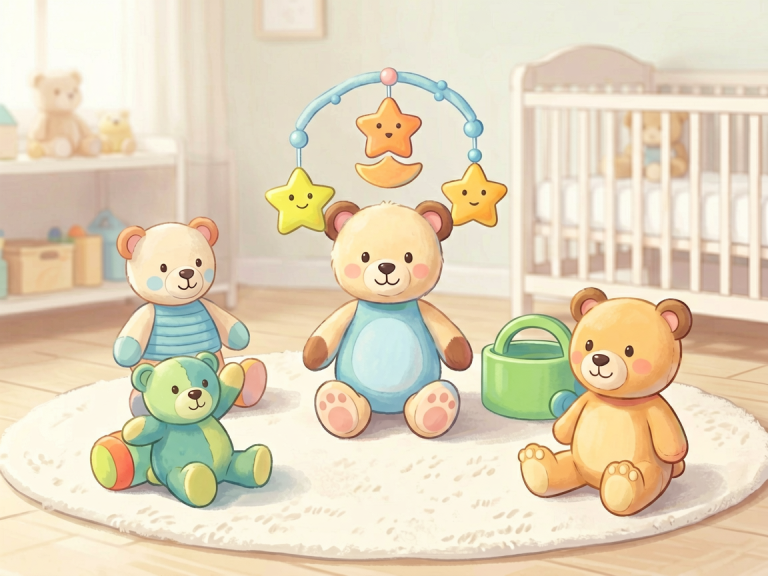
- Gentle mobile: With black-and-white patterns, place 12–14 inches above the baby in the crib (remove once the baby can sit up).
- Rattle: A wooden or silicone ring with a gentle jingle. Baby won’t shake it intentionally yet, but the sound when you shake it attracts attention.
3–6 Months: Grasping and Exploring
- Teething toys: Silicone rings with varied textures, or cooled teethers for gum relief.
- Activity gym or play mat: With hanging toys that baby can bat at and later grab. Look for detachable toys for focused play.
- Soft balls: Cloth or silicone balls that are easy to grip (around 4 inches in diameter).
- Baby-safe rattles with handles: The baby will start to hold and shake them intentionally.
- Sensory balls: With bumps, ridges, and different surfaces.
6–9 Months: Fine Motor and Object Permanence
- Stacking rings: A classic; baby will first mouth them, then learn to knock them down, and eventually stack (later than 9 months often).
- Activity cube or busy box: With doors, knobs, sliding pieces, and a mirror. Early problem-solving.
- Cause-and-effect toys: A pop-up toy with large buttons, or a simple shape sorter with one large shape.
- Soft blocks: Fabric or foam blocks that can be stacked and knocked over.
- Push-and-pull toys: For babies who are starting to crawl; a small car that moves when pushed helps spatial understanding.
9–12 Months: Motion and Problem-Solving
- Shape sorters: With large, chunky shapes and a container.
- Stacking cups: Nesting cups teach size relationships and can be used in bath play.
- Push walker: Sturdy, stable walkers without wheels that are too fast. These strengthen leg muscles and provide balance practice.
- Simple puzzles: Peg puzzles with large knobs and just one or two pieces.
- Balls of various sizes: To roll, chase, and throw. A ball that makes a sound when moved adds interest.
—
How to Observe and Adapt to Your Baby’s Cues
No matter how perfectly a toy matches a developmental stage, it is only educational if the baby is engaged and not overwhelmed. The most important skill for a parent is observation. Watch for signs of interest: a baby who stares intently, reaches, smiles, or coos is learning. Signs of overstimulation include turning away, crying, arching the back, or becoming frantic. When these appear, remove the toy and offer something calming, like a soft blanket or a quiet cuddle.
Also, remember that less is more. Newborns do not need dozens of toys. A few well-chosen items that can be rotated every few days are far more effective than a cluttered play area. Babies learn through repetition; a toy that seems “boring” to an adult is often providing essential practice for a developing skill. For example, a baby who repeatedly drops a spoon from the high chair is not being naughty—she is conducting a physics experiment about gravity and cause and effect.
Adapt the toy based on your baby’s unique preferences. Some babies are visual learners and love mobiles; others are tactile and prefer textured teethers. Follow your baby’s lead, and do not force play. Sometimes the best “educational toy” is a cardboard box, a wooden spoon, or a simple scarf—things that invite creative exploration without predetermined outcomes.
—
Tips for Maximizing Learning Through Play
Toys are tools; the real magic happens in the interaction between baby and caregiver. Here are practical ways to enhance the educational value of any toy:
Narrate the Play
Talk about what you are doing. “Look, this rattle makes a sound! Shake, shake, shake. Now you try!” This builds language skills and helps the baby connect words to actions.
Take Turns
Even with a three-month-old, you can model turn-taking. You shake the rattle, then pause and wait for the baby to respond with a coo or a movement. This teaches the foundations of conversation.
Position Toys for Tummy Time
Place interesting toys just out of reach during tummy time to encourage head lifting and reaching. This strengthens neck, back, and shoulder muscles essential for crawling.
Follow the Baby’s Gaze
When your baby looks at a toy, name it and describe it. “You see the red ring. It’s smooth and round.” This focused attention helps the baby learn to attend to specific objects.
Avoid Over-Prompting
Resist the urge to constantly demonstrate how a toy “should” be used. A baby who is allowed to mouth a stacking ring instead of stacking it is still learning about texture and taste. Intervene only if the baby is frustrated or using the toy unsafely.
Rotate Toys Weekly
Put some toys away and bring out a few others. Novelty sparks curiosity. This also prevents the baby from becoming bored with the same stimuli.
—
Conclusion
Choosing educational toys for newborns is not about buying the most expensive or technologically advanced products. It is about understanding the delicate, rapid development occurring in each month of the first year and selecting safe, simple, and engaging tools that support that growth. From high-contrast cards that awaken vision to stacking cups that teach size and order, every toy has the potential to be a tiny classroom—provided it meets safety standards and aligns with the child’s current abilities. Yet the most crucial element remains the loving, attentive presence of a caregiver who uses toys as bridges for interaction, language, and joy. When you combine a carefully chosen toy with your voice, your smile, and your patience, you create an environment where a newborn can discover the world one rattle, one texture, one laugh at a time. By keeping the principles of safety, developmental appropriateness, and responsive interaction at the forefront, you will not only select educational toys—you will nurture a lifelong love of learning.