Beyond the Screen: The Enduring Power of Screen-Free Building Toys for Kids
In an age dominated by glowing screens, streaming videos, and interactive apps, the humble building toy might seem like a relic of a bygone era. Yet, as parents, educators, and child development experts grow increasingly concerned about the effects of excessive screen time on young minds, a quiet revolution is taking place. The demand for screen-free building toys for kids is surging—not as a nostalgic retreat, but as a forward-looking, empirically supported choice for nurturing creativity, problem-solving skills, and emotional resilience. This article explores why these tangible, hands-on playthings remain indispensable, what types are available, and how they shape the architects of tomorrow—all without a single pixel.
The Screen Dilemma and the Case for Tangible Play
Children today spend an average of five to seven hours per day in front of screens, according to the American Academy of Pediatrics. While some digital content can be educational, the passive nature of most screen-based activities often undermines the active, exploratory learning that builds neural connections. Screen-free building toys offer a radical alternative: they demand physical manipulation, spatial reasoning, trial and error, and sustained focus. Unlike a tablet game that provides instant feedback and guidance, a pile of wooden blocks or a set of magnetic tiles presents an open-ended challenge. The child must decide what to build, how to make it stable, and how to recover when it collapses. This process is not only more engaging but also more neurologically enriching.
Research in developmental psychology shows that hands-on construction activities activate multiple brain regions simultaneously—the visual cortex, the motor cortex, and the prefrontal cortex responsible for planning and executive function. Moreover, building toys provide a sensory experience that screens cannot replicate: the weight of a block, the snap of a connector, the texture of a wooden plank. These tactile inputs ground children in the physical world and help develop fine motor skills that are essential for writing, drawing, and everyday tasks. In short, screen-free building toys are not just “toys”—they are cognitive gyms.
Types of Screen-Free Building Toys: A Spectrum of Possibilities
The market for building toys is vast, ranging from classic wooden blocks to sophisticated engineering kits. Choosing the right type depends on a child’s age, interests, and developmental stage. Below is a breakdown of the most popular and effective categories, each offering unique benefits without requiring batteries or Wi-Fi.
Classic Wooden Blocks and Unit Blocks
Nothing beats the simplicity of a set of wooden blocks. Whether they are simple cubes and rectangles or more complex shapes like arches and cylinders, wooden blocks are the quintessential open-ended toy. They have been used for over a century in Montessori classrooms and progressive kindergartens. The lack of predetermined end results means that a two-year-old can stack and topple, while a six-year-old can construct elaborate castles, bridges, and cities. The weight and natural grain of wood provide sensory satisfaction, and the blocks encourage collaborative play as children negotiate who will place which block where. Unit blocks, which follow a standard proportional system (e.g., a half-unit block is half the length of a full unit), subtly introduce mathematical concepts of fractions, symmetry, and balance.
Magnetic Tiles and Magnetic Construction Sets
Magnetic tiles have become a modern classic. These translucent, interlocking plastic squares, triangles, and other shapes contain embedded magnets that allow children to build structures with surprising stability and speed. A child can create a simple house or a complex geodesic dome in minutes. The bright colors and ability to build in three dimensions make them particularly appealing to preschoolers and early elementary children. They are also an excellent tool for geometry lessons: children can discover that three triangles form a larger triangle, or that a square can be divided diagonally. Because magnetism provides instant connection, frustration is minimized, and even young toddlers can enjoy success. Magnetic construction sets, such as those with rods and balls, offer even more flexibility and are perfect for older kids who want to build moving parts like cranes or spinning tops.
Interlocking Plastic Bricks (e.g., LEGO)
LEGO and its many compatibles have dominated the construction toy world for decades. The stud-and-tube system offers near-infinite possibilities, from following detailed instructions for a licensed set to free-building from a random pile of bricks. For screen-free play, LEGO offers a distinct advantage: it encourages both convergent and divergent thinking. Following instructions builds reading comprehension and sequential logic, while building freely fosters imagination. The small size of the bricks requires fine motor control, and the act of pushing them together and pulling them apart strengthens hand muscles. Many parents worry that the themed sets (e.g., Star Wars, Harry Potter) limit creativity, but even these can be combined and modified. The key is to ensure a large supply of generic bricks in addition to themed kits. LEGO also has a powerful social component: children often build together, sharing ideas and troubleshooting.
Engineering and STEM Construction Kits
For older children—ages 7 and up—engineering kits that involve gears, pulleys, motors (non-digital, manual ones), and structural beams provide a deeper dive into physics and mechanics. Brands like K’NEX, Eitech, and Fischertechnik offer kits where children build working models of ferris wheels, bridges, or vehicles. Some kits use snap-together plastic beams; others use metal parts with screws and nuts. The manual effort required to assemble these kits teaches patience, precision, and an understanding of cause and effect. Because there are no digital instructions (usually a paper booklet), the child must interpret 2D diagrams into 3D reality—a challenging but rewarding cognitive exercise. Many of these kits are designed to be rebuilt into multiple configurations, encouraging experimentation.
Natural and Eco-Friendly Building Toys
A growing segment of the market focuses on sustainability. These toys use materials like bamboo, recycled cardboard, or wheat straw plastic. Examples include tree blocks made from real branches, cork building tiles, and cardboard construction sets that allow children to slot pieces together. These toys often have a raw, organic feel that appeals to families concerned about plastic waste. They also teach an appreciation for natural materials. For instance, a set of “tree blocks” (cross-sections of tree branches of varying diameters) can be used to build log cabins, animal enclosures, or abstract sculptures. The irregular shapes challenge children to think about balance and gravity in a different way than uniform blocks do.
Developmental Benefits of Screen-Free Building Play
Beyond the sheer fun, screen-free building toys deliver a wide array of developmental advantages that screen-based play often fails to provide. These benefits are cumulative and persist well into adulthood.
Cognitive Growth: Problem-Solving and Spatial Awareness
When a child builds a tower that keeps falling, they are engaging in iterative problem-solving. They must hypothesize why it fell (e.g., “the base is too narrow”) and test a new design. This process, known as the “scientific method in miniature,” strengthens executive functions. Spatial awareness—the ability to visualize objects in three dimensions—is also significantly improved. Studies have shown that children who play regularly with construction toys score higher on tests of mental rotation and spatial visualization, skills that are predictive of success in STEM fields. Unlike a digital game where the physics are pre-programmed, a physical building toy obeys real-world physics: if you overhang a block too far, it falls. That concrete feedback is invaluable.
Creativity and Imaginative Play
Screen-free building toys are the ultimate catalyst for imaginative play. A few blocks can become a castle, a spaceship, a den for a stuffed animal, or a city skyline. This symbolization—using objects to represent something else—is a hallmark of cognitive development. Without the constraints of a digital environment that presents pre-defined characters and scenarios, children must invent their own narratives. For example, while building with magnetic tiles, a child might say, “This is the princess’s tower, but the dragon is coming, so I need to add a bridge.” Such storytelling fosters language development, emotional intelligence, and the ability to see multiple perspectives.
Social and Emotional Skills: Patience, Frustration Tolerance, and Collaboration
Building toys are inherently social. When two or more children build together, they must communicate, negotiate, share resources, and resolve conflicts. They learn that a tower built by two might be taller than one built alone—but only if they cooperate. Moreover, the inevitable collapses teach emotional regulation. A child who watches their painstakingly built castle fall may feel frustration, but they also learn that they can rebuild. This resilience is a life skill that no app can teach. Parents can scaffold this emotional learning by encouraging children to articulate their feelings (“It’s okay to be upset; let’s think about what we can do differently”) rather than stepping in to fix the structure.
Fine Motor Mastery and Hand-Eye Coordination
From gripping a small LEGO brick to aligning a magnetic tile, building toys demand precise small-muscle control. This fine motor development is essential for later skills such as handwriting, typing, and using tools. The repetitive actions of snapping, stacking, and twisting strengthen the intrinsic hand muscles and improve dexterity. For younger children, larger blocks or Duplo-size bricks are ideal; as they grow, smaller pieces promote more refined control.
How to Integrate Screen-Free Building Toys into Daily Life
The challenge for many parents is not finding the toys, but creating an environment where they are used consistently. Screens are often the default source of entertainment because they are easy: turn on a tablet and the child is occupied. To make screen-free building toys equally appealing, consider the following strategies:
- Create a dedicated building zone: Set up a low shelf or a bin with accessible blocks, tiles, or bricks. Rotate the selection periodically to maintain novelty.
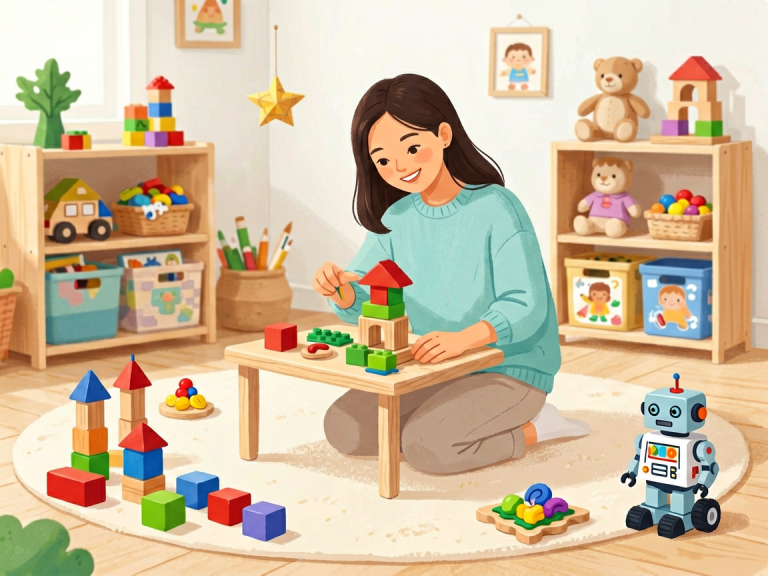
- Join the play: Children are more likely to engage with physical toys when adults model the behavior. Sit down with them and build something together. Ask open-ended questions: “What does this piece remind you of?” or “How can we make this bridge stronger?”
- Limit screen time by default: Use a timer or a digital detox schedule. When children know that screen time is not available during certain hours (e.g., after school before dinner), they naturally gravitate toward other activities.
- Combine building with storytelling: Encourage children to build a setting for a story they are writing or a scene from a favorite book. This bridges literacy and construction.
- Host building challenges: Set a timer and challenge siblings or friends to build the tallest tower, the most creative vehicle, or a structure that can hold a weight. This gamifies the experience and sustains interest.
Conclusion: Building a Future Beyond the Screen
As technology continues to evolve at breakneck speed, the value of screen-free building toys only grows. These simple, low-tech playthings offer something that no app or video can replicate: a direct, hands-on engagement with the physical world. They teach children that failure is part of learning, that patience yields results, and that creativity knows no boundaries. In an era when childhood is increasingly mediated by digital interfaces, providing kids with blocks, tiles, and bricks is not merely a nostalgic indulgence—it is an investment in their cognitive, social, and emotional development. So the next time you are tempted to hand your child a tablet, consider handing them a cardboard box full of building toys instead. The skyscrapers they build will be far more impressive than anything on a screen, and the skills they develop will last a lifetime.