Building the Foundation: The Best Building Toys for Developing Early Math Skills
Introduction
Early childhood is a critical period for cognitive development, and among the most valuable skills children can acquire are mathematical concepts such as counting, shape recognition, spatial reasoning, patterning, and basic arithmetic. While formal instruction has its place, play-based learning offers a far more natural and engaging pathway. Building toys, in particular, stand out as powerful tools for nurturing early math skills. They allow children to manipulate physical objects, experiment with structures, and discover mathematical relationships through hands-on exploration. The best building toys do not simply entertain; they challenge young minds to think logically, solve problems, and internalize foundational math ideas. This article explores why building toys are so effective, what criteria to look for, and presents a curated list of the very best options that combine fun with mathematical growth. By the end, parents, educators, and caregivers will understand exactly how to choose and use these toys to give children a head start in mathematics.
—
The Connection Between Building Toys and Math Skills
Building toys are inherently mathematical. When a child stacks blocks, she is unconsciously exploring concepts of balance, weight, and spatial relationships. When she connects two pieces, she encounters ideas of symmetry and alignment. The act of counting blocks, comparing sizes, or creating patterns directly mirrors early math standards. According to developmental psychologists, children learn best when abstract ideas are made concrete. A wooden block is a tangible representation of a number; a set of magnetic tiles can demonstrate fractions when a square is divided into two triangles. Moreover, building toys encourage trial and error, which fosters a growth mindset—essential for tackling more complex math later. Research from the National Association for the Education of Young Children (NAEYC) highlights that block play significantly improves spatial visualization, a skill strongly linked to success in geometry and STEM fields. Thus, the simple act of building is a rich, multi-sensory math lesson disguised as play.
—
Criteria for Choosing the Best Building Toys for Math
Not all building toys are created equal when it comes to mathematical learning. The most effective ones share several key features. First, they offer open-endedness—the ability to create countless configurations rather than a single predetermined model. This encourages creativity and repeated use, which reinforces math concepts. Second, they include clear geometric shapes (cubes, cylinders, triangles, arches) that allow children to identify and compare properties. Third, they provide size variation (different lengths, widths, heights) to introduce measurement and comparison. Fourth, color-coding or labeling can help with sorting, patterning, and counting. Fifth, toys that allow joining or stacking in multiple directions (e.g., with magnets, interlocking studs, or slots) enable exploration of symmetry, balance, and angles. Finally, age-appropriateness matters: for toddlers, larger, non-toxic pieces; for preschoolers, more intricate connectors. With these criteria in mind, let’s examine the top contenders.
—
Classic Wooden Blocks – The Timeless Math Teacher
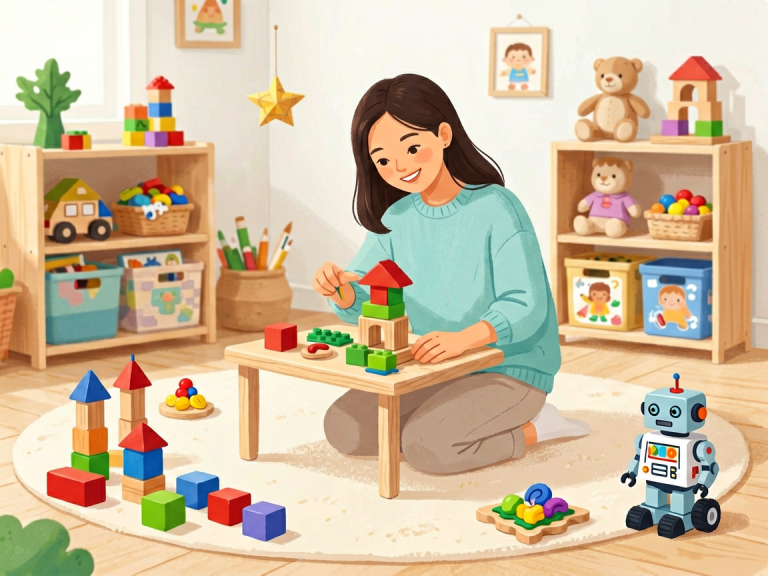
Wooden unit blocks remain a gold standard for early math education. Their simple, uniform shapes—rectangular prisms, cubes, cylinders, half-arches, and triangles—offer endless opportunities for mathematical discovery. A child building a tower must count how many blocks she has stacked, compare the heights of two towers, and balance the structure, which inherently teaches concepts of stability and proportion. When she sorts blocks by shape or color, she practices classification—a precursor to set theory. Wooden blocks also naturally introduce fractions: two half-squares equal one full square; four quarter-cubes can form a larger cube. Because they lack instructions, children must rely on their own mathematical reasoning. Furthermore, the tactile weight of wood provides sensory feedback, reinforcing spatial awareness. Brands like Melissa & Doug, Hape, and Grimm’s offer high-quality sets that last for years. For optimal math learning, include at least 50 to 100 pieces with a variety of geometric forms, and encourage activities such as “build a tower with 12 blocks,” “make a pattern of red, blue, red, blue,” or “how many blocks tall is your castle?”
—
Magnetic Tiles – Geometry and Spatial Reasoning
Magnetic tiles, such as Magna-Tiles or PicassoTiles, have exploded in popularity among educators, and for good reason. These translucent, colorful tiles with magnets along the edges allow children to construct 2D and 3D shapes effortlessly. The immediate click of magnets gives satisfying feedback and eliminates the frustration of pieces falling apart. From a math perspective, magnetic tiles are perfect for exploring geometry: children learn that four squares can form a larger square, that two triangles create a square, and that three triangles make a hexagon—all foundational fraction and geometry concepts. Building a cube from six squares teaches 3D spatial visualization. Moreover, because the tiles are transparent, children can overlay them to see how shapes combine, reinforcing area and symmetry. Scientific studies have shown that playing with magnetic tiles improves mental rotation abilities, a key component of spatial intelligence linked to later math achievement. To maximize learning, pose challenges like “make a shape that has 4 sides” or “build a house that uses exactly 10 tiles.” The bright colors also help with sorting and patterning (e.g., “create a tower where colors alternate”). Magnetic tiles are ideal for children ages 3 and up and can be used well into elementary school.
—
LEGO Duplo – Numbers, Patterns, and Creativity
LEGO Duplo, the larger-block version of classic LEGO, is a powerhouse for early math skills. Each brick is a precise multiple of a single unit (the classic 2×4 brick is 4 studs long, 2 studs wide). This modularity introduces the concept of measurement in a concrete way: “How many studs long is this train?” Children can count studs, compare lengths, and even begin simple addition and subtraction by combining bricks. Duplo sets often include number bricks and figures that encourage counting during play. Patterning is another natural math activity: a child can create a repeating pattern of red, blue, yellow, red, blue, yellow, which teaches sequence recognition. Because Duplo bricks connect in multiple directions, children also explore symmetry and balance. Building a tower that does not fall requires understanding of alignment and weight distribution—a lesson in physics and geometry. Many Duplo sets come with themed accessories (e.g., cars, animals, numbers), which can be used for sorting and classification games. For instance, “put all the green bricks in one pile and all the blue bricks in another” or “give each animal two bricks.” The infinite creative possibilities mean that math learning never gets boring. Duplo is especially recommended for ages 1.5 to 5, and the smaller LEGO Classic sets (without themes) offer even more open-ended building for older preschoolers.
—
Building Bricks with Numbers and Letters – Early Arithmetic
A specialized subset of building bricks—those that have numbers or dots printed on them—directly targets early numeracy. Products like LEGO DUPLO Number Train or B. toys’ Number Blocks feature bricks labeled 0 through 9, along with plus, minus, and equals signs. These toys transform abstract digits into tangible, stackable objects. A child can physically stack the “3” brick on top of the “2” brick and then place the “5” brick next to them, demonstrating addition. The bricks can also be used to compare values: “Which is bigger, 4 or 7?” By lining up bricks in order, children learn number sequencing and one-to-one correspondence. Some sets include counting bricks with printed dots (like dice faces), which help children connect the quantity to the numeral. These toys are particularly effective because they combine the motor skill benefits of building with explicit math content. They also encourage symbolic thinking: a child understands that the brick labeled “3” represents three units. For parents and teachers seeking a structured yet playful approach to arithmetic, these number-specific building toys are invaluable. They work best when paired with open-ended play—for example, build a tower with all the even-numbered bricks, or create a number line on the floor.
—
How to Use Building Toys to Maximize Math Learning
Owning the best building toys is only half the battle; how adults engage with children during play makes the difference. To foster early math skills, adopt a “math talk” approach. While a child builds, ask questions that prompt mathematical thinking: “How many blocks did you use?” “Which tower is taller?” “Can you make a pattern?” “What shape is that window?” Encourage children to count, compare, and predict. For example, before placing a block, ask “Do you think this will fit?” Then let them test it. Use the language of math organically—“You added two more blocks, so now you have five!”—without turning play into a drill. Also, set up simple challenges: “Build a bridge that is exactly 10 blocks long” or “Create a shape that uses only triangles.” Rotate toys to keep interest high, and combine different building sets (e.g., magnetic tiles with wooden blocks) to expand possibilities. Most importantly, let children lead. When they make a “mistake” like a tower falling, guide them to figure out why—this is the essence of mathematical problem-solving. Over time, these playful interactions build a strong foundation for numbers, geometry, and logic.
—
Conclusion
The best building toys for early math skills are those that transform abstract concepts into tangible, playful experiences. Classic wooden blocks, magnetic tiles, LEGO Duplo, and number-specific building bricks each offer unique strengths, from spatial reasoning to counting and patterning. By choosing high-quality, open-ended toys and engaging children with thoughtful math talk, parents and educators can seamlessly integrate mathematical learning into everyday play. These toys do not just prepare children for school; they cultivate a love for discovery and problem-solving that lasts a lifetime. In a world increasingly driven by STEM, giving a child the gift of building—and the math skills that come with it—is one of the most valuable investments we can make. So hand your little one a set of blocks or tiles, and watch them build not only towers, but a bright mathematical future.