The Vital Link Between Newborn Toys and the Development of Attention Span: A Comprehensive Guide
Introduction
The first few months of a newborn’s life are a period of rapid neurological growth, where every interaction with the environment shapes the architecture of the developing brain. Among the many tools available to parents and caregivers, toys designed specifically for newborns play an unexpectedly critical role in nurturing one of the most foundational cognitive skills: attention span. While it may seem paradoxical to speak of “attention” in an infant who can barely hold a gaze for more than a few seconds, research in developmental psychology and neuroscience confirms that the quality and design of early sensory stimuli can significantly influence how a baby learns to focus, shift attention, and eventually sustain concentration. This article explores the science behind attention development in newborns, identifies the key features of toys that effectively improve attention span, and offers practical guidance for selecting and using these toys in ways that support healthy cognitive growth.
Understanding Newborn Attention Span
Newborns are born with an extremely limited capacity for sustained attention. In the first weeks of life, an infant’s visual focus can typically last only 5 to 10 seconds, during which they orient toward high-contrast patterns, human faces, or slowly moving objects. This brief window of focus is not a sign of disinterest or deficiency—it reflects the immaturity of the neural circuits responsible for selective attention, sustained vigilance, and the inhibition of distracting stimuli. The frontal lobes, which play a central role in attention control, are barely developed at birth, and the connections between the visual cortex, the thalamus, and the prefrontal cortex are still being formed.
Nevertheless, attention is not an all-or-nothing phenomenon. Even a newborn’s fleeting gaze represents a critical learning event. Each time an infant fixates on a toy, they are practicing the “orienting” phase of attention—the ability to detect and respond to salient stimuli. Over the first three months, this orienting becomes more reliable, and the duration of focus begins to lengthen, typically reaching 30–60 seconds by three months of age. The toys that surround the baby during this period act as the raw material for this developmental process.
Key Features of Toys That Promote Attention in Newborns
Not all toys are created equal when it comes to supporting attention development. In fact, many conventional brightly colored, noisy, rapidly flashing toys may actually overstimulate a newborn, causing them to look away or become fussy rather than engage. To improve attention span, toys must match the infant’s sensory and cognitive capacities. The following features are critical:
*High Contrast and Simple Patterns*
Newborns’ visual acuity is poor—they can only clearly see objects about 8 to 12 inches away, and their color vision is limited. They are most responsive to black-and-white or high-contrast red-and-white patterns. Toys that feature bold stripes, checkerboards, or simple geometric shapes provide the visual “edges” and boundaries that the immature visual system can detect and track. These stimuli naturally attract the baby’s gaze because they are easy for the brain to process. By holding their gaze, these toys train the oculomotor muscles and the neural pathways that underlie sustained visual attention.
*Slow, Predictable Movement*
Newborns are hardwired to attend to motion, but only if it is slow enough for their developing tracking system. Rapid, erratic movements cause the baby to lose focus. Toys that move in a gentle, rhythmic arc—such as a black-and-white mobile that rotates at a steady pace, a slow-swaying cloth toy, or a parent gently moving a high-contrast card from side to side—encourage the infant to practice smooth pursuit eye movements. This tracking ability is a direct precursor to sustained attention.
*Multisensory but Not Overwhelming*
A toy that engages more than one sense—for example, a soft rattle with a high-contrast face that also makes a gentle sound—can help a newborn link visual input with auditory feedback, thereby strengthening the neural networks that support joint attention. However, the key is moderation. Too many sounds, lights, or textures simultaneously can overload the infant’s sensory system, leading to avoidance. Effective toys offer a single, clear sensory experience at a time, allowing the newborn to concentrate on one stimuli without distraction.
*Appropriate Size and Texture*
Toys that are too large or too small can be frustrating. Newborns are just beginning to develop hand-eye coordination, but they cannot grasp objects purposefully until about three months. Therefore, toys that are lightweight, easy to hold (even if only reflexively), and made of soft, safe materials encourage tactile exploration. The texture itself—whether smooth, bumpy, or furry—can draw the infant’s focus to the feel of the object, providing a tactile anchor that holds attention.
Types of Newborn Toys That Effectively Improve Attention Span
Armed with the knowledge of what features matter, parents can choose specific categories of toys that are proven to support attention in the first three months.
*High-Contrast Visual Cards and Books*
Simple black-and-white or red-and-white pattern cards, often sold as “baby visual stimulation” sets, are one of the most effective tools. A caregiver can hold a card 8–12 inches from the baby’s face, slowly moving it side to side. The infant’s eyes will lock onto the pattern, and the duration of focus can be measured and gradually extended. This simple activity—repeated daily—builds the neural pathways for sustained attention.
*Slow-Motion Mobiles and Ceiling Dangles*
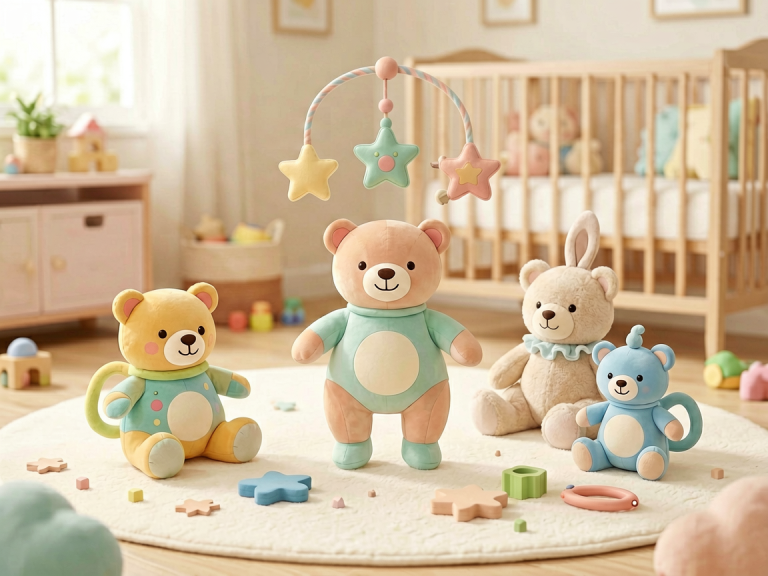
A mobile placed over the crib or changing table that rotates slowly with black-and-white or primary-color shapes is a classic attention-building toy. The key is the speed: it should complete a full rotation in about 15–20 seconds, allowing the newborn to follow from one shape to the next. Research from the University of Cambridge’s Centre for Neuroscience in Education suggests that such predictable motion engages the “perceptual attention” system, improving the infant’s ability to maintain focus over periods of up to a minute.
*Soft, Contrasting Texture Balls and Dolls*
Small, soft toys with distinct high-contrast features—such as a cloth ball with large black dots on a white background—provide a tactile and visual anchor. When placed in the crib or gently pressed against the baby’s hand, the toy stimulates both touch and sight. The combination keeps the newborn engaged longer than a plain-colored toy.
*Unbreakable Mirrors*
Newborns are fascinated by faces, especially the human face. A baby-safe mirror placed at eye level near the changing table allows the infant to gaze at their own reflection. This self-directed attention is powerful: babies will stare at their own face for longer periods than at most other objects, providing a natural opportunity to strengthen focus.
*Gentle Musical Mobiles with Contrasting Shapes*
Some mobiles combine slow rotation with a soft, repetitive lullaby. The auditory component holds the newborn’s attention even when the visual pattern becomes momentarily repetitive. Over weeks, the infant learns to anticipate the music and the movement, which trains the attention system to sustain focus through an unfolding sequence.
Practical Tips for Parents: How to Use Toys to Maximize Attention Development
Selecting the right toy is only half the equation. The way a toy is presented and the context in which it is used dramatically affect its impact on attention span.
*Follow the Newborn’s Cues*
Attention cannot be forced. If a baby turns away, blinks rapidly, or starts crying, they are signaling overstimulation or fatigue. Stop the activity immediately. The goal is to provide brief, positive interactions—30 seconds to 2 minutes—repeated several times a day. Over time, the threshold will increase naturally.
*Create a Distraction-Free Environment*
Newborns have almost no ability to filter out competing stimuli. When presenting a toy, ensure the room is quiet, the lighting is soft but adequate, and there are no other moving objects in the peripheral vision. This “minimalist” setup allows the infant to attend fully to the single stimulus.
*Use Repetition and Routine*
The developing brain thrives on predictability. Show the same high-contrast card or the same slow-motion mobile at the same time each day (e.g., after feeding, before nap). The familiarity reduces the cognitive load and allows the baby to engage more deeply, gradually extending the time they spend looking.
*Introduce Gradual Complexity*
As the newborn approaches 2–3 months, you can incrementally add complexity—a mobile with slightly more shapes, a card with small patterns, or a toy that combines a gentle sound with a visual stimulus. This “scaffolding” approach helps the attention system grow without overwhelming it.
*Prioritize Face Time with Toys*
While mobiles and cards are helpful, the most powerful attention-enhancing “toy” is still the human face. However, parents can combine face-to-face interaction with a toy: for example, holding a high-contrast picture near your own face, then alternately pointing to the picture and making eye contact. This joint attention—where the caregiver and baby are looking at the same object—is a key predictor of later attention skills.
The Science Behind Sensory Stimulation and Attention
Why do these specific toys work? The answer lies in the brain’s developing attentional network. The first nodes—the superior colliculus, pulvinar, and parietal cortex—are hardwired to respond to movement, contrast, and novelty. When a newborn fixates on a high-contrast pattern, the visual cortex sends signals to the locus coeruleus, which releases norepinephrine, a neurotransmitter that promotes alertness and focus. With repeated exposure, the neurons that fire together wire together, strengthening the circuitry that supports longer attention.
Moreover, the slow, predictable motion of a mobile activates the “magnocellular” visual pathway, which is responsible for detecting motion and maintaining visual attention. This pathway develops earlier than the “parvocellular” pathway that handles fine details and color. Toys that stimulate the magnocellular system first—through coarse patterns and slow movement—lay a foundation on which later fine-grain attention can build.
Conclusion
The seemingly simple act of presenting a newborn with a thoughtfully designed toy is an act of nurturing cognitive potential. While no toy can single-handedly guarantee a child’s future attention span, the cumulative effect of thousands of brief, focused interactions in the first months of life shapes the very architecture of attention. High-contrast cards, slow-turning mobiles, soft textured toys, and unbreakable mirrors are not just distractions—they are tools that help an infant learn to attend, to make sense of the world, and to lay the groundwork for all future learning. By understanding the science behind attention development and choosing toys that align with the newborn’s sensory capacities, parents and caregivers can provide the exact type of stimulation that fosters sustained focus—one small, deliberate moment at a time.
In a world increasingly filled with overstimulating digital baby products, returning to simple, high-contrast, slow-moving toys may be one of the most effective ways to support a newborn’s attention span. The investment is small, the impact is deep, and the benefits will echo far beyond the nursery.