Building Little Thinkers: How Toys for Newborns Can Cultivate Early Problem-Solving Skills
Introduction
The first few months of a newborn’s life are a whirlwind of sensory exploration, rapid brain development, and the foundations of what will eventually become complex cognitive abilities. Parents and caregivers often wonder: can a baby who cannot yet sit up, grasp objects deliberately, or even focus their eyes fully actually engage in “problem solving”? The answer is a resounding yes, albeit in a form that is vastly different from the adult version. Problem solving for a newborn is not about solving puzzles or figuring out how to retrieve a toy from under a couch. Instead, it is the earliest, most elemental form of cause-and-effect learning, pattern recognition, and adaptive behavior.
The right toys—those carefully designed to match a newborn’s developmental stage—can significantly enhance this nascent ability. Far from being mere entertainment, these toys serve as the first tools through which a baby learns to interact with the world, predict outcomes, and gradually exert control over their environment. This article explores the science behind early problem solving, the specific features of toys that support it, and practical guidance for selecting and using these toys effectively.
The Cognitive Development of Newborns: What Does “Problem Solving” Mean?
Before diving into toys, it is essential to understand what problem solving looks like in a newborn. According to developmental psychologists such as Jean Piaget, infants are born with a set of reflexes and an innate drive to make sense of their surroundings. During the sensorimotor stage (birth to about two years), babies learn through their senses and actions.
For a newborn (typically 0–3 months), problem solving is not conscious or strategic. It is rooted in operant conditioning and associative learning. For example, a baby who accidentally kicks a mobile and sees it move learns that their leg movement produces a visual effect. If the mobile is visually interesting, the baby may kick again—this is a primitive problem-solving loop: “I did X, and Y happened. I want Y, so I will try X again.” Over time, this simple feedback system builds neural pathways that support intentional action.
Key milestones in early problem solving include:
- Visual tracking: Following a moving object with the eyes teaches prediction and anticipation.
- Grasp-and-release: Eventually, babies learn to let go of an object intentionally, leading to concepts of object permanence and cause-effect.
- Attention to patterns: Newborns prefer novel stimuli and will look longer at new patterns, demonstrating an early form of discrimination and comparison.
Thus, the most effective toys for problem solving are those that provide clear, immediate, and safe feedback to a baby’s actions, even if those actions are initially random.
The Role of Toys in Early Problem Solving
Toys act as structured “experiments” for a baby’s developing brain. Unlike the natural environment, which can be unpredictable (a mother’s face moves, but not always in response to the baby), well-designed toys offer predictable and repeatable consequences. This predictability is key to building the neural circuits for problem solving.
Research in developmental neuroscience shows that the prefrontal cortex—the area responsible for executive functions like planning and self-regulation—begins to be shaped by experience within the first few months. Interactions with responsive toys stimulate the release of dopamine, a neurotransmitter associated with reward and motivation. When a baby kicks a play gym and hears a gentle chime, the brain registers success, reinforcing the action. Over repeated trials, the baby learns to *intend* the action rather than just perform it accidentally.
Moreover, toys that encourage cross-modal integration (e.g., a rattle that makes a sound when shaken) help the baby connect touch, sight, and hearing. This multisensory feedback is a powerful problem-solving challenge: the baby must figure out which actions produce the desired sensory outcome.
Types of Toys That Foster Problem-Solving Skills in Newborns
Not all toys marketed for newborns are equally beneficial. The best ones are simple, safe, and designed with specific developmental goals in mind. Below are several categories with explanations of how each supports problem solving.
*High-Contrast Visual Toys*
Newborns have limited color vision and visual acuity; they see best in high-contrast patterns (e.g., black-and-white). Toys such as black-and-white mobiles, books with bold geometric shapes, or hanging cards help a baby learn visual tracking and focusing. The problem to solve: “Where did that shape go? Can I follow it?” When the mobile rotates due to gentle air currents (or later, due to the baby’s own movement), the baby learns that their environment is dynamic.
*Rattles and Grasping Toys*
A classic rattle is one of the earliest problem-solving tools. When placed in a newborn’s hand (or within reach), the baby’s instinctive grasp produces sound. The feedback is immediate: “I squeezed, and it made a noise.” Over time, the baby learns to intentionally shake the rattle, distinguish different sounds, and even drop it to see what happens. Look for rattles with varied textures, easy-to-hold handles, and gentle sounds that don’t overstimulate.
*Activity Gyms and Play Mats*
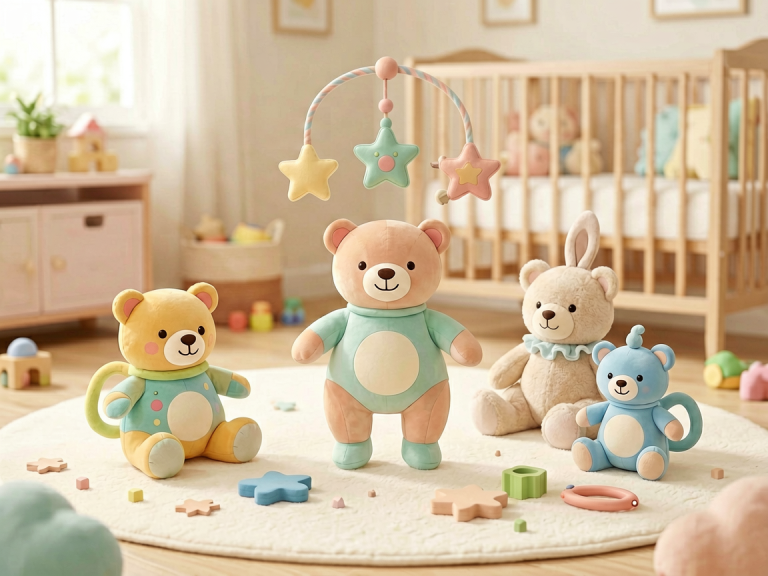
These provide an entire problem-solving environment. A play gym with dangling toys encourages the baby to bat at objects, which may cause them to ring or light up. The baby must coordinate hand-eye movement and learn that a specific motion (e.g., swiping left) triggers a specific result. Some advanced gyms have mirrors, crinkly fabrics, and detachable toys, all of which offer diverse problem-solving opportunities: “If I push this, it crinkles. If I kick that, it jingles.”
*Sensory Balls and Textured Objects*
Small, soft balls with bumps, ridges, or rings introduce the concept of manipulation. A baby may try to hold, mouth, or roll the ball. Rolling a ball away and watching it disappear is an early lesson in object permanence—a foundational problem-solving skill. The challenge: “How do I make it come back?” While a newborn cannot crawl yet, they can track the ball’s path, and later, parents can retrieve it, demonstrating cause and effect in social interaction.
*Musical Toys and Sound Boxes*
Toys that produce a sound when pressed, shaken, or twisted (e.g., a soft piano mat, a wind-up music box) teach the baby that their actions have auditory consequences. Even a simple toy that plays a tune when a button is pushed helps train the brain to associate a specific action with a specific outcome. As the baby grows, they will begin to search for the button intentionally.
Practical Tips for Parents: Using Toys to Maximize Problem-Solving Growth
Selecting the right toys is only half the battle. How parents present and interact with these toys profoundly influences their effectiveness. Follow these evidence-based strategies:
*1. Follow the Baby’s Lead*
Observe what the baby is interested in. If they are staring at a high-contrast card, let them study it without interruption. If they are kicking at a play gym, praise their attempts (even if they miss). Avoid over-rotating toys; let the baby have time to explore one toy at a time.
*2. Create Opportunities for Participation*
Place toys just within reach of the baby’s hands or feet. For example, dangle a soft toy above the baby’s chest during tummy time so they can bat at it. This positions the baby as an active agent rather than a passive observer.
*3. Introduce Simple Cause-Effect Toys Gradually*
Start with toys that have one clear feedback (e.g., a rattle that always makes sound when shaken). As the baby develops (around 4–6 months), you can introduce toys with multiple actions (e.g., a busy box where pressing one button lights up, twisting another chirps).
*4. Rotate Toys to Maintain Novelty*
Newborns quickly habituate—they lose interest in familiar stimuli. Rotating toys every few days keeps the environment fresh and encourages renewed exploration. Each rotation is a new problem-solving challenge.
*5. Use Social Interaction as a “Toy”*
Remember that the most powerful problem-solving tool is a responsive caregiver. Play peek-a-boo, make faces, and respond to the baby’s coos. When a baby cries and a parent comes, the baby learns that their signal produces a result—the most fundamental problem-solving skill of all.
Conclusion
The notion that newborns can develop problem-solving skills may seem counterintuitive, but it is a beautiful truth of early brain development. Through carefully chosen toys—high-contrast visuals, rattles, activity gyms, sensory objects, and musical playthings—we can provide the first structured challenges that help a baby learn how their world works. Each swipe of a hand, each kick of a foot, and each turn of the head becomes a tiny experiment. These experiments, repeated thousands of times, build the cognitive foundation for reasoning, creativity, and persistence later in life.
As parents, we are not just giving babies something to look at or hold. We are giving them the opportunity to discover that they can make things happen. That discovery is the spark of problem solving—and it begins with the simplest of toys in the very first weeks of life.
*(Word count: 1,168)*