Building the Foundation of Speech: The Role of Newborn Toys in Language Development
Introduction: Why Language Development Begins at Birth
Many parents assume that language development starts when a baby utters their first word, usually around the first birthday. In reality, the foundation of language is laid much earlier—during the newborn period, typically defined as the first two to three months of life. Even before a baby can coo or babble, their brain is actively processing sounds, rhythms, and patterns of speech. This is why the environment we create for newborns, including the toys we choose, can have a profound impact on their future language abilities.
Toys designed for newborns are not merely for entertainment or visual stimulation. They serve as tools that engage multiple senses, encourage caregiver interaction, and expose infants to the building blocks of communication: tone, pitch, repetition, and turn-taking. Understanding how to select and use such toys can empower parents to support their child’s linguistic journey from the very first days.
The Science Behind Newborn Language Learning
The Neurological Window of Opportunity
Newborns are born with billions of neurons, but the connections between them—synapses—form rapidly in response to environmental input. Language development relies heavily on the auditory cortex, which begins processing speech sounds even before birth. Studies show that newborns prefer the sound of human voices over other noises, and they can distinguish their mother’s voice from a stranger’s within hours of birth. This innate sensitivity means that every sound-rich interaction, including those facilitated by toys, is an opportunity to strengthen neural pathways related to language.
The Role of Parental Interaction
It is crucial to understand that no toy can replace a responsive caregiver. However, the right toys can act as catalysts for meaningful interaction. When a parent uses a toy to engage a newborn—by narrating actions, mimicking sounds, or responding to the baby’s reactions—they create a feedback loop that teaches the infant about the social nature of communication. This back-and-forth, known as serve and return, is one of the most critical elements of early language acquisition. Toys that invite such interaction are therefore far more valuable than passive, solitary playthings.
Types of Newborn Toys That Promote Language Development
High-Contrast Visual Toys: Sparking Attention and Focus
Newborns have limited vision; they see best at a distance of 8 to 12 inches and are most attracted to high-contrast patterns, especially black, white, and red. Toys such as black-and-white contrast cards, mobiles with geometric shapes, and soft books with bold images serve an important language function. When a caregiver holds a contrast card and says, “Look at the black circle! Round and round,” they are pairing visual stimulation with spoken language. The baby’s brain begins to associate the sight of an object with the sound of words. Over time, this builds the foundation for object-labeling—a key early language skill.
Musical and Sound-Producing Toys: Introducing Rhythm and Prosody
The rhythm and melody of speech, known as prosody, are vital for language comprehension. Newborns are highly attuned to the rise and fall of a voice. Toys that produce gentle sounds—soft rattles, chime balls, or musical mobiles—can be used to introduce rhythmic patterns. For example, a parent might shake a rattle in time with a simple nursery rhyme: “Shake, shake, shake, a little rattle now.” This not only teaches the baby to anticipate repetition but also encourages the infant to respond with coos or movements, which is the earliest form of conversational turn-taking.
Tactile Toys with Textures: Encouraging Exploration and Vocabulary Building
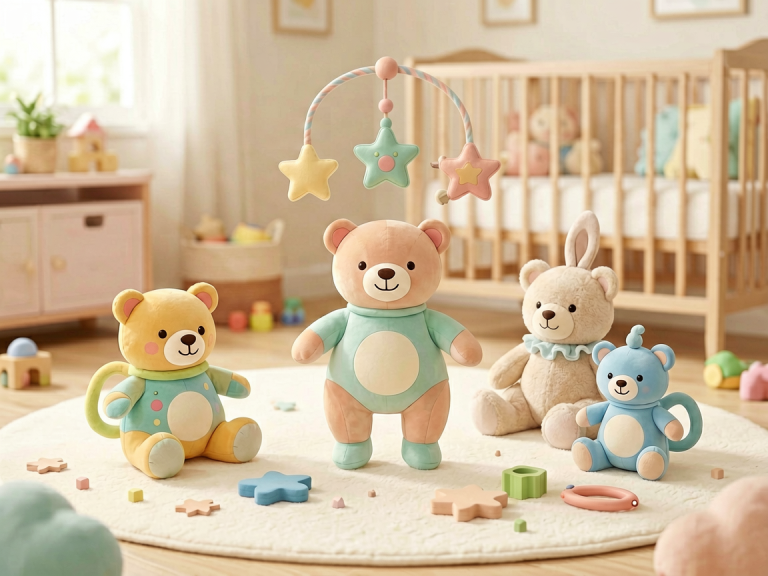
Touch is a powerful sense for newborns. Toys with varied textures—plush animals with different fabrics, wooden rings, silicone teethers—allow babies to explore through mouthing and grasping. While playing, caregivers can describe what the baby is feeling: “This is soft, like a bunny rabbit. This is bumpy, like a ball.” These descriptive words build a sensory vocabulary. Moreover, when a baby mouths a toy, they are not only exploring texture but also stimulating oral motor muscles, which are essential for later speech production.
Mirrors and Face-Like Toys: Promoting Social Communication
Newborns are naturally drawn to faces. Toys that feature simple, smiling faces—such as soft cloth mirrors or plush dolls with expressive eyes—encourage the baby to gaze, smile, and eventually vocalize. When a parent holds a mirror and says, “Who is that? That’s you! Hello, baby!” they are modeling the social use of language. The baby begins to understand that language is used to connect with others. This social referencing is a crucial step toward joint attention, which is strongly correlated with later vocabulary growth.
Practical Strategies for Using Toys to Enhance Language
Narrate Everything
One of the simplest yet most effective strategies is to narrate the toy-play experience. Instead of simply handing a rattle to a newborn, say, “Here is your rattle. Listen! It goes shake-shake-shake. Can you shake it?” Even if the baby cannot yet hold the rattle, the parent can shake it while speaking. This constant stream of language exposes the newborn to hundreds of words, sentence structures, and intonations daily. Research has shown that the quantity of words a child hears in infancy is a strong predictor of vocabulary at age two.
Follow the Baby’s Lead
While toys can initiate interaction, it is equally important to follow the baby’s cues. If a newborn turns away from a toy or becomes fussy, pushing the toy further can be counterproductive. Instead, pause and wait. Observe what the baby is looking at or reaching for, and then use that object as a language opportunity. For example, if the baby stares at a mobile with stars, the parent can say, “You see the star! Twinkle, twinkle, little star.” This responsive approach builds the baby’s sense of agency and reinforces that their interests matter in communication.
Use Repetition and Variation
Newborns learn through repetition. Singing the same lullaby while shaking a rattle, or showing the same contrast card repeatedly, helps the brain recognize patterns. However, subtle variation—changing the pitch, adding a new word, or swapping the rattle for a bell—keeps the baby engaged and demonstrates that language is flexible. For instance, one day a parent might say, “The rattle is loud,” and the next day, “The rattle is noisy.” The baby absorbs synonyms and learns that different sound combinations can describe similar experiences.
What to Avoid: Common Pitfalls
Not all toys marketed for newborns are beneficial for language development. Electronic toys that produce loud, repetitive beeps or play pre-recorded songs without caregiver involvement can actually hinder language growth. When a toy “talks” for the baby, it replaces the need for human interaction. Similarly, toys with too many flashing lights and sounds can overstimulate a newborn, causing them to shut down rather than engage. The best toys are simple, open-ended, and designed to be used together with a caregiver’s voice.
Additionally, parents should avoid overwhelming the baby with too many toys at once. A cluttered play area can distract from focused interaction. Rotating just two or three toys each week allows the newborn to become familiar with them, which supports memory and language associations.
The Long-Term Impact of Early Toy Selection
The toys we introduce to a newborn are not just fleeting sources of amusement. They are the first tools in a lifelong journey of communication. By choosing toys that promote auditory, visual, and tactile engagement—and by actively partnering with those toys through narration, rhythm, and responsiveness—parents lay the groundwork for a child who will not only speak but will also listen, understand, and connect. The gentle rattle, the high-contrast card, the soft mirror—each holds the potential to spark a neuron, shape a sound, and whisper the very first words of a conversation that will last a lifetime.
In conclusion, the most powerful “toy” for a newborn’s language development will always be a loving, attentive adult. But thoughtfully selected toys can amplify that interaction, turning everyday moments into rich learning experiences. For any parent wondering how to give their newborn a head start in language, the answer is simple: choose toys that invite your voice, your face, and your undivided attention. The rest will follow, one coo, one babble, and one word at a time.