The Building Blocks of Childhood: The Profound Impact of Construction Toys on Child Development
Introduction
From the simple wooden blocks that have been a staple in nurseries for centuries to the sophisticated magnetic tiles and programmable robotic kits of today, building toys for kids have remained one of the most cherished and educationally valuable categories of playthings. At first glance, these toys may appear to be nothing more than colorful shapes waiting to be stacked or snapped together. Yet beneath their playful surfaces lies an extraordinary tool for cognitive, social, emotional, and physical development. When a child picks up a block, she is not merely manipulating an object—she is embarking on a journey of discovery that shapes the architecture of her mind. This article explores the multifaceted benefits of building toys, offers guidance on selecting the right types for different ages, and examines why these timeless playthings deserve a central place in every child’s toy chest.
The Cognitive Benefits: From Spatial Reasoning to Problem-Solving
Building toys are perhaps best known for their ability to enhance cognitive skills, and for good reason. When a child engages with a construction set, she is simultaneously exercising multiple brain functions. Spatial reasoning—the ability to visualize and manipulate objects in two and three dimensions—receives a powerful workout. A toddler learning to balance one block atop another must mentally estimate the center of gravity and adjust her hand movements accordingly. An older child designing a complex LEGO castle must anticipate how each piece will fit into the overall structure, rotating the shapes in her mind before she ever touches them. Research in developmental psychology has consistently linked early spatial play with later success in STEM fields, including mathematics, engineering, and architecture. A landmark study published in the journal *Child Development* found that children who frequently played with construction toys demonstrated superior mental rotation abilities and geometric understanding compared to those who did not, even when controlling for factors like parental education and income.
Beyond spatial skills, building toys are unparalleled in their capacity to cultivate problem-solving and critical thinking. Every construction project presents a series of mini-challenges: “Why does this tower keep falling over?” “How can I make a bridge that spans this gap without collapsing?” “What should I do if I run out of red bricks?” These questions force children to hypothesize, test, analyze failures, and iterate—a process that mirrors the scientific method. Unlike puzzles with a single correct answer, building toys offer infinite solutions, teaching children that there is often more than one way to achieve a goal. This flexibility of thought is a hallmark of creative problem-solving and is increasingly valued in our rapidly changing world.
Fostering Creativity and Imagination Through Open-Ended Play
One of the most remarkable features of building toys is their open-ended nature. Unlike many electronic toys that prescribe specific narratives or outcomes, a set of blocks or magnetic tiles invites the child to become the author of her own story. A few wooden cubes can transform into a castle for a princess, a garage for a toy car, a spaceship bound for Mars, or a simple house for a family of stuffed animals. This blank slate quality is precisely what makes building toys so powerful for creativity development. When children are given the freedom to build whatever they imagine, they learn to generate ideas, make choices, and take ownership of their creations. They experiment with symmetry, color, proportion, and balance, often discovering aesthetic principles intuitively. A child might decide that a tower looks “too boring” and add a curved arch or a decorative pinnacle, exercising her sense of design.
Moreover, building toys encourage what psychologists call “divergent thinking”—the ability to generate many different ideas from a single starting point. A child presented with a pile of LEGO bricks might build a flower, a robot, a boat, or a abstract sculpture, each idea leading to another. This contrasts sharply with convergent thinking, which focuses on finding the single correct answer. In a world that increasingly requires innovation, the habit of divergent thinking nurtured by construction play is an invaluable asset. Importantly, this creative process does not have to be solitary. When children build together, they negotiate roles, share ideas, and combine their visions, learning that collaboration can lead to creations far more intricate than any one child could produce alone.
Social and Emotional Development: Collaboration, Patience, and Resilience
While building toys are often viewed as solitary activities, they are equally powerful in fostering social skills. When siblings or classmates gather around a shared set of blocks, they must communicate their intentions, resolve conflicts over limited resources, and coordinate their efforts. “I’ll build the base, you build the tower,” one child might say, learning the language of teamwork. These interactions teach children about compromise, turn-taking, and the importance of listening to others’ perspectives. For children who are naturally shy or struggle with social cues, building play can provide a structured, low-pressure environment in which to practice these skills. The shared focus on a tangible goal—completing a structure—can ease social anxiety and create natural opportunities for conversation.
Emotionally, building toys are remarkable teachers of patience and resilience. Every child who has attempted to build a tall tower has experienced the heartbreak of watching it tumble. In that moment, the toy presents a profound lesson: failure is not the end, but a stepping stone. A child can choose to cry, give up, or—with gentle encouragement from a parent—try again, perhaps with a wider base or sturdier supports. This process of experiencing frustration, managing disappointment, and persisting toward a goal builds what psychologist Angela Duckworth calls “grit.” It also helps children develop a growth mindset—the belief that abilities can be developed through effort. When a child succeeds after repeated attempts, the sense of accomplishment is deeply rewarding, reinforcing the idea that hard work pays off. Over time, children learn to approach challenges with more confidence and less fear of failure.
Types of Building Toys: A Guide for Parents and Educators
The variety of building toys available today can be overwhelming, but understanding the different categories can help parents and educators make informed choices. Traditional wooden blocks, such as unit blocks or colored cubes, remain excellent for toddlers and preschoolers. Their simplicity, weight, and tactile warmth encourage open-ended stacking and balancing, while the lack of connectors means that structures are inherently unstable—a feature that teaches cause and effect in a natural way. For children aged 3 and up, interlocking plastic bricks, like those from LEGO, offer greater precision and the ability to create more complex, stable models. Theme sets—from castles to space stations—can spark specific interests, but classic bricks in a variety of shapes and colors are more valuable for creative flexibility.
Magnetic building tiles, such as Magna-Tiles or PicassoTiles, have surged in popularity for good reason. These translucent, geometric shapes snap together with magnets embedded in their edges, allowing children to build 3D structures with ease. They are particularly effective for teaching geometry, symmetry, and the properties of shapes, and they are forgiving for younger children who may lack fine motor control. For older children, advanced construction sets like K’Nex, Erector Sets, or Meccano introduce mechanical principles such as gears, pulleys, and levers. These kits often require following instructions, which builds reading comprehension and sequential thinking, but can also be used for original creations. Finally, building toys that incorporate technology, such as LEGO Boost or Snap Circuits, bridge the gap between physical construction and programming, teaching basic coding and engineering concepts in a hands-on way.
Safety Considerations and Age-Appropriate Selection
Choosing building toys that are safe and developmentally appropriate is crucial. For infants and toddlers under three, small parts pose a choking hazard, so large, lightweight blocks with smooth edges are essential. Wooden blocks without paint or with non-toxic finishes are ideal, as they withstand chewing and drooling. As children grow, parents should check for sharp edges, toxic materials, and magnets that can be swallowed. Magnetic toys intended for older children should never be given to toddlers, as ingesting multiple magnets can cause life-threatening intestinal injuries. Additionally, parents should be mindful of the volume of pieces—a set with hundreds of tiny bricks may overwhelm a preschooler, while a set with too few pieces may bore an older child.
Age recommendations on packaging are a helpful starting point, but observe your child’s individual abilities and interests. Some four-year-olds are ready for small LEGO bricks, while others still prefer larger Duplo blocks. The key is to offer a toy that is challenging enough to engage without causing constant frustration. A good rule of thumb is the “Goldilocks principle”: not too easy, not too hard. When children are just slightly out of their depth—a concept called the “zone of proximal development”—they learn most effectively with adult support. For this reason, building toys that grow with the child, such as open-ended sets that can be combined with additional pieces over time, are excellent investments.
The Role of Parents: Supporting Play Without Overdirecting
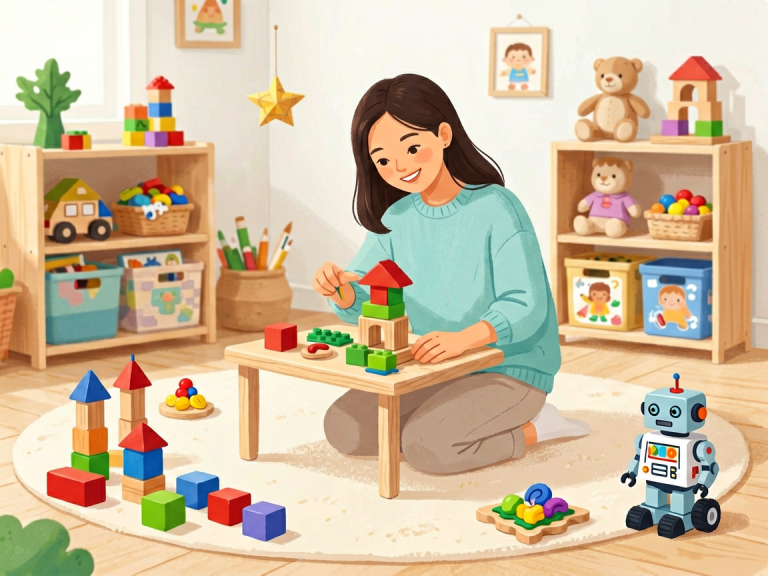
Parents and caregivers play a vital role in maximizing the benefits of building toys, but the most effective role is often that of a facilitator rather than a director. When a child is deeply engaged in construction, interrupting with “Why don’t you build a house instead?” can undermine her autonomy and creativity. Instead, observe and offer encouragement: “That’s a really interesting shape you made—tell me about it.” Asking open-ended questions, such as “What do you think would happen if you added more blocks to the top?” or “How did you get that piece to balance?” helps children articulate their thinking and deepens their learning. When a child encounters a problem, resist the urge to solve it for her. Instead, guide her to find her own solution: “What have you tried so far? What else could you try?”
Another valuable role is modeling. When parents build alongside their children, they demonstrate persistence, creativity, and joy in the process. This shared activity also strengthens the parent-child bond. However, it is important to let the child lead. If a parent builds an elaborate structure while the child watches, the child may feel inadequate or lose interest. Collaborative building, where each person contributes ideas and pieces, is more beneficial. Finally, parents can enrich the play by providing context—reading books about architecture, visiting a construction site, or looking at photos of famous buildings. These real-world connections help children see that their play is connected to the larger world of design and engineering.
Conclusion: Building More Than Just Structures
In an age dominated by screens and pre-programmed toys, building toys stand as a testament to the enduring power of hands-on, creative play. They are not merely pastimes but profound learning tools that shape the architects of tomorrow—not only of buildings and bridges, but of ideas, solutions, and innovations. Through building, children learn to think in three dimensions, to persist through failure, to collaborate with others, and to imagine worlds that do not yet exist. They learn that from a pile of simple blocks, something beautiful and complex can emerge. And in a world that often prizes speed and efficiency over patience and creativity, that lesson is more valuable than ever. So the next time you see a child absorbed in constructing a tower, a castle, or an abstract sculpture, remember: she is not just playing. She is building the foundation of a mind that will one day create, solve, and inspire. And that is the most important construction project of all.