The Power of Building Toys: How Construction Play Shapes Preschoolers’ Development
Introduction
In the colorful, bustling world of early childhood, few activities capture a preschooler’s imagination and curiosity quite like building toys. From classic wooden blocks to magnetic tiles, from interlocking plastic bricks to foam logs, these seemingly simple playthings hold profound potential. For children aged three to five, building toys are not just a source of entertainment—they are tools for cognitive growth, motor skill refinement, social learning, and emotional resilience. As educators and parents increasingly seek developmentally appropriate resources, understanding the multifaceted benefits of building toys becomes essential. This article explores why these toys are indispensable in the preschool years, how they support various domains of development, and what caregivers should consider when selecting them.
The Cognitive Benefits: Constructing the Foundations of Logical Thinking
Building toys are inherently problem-solving tools. When a preschooler attempts to stack blocks without them toppling, or connects a magnetic tile to form a stable tower, she engages in a cycle of hypothesis, experimentation, and revision. This process lays the groundwork for what developmental psychologists call "executive function"—the set of mental skills that includes working memory, flexible thinking, and self-control.
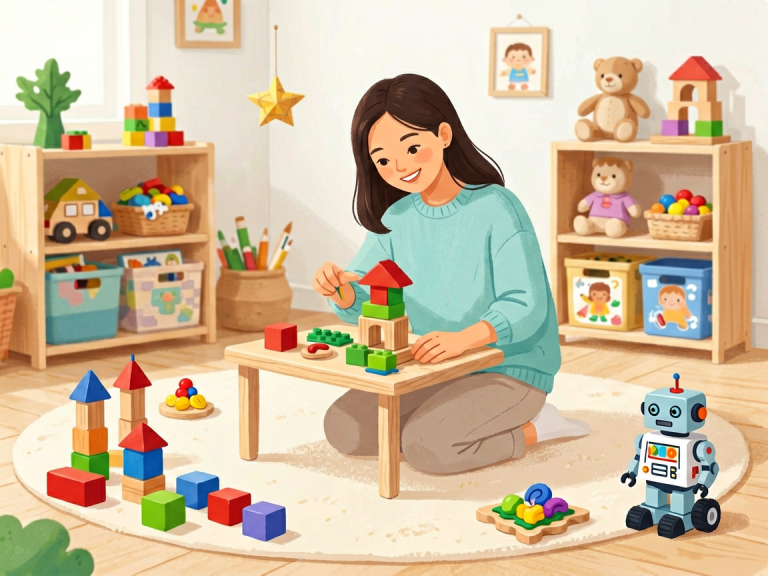
Take, for instance, a simple set of wooden unit blocks. A child must decide which block size will support the next layer, how to redistribute weight to avoid collapse, and whether to build a tall, narrow structure or a short, wide one. These decisions require spatial reasoning, a critical component of later mathematical and scientific thinking. Research published in the journal *Early Childhood Research Quarterly* has shown that preschoolers who frequently engage with construction play score higher on tests of spatial visualization and mental rotation. Moreover, building toys encourage symbolic thinking—a five-year-old might declare that her block tower is a castle, or that a round piece is a wheel. This transformation of objects into symbols is a precursor to literacy and abstract reasoning.
Another cognitive gift of building toys is the promotion of focus and persistence. Unlike many electronic toys that offer instant rewards, building involves trial and error. When a structure falls, the preschooler must decide whether to cry, walk away, or try again. With supportive adult guidance, children learn that failure is a stepping stone, not a dead end. This frustration tolerance is a vital emotional resource that supports later academic success.
Motor Development: From Grasping to Mastery
Preschool is a period of rapid motor refinement, and building toys are perfectly designed to match this developmental surge. While a two-year-old might simply enjoy picking up a large block and dropping it, a four-year-old is ready for more precise manipulation. The variety of shapes, sizes, and connection mechanisms in building toys offers a graded challenge for fine motor skills.
Consider interlocking plastic bricks (like those from LEGO Duplo, which are larger for small hands). To attach two bricks, a child must align the studs precisely, apply downward pressure with the palm or fingers, and sometimes twist slightly to secure the connection. This requires bilateral coordination (using both hands together), hand-eye coordination, and the development of the thenar muscles (the fleshy part of the thumb). Over time, such activities strengthen the pincer grip essential for writing. Similarly, magnetic tiles—which snap together with satisfying clicks—allow for easier assembly but still demand precise placement and careful stacking.
Gross motor skills also get a workout. Building a large floor-based structure (like a tunnel made from foam blocks) encourages children to squat, stretch, reach upward, and carry heavy pieces. These whole-body movements support balance, core strength, and spatial awareness. In classrooms where building toys are a daily staple, teachers often observe that children who struggle with gross motor delays make noticeable progress through regular construction play.
Creativity and Imaginative Play: Building Worlds from Blocks
One of the most delightful features of building toys is their open-ended nature. Unlike a puzzle with a single solution, a set of building toys offers infinite possibilities. This lack of predetermined outcome is the very essence of creative thinking. A preschooler might build a house one day and a rocket ship the next, or mix pieces from different sets to create a hybrid structure that has no real-world counterpart.
This creative process is closely tied to narrative development. As children construct, they often narrate stories. "This is the garage for the fire truck," says a three-year-old, stacking two blocks side by side. "Now the tower is for the princess, and she is crying because the dragon is coming." Such verbal play builds vocabulary, sentence structure, and storytelling skills. It also allows children to explore emotions and social roles in a safe, controllable environment. Building toys thus serve as props for socio-dramatic play, which is a critical avenue for empathy and perspective-taking.
Moreover, the physical act of building can be surprisingly expressive. A child who feels anxious might build a tiny, enclosed space—a "cozy cave"—while a confident child might construct a tall, asymmetrical tower that defies gravity. Caregivers and teachers who observe these creations gain valuable insights into a child’s emotional state and can respond with appropriate support.
Social and Emotional Learning: Cooperation, Negotiation, and Resilience
Building toys are not exclusively solitary activities. In preschool classrooms and family playrooms, they often become the centerpiece of social interaction. When two or three children collaborate on a structure, a complex social dance unfolds. They must decide who will hold the base steady, who will fetch the next piece, and what the final design should be. This requires negotiation, turn-taking, and compromise—skills that do not come naturally to three-year-olds but can be nurtured through guided play.
For example, a common challenge arises when one child wants to build a tall tower and another wants a long bridge. Conflict can be a learning opportunity. An adult might say, "How can we combine both ideas? Could the bridge connect two towers?" Such scaffolding helps children learn to integrate perspectives. Over time, repeated cooperative building experiences teach preschoolers that others have valuable ideas, that disagreements can lead to creative solutions, and that shared success feels rewarding.
Building toys also support emotional regulation. The frustration of a collapsing structure can be intense for a young child. When a tower falls for the third time, a child may feel anger or tears. If a caregiver is present to acknowledge the emotion ("I see you're upset that it fell") and offer a simple strategy ("Maybe we need a bigger base"), the child learns to manage disappointment. This emotional coaching is far more effective when it occurs in the midst of a natural, self-chosen activity rather than a structured lesson.
Choosing the Right Building Toys for Preschoolers
Given the wide array of building toys on the market, selection can feel overwhelming. However, a few key principles can guide caregivers. First, prioritize open-ended materials over single-purpose kits. A set of basic wooden blocks, magnetic tiles, or large interlocking bricks is far more valuable than a themed set that can only be assembled into one predetermined model. The latter limits creativity and often frustrates young children who lack the fine motor skills for tiny pieces.
Second, consider the developmental stage. For younger preschoolers (ages 2–3), large, lightweight blocks that are easy to grasp and stack are ideal. At this age, the act of stacking itself is the goal, not the final structure. For older preschoolers (ages 4–5), materials with simple connectors (like snap-together gears or magnetic rods) offer more complexity. Avoid toys with small parts that pose choking hazards; look for age labels and recalls.
Third, consider the child's interests. A child fascinated by vehicles might enjoy a set that includes wheels and axles. Another who loves animals might prefer building habitats. The best building toys are those that can be integrated into the child's existing imaginative world.
Finally, balance novelty with familiarity. Children often revisit the same building set many times, discovering new ways to use it. A set that has been played with for months can still inspire deep learning. Moreover, combining multiple sets—for instance, adding fabric scraps, cardboard tubes, or clay to a block collection—can reignite interest and expand creative possibilities.
Conclusion: Building More Than Structures
Building toys for preschoolers are far more than simple playthings; they are catalysts for holistic development. Through the seemingly simple act of stacking, snapping, and balancing, young children construct the cognitive frameworks for mathematics and science, refine the motor skills needed for writing and self-care, develop the creativity that fuels innovation, and practice the social-emotional competencies that underpin healthy relationships. As research continues to affirm the importance of play-based learning, building toys remain a timeless, accessible, and profoundly effective tool.
For parents and educators, investing in quality building toys is not an indulgence—it is an investment in a child's future. The towers may fall, the bridges may break, and the buildings may be dismantled in moments, but the lessons they leave behind stand firm. In every block laid, screw turned, and tile snapped, a preschooler is not just playing—she is growing.