The Ultimate Guide to the Best Toys for 4-Year-Olds: Nurturing Growth, Creativity, and Joy
Introduction: Why Choosing the Right Toys Matters at Age Four
At four years old, children stand at a remarkable crossroads of development. They are no longer toddlers with limited motor skills and short attention spans, nor are they yet school-age children who can sit still for structured lessons. This age is a golden window of rapid cognitive, physical, social, and emotional growth. Four-year-olds are bursting with curiosity, language explosion, and a newfound ability to engage in imaginative play. They ask endless “why” questions, love pretend scenarios, and crave opportunities to test their physical limits. The toys they interact with during this period are not mere distractions; they are tools that shape their neural pathways, boost problem-solving abilities, refine fine and gross motor skills, and teach essential social lessons like sharing, turn-taking, and empathy. However, the market is flooded with options—some overstimulating, some too simplistic, and many that fail to capture a four-year-old’s complex needs. This article explores the best toys for 4-year-olds, categorized by developmental purpose, ensuring that every plaything you choose becomes a catalyst for learning and joy.
1. Building and Construction Toys: Foundations of Logic and Fine Motor Skills
Four-year-olds are natural architects. They love stacking, balancing, and creating structures, which is why building toys are among the most beneficial choices. Beyond sheer fun, these toys teach spatial reasoning, cause-and-effect, and persistence. When a tower topples, a child learns to adjust their strategy—an early lesson in engineering and resilience.
Magnetic Tiles (e.g., Magna-Tiles or PicassoTiles) are an exceptional category. These translucent, magnetic squares and triangles click together effortlessly, allowing even small hands to construct castles, rockets, or animal shapes. Unlike traditional blocks, magnetic tiles offer instant gratification while encouraging 3D thinking. A four-year-old can follow simple visual patterns or invent their own designs, simultaneously strengthening hand-eye coordination and creativity. Moreover, the bright colors and light-transmitting properties make them mesmerizing during indoor play.
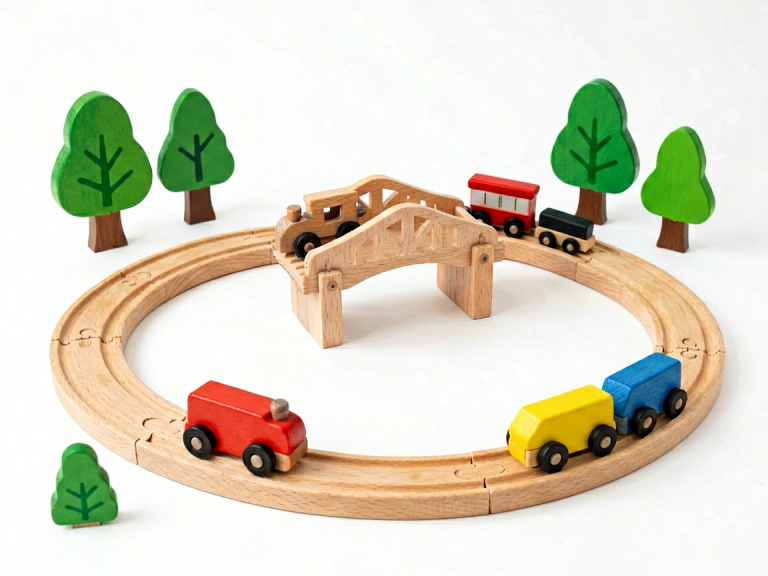
Classic Wooden Blocks remain timeless for a reason. A set of 100–200 natural wooden blocks in various sizes and shapes (rectangles, arches, cylinders, triangles) provides an open-ended experience. Four-year-olds can build roadways for toy cars, balance blocks into bridges, or create imaginary cities with their stuffed animals. Wooden blocks also promote cooperative play when siblings or friends build together, teaching negotiation and shared vision. Unlike plastic kits with prescribed models, wooden blocks foster divergent thinking—there is no “wrong” way to stack them.
LEGO Duplo sets are specifically designed for preschoolers. The larger brick size prevents choking hazards while still allowing complex builds like fire stations, farms, or vehicles. The sets often include simple instructions, introducing early literacy of following sequential steps. More importantly, Duplo encourages storytelling: after building a zoo, a child can populate it with animals and create narrative scenarios. This blend of construction and pretend play is ideal for the four-year-old brain.
2. Imaginative and Role-Play Toys: The Stage for Social and Emotional Development
At age four, fantasy takes center stage. Children spend hours pretending to be doctors, parents, astronauts, or superheroes. Role-play is not just entertaining; it is how children process the world around them, practice empathy, and experiment with different social roles. The best toys in this category provide props that spark rich narratives without dictating them.
Dress-Up Costume Trunks are a must-have. A simple collection of hats, scarves, capes, masks, and fabric scraps can transform a living room into a kingdom of knights, a hospital, or a spaceship. Look for costumes that are easy to put on and take off independently (Velcro closures, elastic waists) to boost self-confidence. Four-year-olds often mimic adult behaviors—pretending to cook, give shots, or fix a car—so include a stethoscope, a toy cash register, or a tool belt to expand the script.
Play Kitchens and Grocery Sets fuel domestic role-play. A wooden or plastic play kitchen with pots, pans, play food, and utensils lets children imitate meal preparation, cleaning, and serving. This type of play supports language development as they “order” food, “pay” with play money, or describe ingredients. It also normalizes household responsibilities, making children more likely to help with real chores later. For a space-saving alternative, consider a compact market stand or a shopping cart with play produce.
Puppets and Puppet Theaters are underrated gems. A set of hand puppets representing animals, people, or fantasy creatures enables children to act out feelings they cannot yet articulate. A shy child may use a lion puppet to roar out anger, while a nurturing child might craft a story about a lost puppy. Puppet play enhances narrative skills, emotional intelligence, and oral fluency. Even a simple draped blanket over a table can serve as a stage, making it an affordable option.
3. Cognitive and Learning Toys: Playful Pathways to Pre-Academic Skills
Four-year-olds are sponges for information, but they learn best through play, not drill-and-kill worksheets. The right educational toys embed literacy, numeracy, and logical thinking into hands-on activities. Avoid toys that promise to “make your child a genius” but instead choose those that encourage discovery.
Alphabet and Number Puzzles (floor puzzles or chunky wooden puzzles) are excellent. Look for puzzles where each piece has a letter and a corresponding animal (A for alligator, B for bear). As children fit pieces into place, they practice letter recognition, phonetic sounds, and fine motor control. The same concept applies to number puzzles with dots and numerals. Four-year-olds can also begin matching uppercase to lowercase letters or sequencing numbers 1–20. Puzzles with self-correcting pieces (only the right fit works) promote independence.
Memory and Matching Games designed for preschoolers help develop working memory and concentration. Sets with large, thick cards featuring simple images (animals, vehicles, fruits) are ideal. Adults can play alongside, asking questions like, “Do you remember where the red truck was?” The game builds turn-taking skills and visual discrimination. Some memory games incorporate counting or colors, offering layered learning.
Math Manipulatives like counting bears, linking cubes, or bead strings bring abstract concepts into the physical world. A four-year-old can sort bears by color, create patterns (red-blue-red-blue), or count how many cubes are needed to match a card. These toys are especially valuable because they allow trial and error without fear of failure. When a child accidentally knocks over a tower of ten blocks, they internalize the concept of decomposition without a worksheet.
Science Exploration Kits tailored to four-year-olds can spark lifelong curiosity. Simple kits like a kid-safe microscope for examining leaves or a magnet set with magnetic and non-magnetic objects let children hypothesize and test. Also consider a bug-catching kit with a magnifying jar—nothing beats the wonder of observing a ladybug up close. These experiences build vocabulary (e.g., “attract,” “repel,” “antennae”) and scientific thinking.
4. Gross Motor and Outdoor Toys: Channeling Endless Energy
Four-year-olds have abundant energy and rapidly growing muscles. They run, jump, climb, and spin with reckless delight, and they need toys that channel this energy safely while building balance, coordination, and confidence. Outdoor play also combats sedentary screen time.
Balance Bikes are a bicycle without pedals, allowing children to push off with their feet and glide. This design teaches the core skill of balancing before pedaling becomes a distraction. Studies show that children who start on balance bikes learn to ride a standard bicycle much earlier (often by age four or five). They also strengthen leg muscles and spatial awareness. Look for a lightweight frame with an adjustable seat.
Tricycles and Push-Push Toys are classic but still effective. A sturdy tricycle with a low center of gravity gives a four-year-old independence to zoom around the driveway or park. Some tricycles have a parent handle for steering assistance. Alternatively, a “push car” that a child propels by alternating feet on the ground (a “plasma car” or “wiggle car”) offers a unique steering experience that engages core muscles.
Balls, Beanbags, and Ring Toss Sets encourage throwing, catching, and aiming—skills that underpin later sports participation. A soft, oversized ball that is easy to catch reduces frustration. Ring toss games improve hand-eye coordination and teach early math concepts like counting points. For rain days, consider an indoor hopscotch mat or a set of stepping stones made of foam that children can balance on.
Climbing Playsets and Slides are a backyard investment that yields immense benefits. A small climbing dome or a plastic slide with a ladder challenges children to coordinate hands and feet, judge distances, and overcome fear. Climbing also builds upper body strength and spatial planning. If outdoor space is limited, indoor foam climbing blocks shaped like wedges and steps can create a mini obstacle course in the living room.
5. Art and Creative Expression Toys: Unlocking Imagination Without a Rulebook
Four-year-olds are natural artists. They love to scribble, paint, cut, and glue—often making messy, glorious chaos. Art toys allow them to express feelings they cannot verbalize, explore colors and textures, and practice fine motor control. The key is to provide tools that are open-ended and easy to clean.
Washable Markers, Crayons, and Chalk are non-negotiable. Choose triangular crayons that promote a proper grip, and washable markers in a variety of colors. A large roll of butcher paper on a low table invites spontaneous drawing. Sidewalk chalk transforms sidewalks into giant canvases where children can draw rainbows, hopscotch grids, or self-portraits. The act of drawing strengthens finger muscles needed for writing.
Playdough Kits offer endless sensory play. Simple playdough in primary colors plus a set of tools (rolling pins, cookie cutters, plastic knives) lets children create snakes, pizzas, flowers, or pretend food. Add googly eyes, pipe cleaners, and popsicle sticks for more complexity. Playdough squashing and rolling is an excellent stress reliever and fine motor workout. Make your own playdough for added kitchen science.
Sticker Books and Collage Materials appeal to the collector mentality of four-year-olds. Large sticker sheets with themes like animals, vehicles, or princesses allow children to arrange scenes without needing precise cutting skills. Safety scissors for left- and right-handed children, glue sticks, and paper scraps encourage collage making. These activities train bilateral coordination (using both hands together) and planning (where to place each sticker).
Easels and Art Smocks elevate the experience. A double-sided easel (chalkboard on one side, dry-erase on the other) provides a vertical surface that encourages different wrist movements than horizontal drawing. An art smock or old t-shirt protects clothes, freeing the child to experiment without fear of mess. Rotating materials (watercolor palettes, dot markers, stamp sets) keeps the novelty alive.
6. Social and Cooperative Play Toys: Learning to Share and Collaborate
At four, friendships become more important, and children begin to prefer playing *with* peers rather than just *alongside* them. Toys that require cooperation, turn-taking, and shared goals are invaluable for developing social competence.
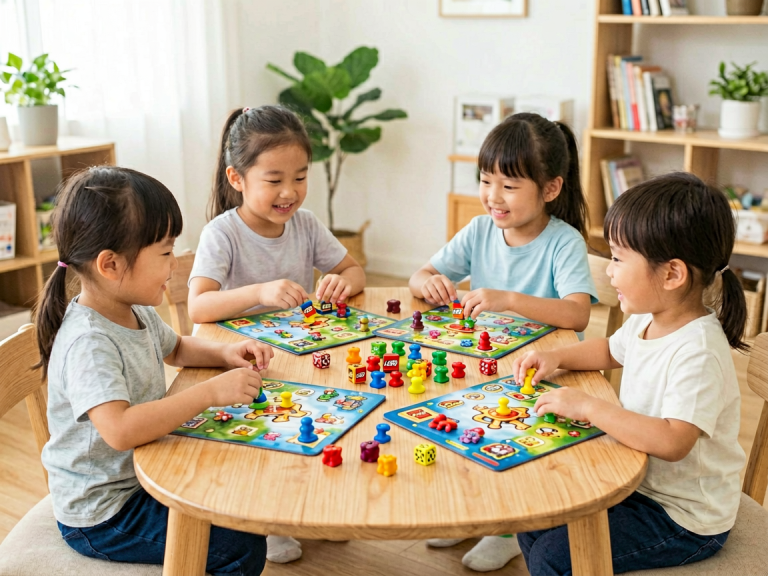
Simple Board Games designed for ages 3+ provide structured social interaction. Classics like “Hi Ho! Cherry-O” teach counting and taking turns; “Candy Land” and “Chutes and Ladders” involve matching colors and numbers while practicing patience when landing on a slide. Unlike competitive games for older kids, these games are luck-based, so frustration is minimized. A child learns to accept losing gracefully—a crucial life skill.
Magnetic Fishing and Hunting Games where players must take turns fishing (with rods and magnetic fish) or picking objects with tweezers encourage cooperation if played in pairs. Some games require two players to lift a puzzle together or pass a marble along a track—these are excellent for teaching teamwork and communication.
Building Sets for Two like large foam blocks or interlocking tubes (e.g., Straws and Connectors) can be used to build a fort large enough for two children to sit inside. When kids collaborate on a grand structure, they must negotiate roles (“I’ll hold this piece, you put it on top”) and compromise when ideas clash. This is a social skills bootcamp wrapped in fun.
Conclusion: The Power of Play, Chosen with Purpose
Selecting the best toys for a 4-year-old is not about accumulating the latest trend or the most expensive gadget. It is about understanding the developmental milestones of this magical age and choosing playthings that stretch those abilities while delighting the child. The toys outlined above—magnetic tiles for spatial reasoning, dress-up bins for empathy, balance bikes for physical confidence, board games for social grace—all share one trait: they are open-ended invitations to explore, not closed-ended assignments. They adapt to the child’s mood, skill level, and imagination. When you watch a four-year-old spend an hour arranging a wooden block city, arguing over who gets to be the doctor, or squealing with joy as their balance bike glides downhill, you are witnessing the profound work of childhood. The best toys are not those that do something to the child, but those that enable the child to do something to the world. Choose wisely, play often, and cherish the messy, creative, unstoppable energy of a four-year-old at play.