The Ultimate Guide to Building Toys: Creative Gift Ideas for Every Age
In a world increasingly dominated by screens and passive entertainment, building toys stand as a timeless bridge between play and learning. They ignite imagination, sharpen problem-solving skills, and foster a sense of accomplishment that few other gifts can match. Whether you are shopping for a toddler discovering shapes, a budding engineer, or even an adult seeking a mindful hobby, the right building toy can spark hours of creative engagement. This comprehensive guide explores a wide range of building toy gift ideas, categorized by age, interest, and developmental benefit. From classic wooden blocks to advanced robotics kits, you will discover thoughtful suggestions that make every occasion—birthdays, holidays, or “just because”—truly memorable.
Why Building Toys Make Exceptional Gifts
Before diving into specific recommendations, it is worth understanding what makes building toys such powerful gifts. Unlike passive toys that simply entertain, building toys demand active participation. A child stacking blocks must consider balance and symmetry. A teenager assembling a complex mechanical model learns about gears and torque. An adult constructing a miniature architectural landmark practices patience and precision. These activities stimulate spatial reasoning, fine motor skills, and perseverance. Moreover, building toys are inherently open-ended: the same set of magnetic tiles can become a castle today and a spaceship tomorrow. This versatility ensures that the gift remains engaging long after the wrapping paper has been discarded. Studies have shown that constructive play correlates with higher academic performance in STEM subjects later in life. By giving a building toy, you are not just offering a momentary distraction—you are investing in cognitive growth, creativity, and confidence.
For the Littlest Builders: Ages 1–3
Young children explore the world primarily through touch and cause-and-effect experiments. The safest and most developmentally appropriate building toys for this age group are large, lightweight, and free of small parts that could become choking hazards.
Soft Blocks and Stacking Cups
Soft fabric blocks with varied textures, colors, and patterns are ideal for infants who are just beginning to grasp and release objects. They allow babies to knock over towers without injury, teaching basic physics concepts like gravity and balance. Stacking cups, often nested inside one another, introduce concepts of size, order, and spatial relationships. As toddlers learn to line up cups from largest to smallest or build a simple pyramid, they develop hand-eye coordination and early problem-solving skills. Brands like Fisher-Price, Manhattan Toy, and B. toys offer excellent options that are both durable and washable.
Large Wooden Unit Blocks
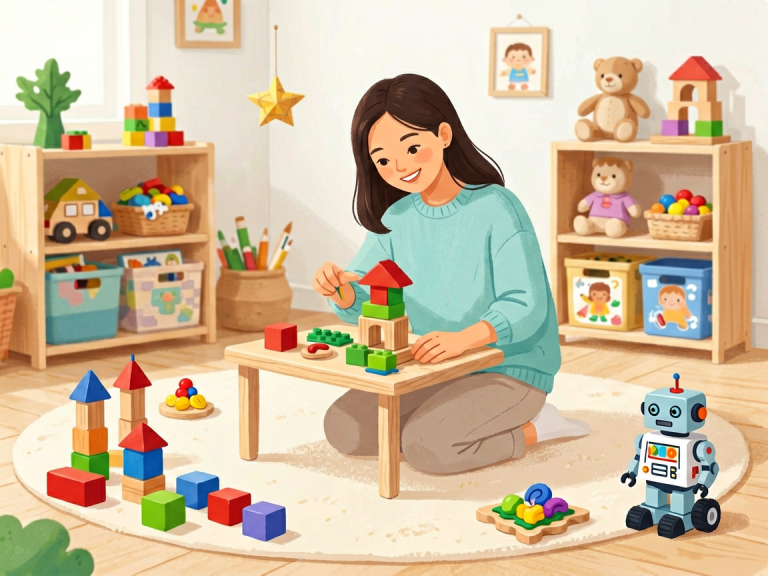
For children around eighteen months and older, a set of smooth, unpainted wooden unit blocks provides endless possibilities. Unlike plastic alternatives, wooden blocks have a satisfying weight and warmth. They encourage open-ended construction—a child might build a simple tower, a bridge, or a pretend house. The lack of prescribed instructions means the only limit is imagination. Look for sets that include basic geometric shapes: cubes, rectangles, cylinders, and triangles. Avoid sets with magnets or interlocking mechanisms, as these can frustrate very young children who lack the dexterity to connect them. Instead, choose classic hardwood blocks from companies like Melissa & Doug or Hape, which prioritize safety and sustainable materials.
Magnetic Tile Sets (With Supervision)
Some magnetic tile sets labeled for ages 3+ can actually be introduced earlier under adult supervision. Tiles like Magna-Tiles or PicassoTiles are large, transparent, and easy to grasp. Infants and toddlers enjoy clicking them together to form simple 2D shapes or low 3D structures. The strong magnets provide instant satisfaction—pieces snap into place with a satisfying click. However, always check that tiles are sealed tightly (to prevent magnet leakage) and supervise play to ensure no pieces are mouthed. These tiles lay the foundation for understanding magnetism, geometry, and symmetry.
Preschool and Early Elementary: Ages 4–7
At this stage, children’s fine motor skills improve dramatically, and their imaginative play becomes more complex. They can follow simple instructions but still thrive in open-ended creative scenarios. Building toys for this group should balance challenge with success, promoting independence and pride.
Classic Interlocking Bricks (LEGO Duplo and Junior)
LEGO Duplo is the obvious starting point for preschoolers. These bricks are twice the size of standard LEGO, making them easy for small hands to manipulate. Sets designed for ages 4–7 include vehicles, animals, and simple buildings with basic instructions. The real beauty, however, lies in mixing sets: a child can combine a fire station with a farm to invent entirely new stories. For those ready to transition to smaller bricks, the LEGO Junior series (ages 5–7) uses only a few specialized pieces, so children can build a police car or a dinosaur with confidence. The sense of “I did it myself!” is immensely rewarding.
Magnetic Construction Sets
Beyond tiles, magnetic rods and balls (such as Geomag or Magformers) appeal to this age group. Children can build geometric shapes, animals, and even simple mechanisms like spinning tops. The magnetism allows structures that would be impossible with gravity alone—for example, floating arches or cantilevered arms. These sets teach early engineering principles and encourage experimentation. Because connections are easy to make and break, children feel free to try bold designs without fear of permanent failure.
Wooden Train Tracks and Marble Runs
Wooden train track systems (like Brio or Thomas & Friends) combine building with storytelling. Children lay out tracks, create junctions, and move trains around. This activity fosters planning and spatial layout skills. Similarly, wooden marble runs (e.g., Hape Quadrilla or Marble Genius) challenge children to assemble ramps, tunnels, and towers so that a marble can roll from top to bottom. The trial-and-error process of adjusting a ramp’s angle or repositioning a block to prevent the marble from flying off is a brilliant lesson in physics and persistence. Both types of toys remain engaging for years, as kids can create increasingly complex layouts.
School-Age Children and Tweens: Ages 8–12
As children enter middle childhood, they crave more intricate challenges and often develop specific interests—robots, architecture, vehicles, or fantasy worlds. Building toys for this age should offer depth, customization, and often a dose of STEM learning.
Advanced LEGO Sets (Technic and Architecture)
Standard LEGO sets for ages 8+ feature hundreds of pieces and detailed instructions. But the real highlight is LEGO Technic, which introduces gears, axles, and pneumatic systems. Children can build motorized cars with functioning steering, cranes that actually lift loads, or helicopters with rotating blades. These sets teach mechanical principles in a hands-on way. For children fascinated by landmarks, LEGO Architecture sets let them recreate the Taj Mahal, the Eiffel Tower, or Fallingwater. Building these iconic structures requires careful reading of instructions and attention to symmetry, yet the final product is a stunning display piece. Additionally, LEGO Boost or LEGO Mindstorms (ages 10+) introduces basic programming, allowing kids to build robots that follow commands.
Magnetic Tile Advanced Sets
Older children can explore magnetic construction at a higher level. Sets like Magna-Tiles XL or Tegu magnetic wooden blocks offer larger pieces and more shapes. More importantly, some brands produce metal ball runs combined with magnetic tracks—children can design intricate paths for a steel ball, incorporating loops, zigzags, and jumps. This is essentially a low-tech version of programming: the child predicts the ball’s trajectory and adjusts the layout accordingly. It’s deeply satisfying and educational.
Wooden 3D Puzzle Kits
For children who enjoy hands-on craftsmanship, wooden 3D puzzle kits (such as those by Robotime or UGEARS) are fantastic. These kits consist of laser-cut plywood sheets with pre-cut pieces that pop out. Children assemble model cars, clocks, music boxes, or even mechanical automata without glue or tools—the pieces interlock via friction. The process requires patience and careful matching of numbered parts. The final result is a fully functional wooden mechanism, which provides a tangible sense of achievement. Some kits include gears and rubber bands that make the model move, adding another layer of fascination.
Construction Sets with Real Tools
Some building toy brands bridge the gap between play and real-world skills. For example, Meccano or Erector sets use metal strips, nuts, bolts, and screwdrivers. Children build sturdy models like cranes, bridges, or robots. This is an excellent introduction to practical engineering and tool use. Another option is GoldieBlox, which combines building with storytelling: girls (and boys) follow a narrative that leads them to construct a belt drive, a zipline, or a parade float. These sets specifically aim to engage girls in engineering by linking construction to creative problem-solving.
Teenagers and Adults: Ages 13 and Up
Building toys are not just for children. Many adults rediscover the joy of construction through complex kits that require days or even weeks to complete. These gifts offer mindfulness, reduce stress, and satisfy a deep human desire to create something with one’s own hands.
Model Kits: Ships, Cars, and Landmarks
Detailed plastic or wooden model kits (from brands like Revell, Tamiya, or Airfix) challenge older builders to paint, glue, and assemble intricate replicas of historical ships, WWII planes, or modern sports cars. The process demands steady hands and careful planning. For those who prefer architecture, papercraft or cardboard model kits (such as PaperLandmarks or Robotime’s book nook sets) produce stunning miniature rooms or cityscapes. These kits often include LED lights to enhance the final display. They are perfect gifts for hobbyists who want a project that yields a beautiful decoration.
3D Metal Puzzle Kits
Metal model kits, like those from Metal Earth or Piececool, consist of thin stainless steel sheets that you cut and fold into detailed replicas—the Eiffel Tower, a dragon, a telescope, or a Mars rover. No glue is needed; tiny tabs and slots hold everything together. Assembling a metal puzzle requires tweezers, patience, and excellent eyesight. The result is a sleek, shiny, and highly detailed ornament. These kits are relatively affordable yet surprisingly challenging, making them excellent gifts for adults who enjoy precision work.
Programmable Robotics and Electronics Kits
For the tech-savvy teenager or adult, building a robot from a kit like LEGO Mindstorms (still popular) or more advanced platforms like Arduino, Raspberry Pi, or micro:bit can be transformative. Kits such as the Makeblock mBot or the Sphero RVR provide components (motors, sensors, microcontrollers) that users assemble and then program using block-based or Python code. These gifts teach electronics, coding, and problem-solving in a deeply engaging way. The builder can go on to modify the robot, add new sensors, or create autonomous behaviors—making this a gift that evolves with the user’s skills.
Architectural and Structural Kits
Some companies specialize in building models with architectural integrity. For example, Arckit creates modular architectural model kits that use plastic “bricks” and panels to construct houses, skylights, and modernist buildings. Included software allows designers to draft their own floor plans. Similarly, the Japanese brand Nanoblock offers micro-sized building blocks that create incredibly detailed landmarks (e.g., Himeji Castle, Big Ben). These kits appeal to aspiring architects and anyone who loves meticulous craftsmanship. They also make elegant desktop decorations once finished.
Eco-Friendly and Unique Building Toys
Sustainability is an increasing consideration for gift-givers. Fortunately, many building toys are crafted from responsibly sourced wood, recycled plastics, or biodegradable materials. Brands like PlanToys, Tegu, and Green Toys offer non-toxic, durable products. Additionally, some independent designers sell DIY kits using cardboard tubes, cork, or bamboo. For a truly unique gift, consider subscription boxes such as KiwiCo, which delivers a new hands-on building project each month, covering topics from simple machines to color chemistry. These boxes are excellent for ongoing engagement and provide a curated variety of building experiences.
How to Choose the Perfect Building Toy Gift
Selecting the right building toy involves considering several factors beyond the recipient’s age. First, think about the child’s temperament. A patient, detail-oriented child will enjoy a complex 3D puzzle; a more playful, active child might prefer magnetic tiles that allow rapid assembly and disassembly. Second, consider the available play space. Large wooden block sets or train tables require floor space, while desktop metal puzzles are perfect for small apartments. Third, assess the level of adult involvement needed. Some kits frustrate children if they cannot build independently, so ensure the difficulty matches the child’s experience. Finally, think about long-term value. Open-ended toys like LEGO or magnetic tiles remain engaging because they can be combined with other sets, encouraging years of creativity. A one-time puzzle model might be finished quickly, but it yields a keepsake.
Conclusion: Building More Than Toys
Building toys are gifts that keep on giving—long after the last piece is snapped into place, the skills and confidence they foster endure. They teach children that mistakes are opportunities to rebuild, that patience yields beautiful results, and that imagination can transform a pile of blocks into a rocket ship or a castle. For adults, they offer a rare chance to disconnect from digital noise and reconnect with the physical act of creating. Whether you choose a simple set of wooden blocks for a toddler or an intricate metal model for an engineering enthusiast, you are giving more than a toy: you are giving the joy of construction, the thrill of problem-solving, and the pride of seeing something new come into existence. So the next time you search for a meaningful gift, look beyond the screen and consider the humble building toy—it may be the best decision you ever make.