The Power of Play: Selecting the Best Learning Toys for 4-Year-Olds
—
Introduction: The Fourth Year – A Leap in Development
The age of four is a magical crossroads in early childhood. Children are no longer toddlers, yet they are not quite ready for formal school. They possess an insatiable curiosity, a rapidly expanding vocabulary, and a growing ability to understand cause and effect. At this stage, play is not merely a pastime; it is the primary vehicle for learning. The right learning toys for 4-year-olds can transform everyday moments into rich educational experiences, building a foundation for cognitive, social, emotional, and physical growth. However, with the overwhelming array of options on the market, parents and educators often wonder which toys truly deliver developmental benefits rather than fleeting entertainment. This article explores the critical milestones of a four-year-old and provides a detailed guide to choosing toys that nurture learning through joyful, hands-on engagement.
—
Understanding Developmental Milestones at Age 4
To select effective learning toys, one must first understand what a typical four-year-old can and should be practicing. Cognitively, children at this age begin to master counting up to ten or twenty, recognize some letters and colors, and enjoy sorting objects by shape or size. Their attention span lengthens to about 10–15 minutes for activities they find engaging. Language development is explosive: they use four-to-five-word sentences, ask endless “why” questions, and love telling stories. Socially, they start to engage in cooperative play, sharing roles in pretend scenarios, though they may still struggle with taking turns. Physically, they refine fine motor skills—using scissors, holding a pencil with a tripod grip, and buttoning clothes—while their gross motor skills allow them to hop on one foot, catch a ball, and climb confidently. Keeping these milestones in mind helps us identify toys that challenge without frustrating, and that encourage the exact skills children are primed to develop.
—
Cognitive Growth: Puzzles, Memory Games, and Problem-Solving Toys
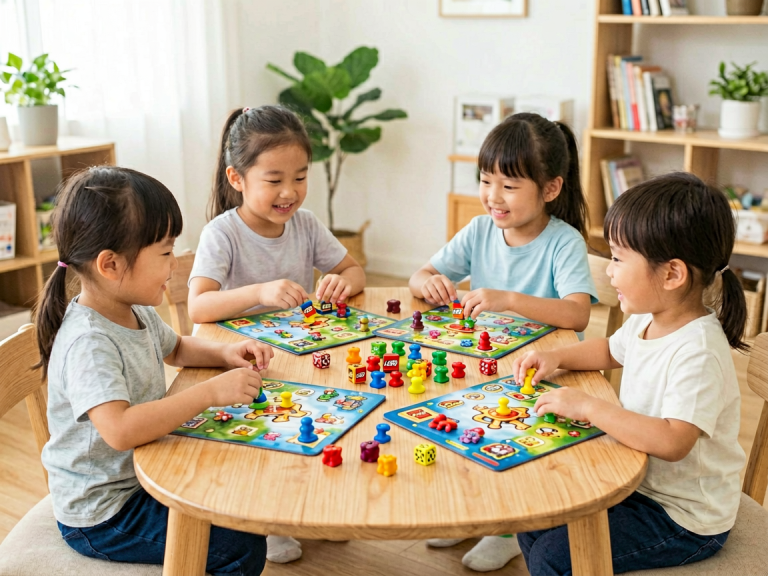
The four-year-old brain is a pattern-seeking machine. Toys that require matching, sequencing, and simple logic are excellent for cementing cognitive skills. Floor puzzles with 24 to 48 pieces, for example, teach spatial reasoning and patience. Unlike jigsaw puzzles for older children, those designed for four-year-olds often have larger pieces and familiar images like animals or vehicles, making success accessible. Memory matching games—where children flip cards to find pairs—strengthen working memory and concentration. To make them more engaging, choose sets with real photographs or interesting textures. Sorting and stacking toys that involve graded rings, colored pegs, or shape-sorters with multiple attributes (e.g., both shape and color) encourage logical classification. Early board games like “Candy Land” or “Hi Ho! Cherry-O” introduce turn-taking, basic counting, and rule-following in a low-pressure environment. The key is to select toys that allow for trial and error without harsh consequences, so children learn that persistence leads to mastery.
—
Language and Literacy: Storytelling, Phonics, and Vocabulary Builders
Language acquisition at age four is dramatic, and toys that promote listening, speaking, and pre-reading skills are invaluable. Alphabet puzzles and magnetic letter sets help children recognize letter shapes and sounds, especially when paired with songs or verbal cues. Phonics-based toys that pronounce letter sounds when pressed can be effective, but they should be used interactively—a parent or caregiver should model the sounds and connect them to familiar words. Storytelling kits with felt characters, story cubes, or simple picture cards encourage a child to create their own narratives, building vocabulary and narrative structure. Puppets are another powerful tool: a child can speak through a puppet, practicing dialogue and emotional expression without self-consciousness. Interactive books with lift-the-flaps, sound buttons, or textured pages keep attention focused on text and illustrations. However, the most important “toy” for language development remains a caring adult who reads aloud, asks open-ended questions, and listens to the child’s responses. The best language toys are those that spark conversation, not just passive listening.
—
Fine and Gross Motor Skills: Building Blocks, Art Supplies, and Balance Toys
Physical play is essential for a four-year-old’s body and brain. Fine motor skills—the small movements of fingers and hands—directly support writing, cutting, and self-care. Building blocks (classic wooden unit blocks or Duplo-style bricks) require precise hand-eye coordination as children stack, align, and balance pieces. Art supplies such as child-safe scissors, crayons, play dough, and finger paints offer limitless opportunities to strengthen hand muscles. Encourage cutting along simple lines, rolling play dough into snakes, or lacing beads onto strings. Lacing cards and pegboards are excellent for developing the pincer grip needed for pencil control. For gross motor skills, balance bikes (pedal-free bicycles) teach steering and equilibrium, preparing children for a regular bike later. Small trampolines with handlebars, soft climbing structures, and tumbling mats allow safe practice of jumping, rolling, and balancing. Beanbag toss games and soft balls for catching and throwing improve coordination and spatial awareness. A crucial point: these toys should be used in open spaces with supervision, and the goal is movement, not competition.
—
Social and Emotional Learning: Pretend Play, Cooperative Games, and Role-Play Sets
Four-year-olds are deeply engaged in make-believe, and this is where they practice empathy, negotiation, and self-regulation. Dress-up costumes (doctor, firefighter, chef, or animal) let children experiment with different identities and social roles. Play kitchens, tool benches, and dollhouses provide a setting for them to reenact daily routines, express emotions, and solve small conflicts (e.g., “Who gets the red plate?”). Cooperative board games (where players work together to achieve a common goal, such as “The Sneaky, Snacky Squirrel” or “Hoot Owl Hoot!”) teach turn-taking and teamwork without the stress of winning or losing. Puppet theaters and puppet sets allow children to act out fears or joys in a safe, controlled way. Emotion flashcards or feelings puzzles help children name and discuss emotions like frustration, excitement, or sadness. When selecting toys for social-emotional growth, look for open-ended items that encourage interaction with peers or adults, rather than solitary screen-based play. Role-play builds language and also fosters a sense of agency: a child can be the boss, the parent, or the hero, all of which build confidence.
—
STEM Exploration: Simple Science Kits, Magnets, and Number Toys
STEM (Science, Technology, Engineering, Mathematics) may sound advanced for a four-year-old, but at this age it simply means exploring the world through cause and effect, measurement, and elementary principles. Water tables or sensory bins filled with rice, sand, or water, along with cups, funnels, and scoops, teach volume, gravity, and prediction. Magnetic building sets (such as Magna-Tiles or Magformers) let children discover attraction and repulsion while constructing towers and houses. Simple science kits that include a magnifying glass, bug containers, color-mixing supplies, or baking soda-and-vinegar experiments encourage observation and hypothesis-making. Number toys like counting bears, abacuses, and number puzzles introduce one-to-one correspondence and basic addition/subtraction through play. Balance scales with weights or small objects teach comparison (heavier/lighter). Even a set of measuring cups used during pretend cooking becomes a math lesson. The critical element is adult involvement: asking “What do you think will happen if we add more water?” or “How many bears are there now?” turns simple play into scientific thinking. Avoid electronic “teaching machines” that merely quiz; STEM at age four should be hands-on, messy, and exploratory.
—
How to Choose Quality Learning Toys – Safety, Open‑Endedness, and Engagement
With so many products claiming to be “educational,” parents need a reliable filter. First and foremost: safety. Check for non-toxic materials (BPA-free, lead-free, phthalate-free), no small parts that could be choking hazards, and durable construction that won’t splinter or break into sharp edges. The toy should be age-labeled appropriately. Second, open-endedness. The best learning toys have no single correct way to use them. A set of wooden blocks can become a castle, a rocket, a farm, or a mountain—its value grows as the child’s imagination expands. Toys with a single function (e.g., a plastic phone that only plays pre-recorded songs) quickly lose appeal. Third, engagement. Does the toy invite the child to act, experiment, and create, or does it passively entertain? Button-bashing electronic toys that light up and talk without requiring thought often do little for learning. Fourth, adaptability. Can the toy be used in different ways as the child matures? For example, counting bears can be used for sorting, patterning, and simple arithmetic across ages three to six. Finally, balance. A child’s toy collection should include a mix of building, art, pretend, physical, and social toys—not just one category. Obsessing over “smart” toys is less important than providing time and space for unstructured play.
—
Conclusion: Beyond Entertainment – Toys as Tools for Lifelong Learning
The toys we offer our four-year-olds are more than shiny possessions; they are the tools with which children build their understanding of the world. A thoughtfully chosen learning toy can spark a love for numbers, ignite a passion for storytelling, or teach the quiet art of patience. Yet, no toy replaces the presence of a caring adult who plays alongside, asks questions, and celebrates discoveries. The best learning environment combines high-quality toys with active engagement, free exploration, and plenty of time. As you consider the next purchase for your four-year-old, remember that a simple cardboard box and a set of markers can be as educational as any expensive gadget—if it invites creation, problem-solving, and joy. In the end, the most important lesson is that learning is fun, and the right toys help children discover that truth for themselves.