How Many Toys Should Newborns Have? A Guide to Minimalist and Developmentally Appropriate Play
Introduction: The Paradox of Plenty
When a baby enters the world, so too does a cascade of gifts, hand-me-downs, and well-meaning purchases. Walk into any nursery today, and you are likely to find a plastic mountain of rattles, mobiles, activity gyms, soft books, and plush animals. The question “how many toys should newborns have?” seems almost counterintuitive in a culture that equates love with abundance. Yet, pediatricians, child development specialists, and early childhood educators are increasingly urging parents to reconsider the sheer volume of objects surrounding a newborn. The answer, they argue, is not a single number but a philosophy rooted in the baby’s sensory, motor, and cognitive needs. This article unpacks the science of early play, offers evidence-based guidelines, and provides a practical framework for choosing the right quantity and quality of toys for infants from birth to around six months.
The Overstimulation Trap: Why Less Is More for a Newborn’s Brain
A newborn’s brain is a marvel of neuroplasticity, forming up to one million new neural connections every second during the first year. However, this rapid growth does not mean that more input is better. In fact, infants are easily overwhelmed by excessive visual, auditory, and tactile stimuli. When a baby is surrounded by dozens of toys—flashing lights, competing sounds, dangling objects—their developing nervous system cannot effectively filter and process the information. This leads to a state of overstimulation, which often manifests as fussiness, crying, turning away, or difficulty settling for sleep.
Dr. Tovah P. Klein, director of the Barnard College Center for Toddler Development, explains in her research that newborns need “a calm, predictable environment” to feel secure. Too many toys create visual clutter and distract from the most important “toy” of all: the caregiver’s face. A 2018 study published in *Infant Behavior and Development* found that infants as young as two months old showed shorter attention spans and increased signs of stress when presented with four toys at once compared to a single toy. The reason is simple: the infant’s executive attention system is not yet mature. They cannot voluntarily choose where to focus; instead, they are pulled in multiple directions, exhausting their limited cognitive resources.
Thus, the first principle for answering “how many toys should newborns have?” is minimalism for the sake of protection. For a child who cannot yet sit up or intentionally grasp objects, the ideal is not a playroom but a contained, quiet space with a few carefully chosen items.
The Developmental Milestone Lens: What Newborns Actually Need to Play With
To understand the right number, we must first understand what a newborn actually does during play. From birth to three months, infants are primarily engaged in reflexive actions (grasping, kicking) and sensory exploration. Their vision is blurry beyond about 8–12 inches, they prefer high-contrast patterns (black and white, bold reds), and they are drawn to human faces and voices. From three to six months, they begin to bat at objects, bring hands to mouth, and show interest in cause-and-effect (e.g., a rattle makes sound when shaken). At no point does a newborn “play” in the way a toddler does; rather, they are building foundational neural pathways through repetition and interaction.
Given these milestones, the toys a newborn truly needs can be counted on one hand. A high-contrast black-and-white mobile, a soft mirror, a simple rattle or grasping ring, and a textured cloth book are sufficient for the first few months. Why? Because each toy serves a distinct developmental purpose without overlapping or competing. The mobile provides visual tracking practice; the mirror encourages self-awareness; the rattle develops auditory localization and hand-eye coordination; the cloth book introduces texture and early language when a caregiver narrates the images.
Adding more than five or six toys at this stage is not only unnecessary but counterproductive. A 2020 study from the University of Toledo found that infants in “toy-dense” environments (more than ten accessible toys) spent significantly less time engaged in sustained play with any single item compared to infants in “sparse” environments (three to four toys). The researchers concluded that toy clutter inhibits deep exploration, which is the very essence of early learning.
The Quality Over Quantity Principle: What Makes a Toy “Good” for a Newborn
If the number is small, the quality must be high. But what defines a quality newborn toy? Three key features stand out:
- Sensory simplicity. The best toys for newborns are those that stimulate one or two senses at a time, not all five simultaneously. A wooden rattle with a gentle sound is better than a plastic one with flashing lights and electronic melodies. The latter overstimulates the auditory and visual systems simultaneously, making it difficult for the baby to isolate the cause-and-effect relationship.
- Safety and natural materials. Newborns explore primarily through mouthing. Toys made from untreated wood, organic cotton, or food-grade silicone are preferable to cheap plastics that may contain BPA, phthalates, or lead. Additionally, avoid small parts, sharp edges, and long cords that pose choking or strangulation risks.
- Open-ended potential. While a newborn cannot yet use toys in creative ways, the best choices are those that grow with the child. A simple set of wooden rings can be used for grasping at three months, stacking at eight months, and sorting by color at 18 months. In contrast, a single-purpose electronic toy (e.g., a singing light-up fish) loses its novelty quickly and offers limited developmental benefit.
Applying these criteria drastically reduces the number of “acceptable” toys. Parents often find that a curated selection of five to seven high-quality items serves their newborn far better than a closet full of cheap, garish plastic gadgets.
A Practical Guideline: The Magic Number for Newborns
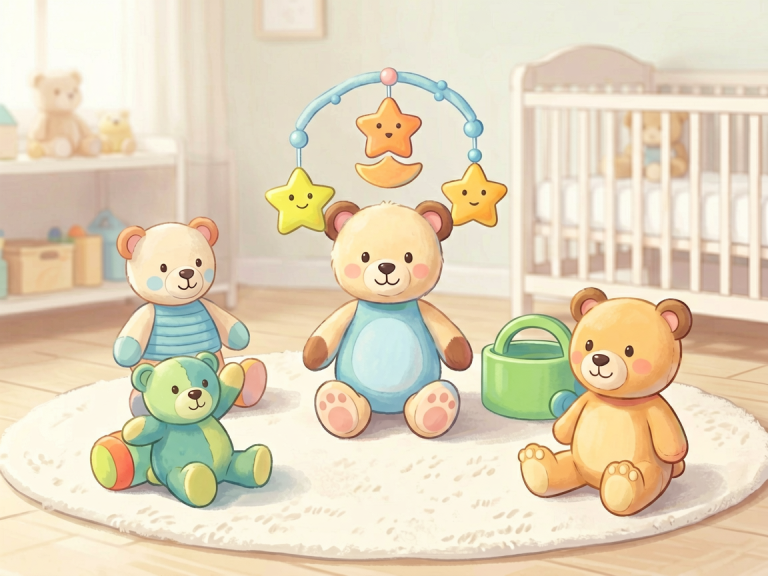
So, how many toys should newborns have? Based on developmental research and practical experience from early childhood experts like Magda Gerber (founder of RIE parenting) and Maria Montessori, the recommended range for a newborn (0–6 months) is between three and seven toys available at any one time. This number can be broken down as follows:
- One visual mobile (preferably a black-and-white or simple color pattern, hung above the changing table or crib).
- One grasping toy (e.g., a wooden ring, a fabric knot ball, or a soft rattle).
- One auditory toy (a gentle bell, a crinkle fabric, or a shaker).
- One textured object (a sensory ball with bumps, a silky scarf, or a crinkle book).
- One mirror (unbreakable, placed at floor level for tummy time).
- One soft doll or animal (for emotional attachment and early social play).
- One activity gym (optional, but if used, keep it simple—no more than two or three hanging toys).
This list can be rotated. In fact, rotation is the key to maintaining interest without increasing the total number. Every week or two, swap out one or two toys for others that you have stored away. The baby perceives these “new” objects as exciting, while the overall environment remains uncluttered.
The Danger of Too Many Toys: Beyond Overstimulation
Beyond immediate overstimulation, a surplus of toys in infancy can have longer-term consequences. Researchers at the University of Cambridge found that children who grew up in toy-rich but interaction-poor environments showed lower levels of sustained attention and higher rates of frustration at age two. The reason is that toys cannot replace human interaction. When a parent believes that buying more toys equals providing more stimulation, they may inadvertently substitute active engagement (talking, singing, making eye contact) with passive entertainment (turning on a musical toy, placing the baby in a bouncer surrounded by gadgets). The baby learns to be a passive consumer of stimuli rather than an active explorer.
Moreover, too many toys can impair the development of intrinsic motivation. A newborn who is always presented with a new, shiny object never learns to delight in the same rattle for ten minutes, studying its shape, texture, and sound from every angle. This deep, repetitive exploration is the bedrock of later problem-solving and creativity. As pediatric occupational therapist Angela Hanscom writes in her book *Balanced and Barefoot*, “Children need to be bored with their toys before they can become creative with them.”
The Role of the Caregiver: The Ultimate Toy
No discussion of newborn toys is complete without addressing the most important “toy” of all: the caregiver. A baby’s developing brain is wired for social interaction. The human voice, the warmth of touch, the mirroring of facial expressions—these are far more enriching than any manufactured object. In fact, a 2015 study from the University of Washington’s Institute for Learning & Brain Sciences demonstrated that infants as young as five months learned new sounds more effectively from a live human than from a recorded source. The same principle applies to play: a caregiver who sits with the baby, shakes a rattle slowly, and narrates “You hear that? It makes a ding-ding sound!” is offering a learning experience no toy can match.
Therefore, the true answer to “how many toys should newborns have?” is not a fixed number but a mindset: enough to spark curiosity, but not so many that they crowd out human connection. If you find yourself with more than eight or ten toys on the baby’s play mat or in the crib, consider donating, storing, or returning the extras. Focus instead on the quality of your interactions. Sing a simple song. Let the baby grasp your finger. Lie next to them on the floor and make silly faces. That is the richest “toy” a newborn will ever know.
Conclusion: Embrace the Empty Space
Parents often feel pressure to provide a stimulating environment from day one. But stimulation does not mean quantity; it means appropriateness. A newborn’s world is already full of wonder—the shifting shadows of a window, the rhythm of a parent’s heartbeat, the soft brush of a blanket. Toys are merely tools to support this natural exploration. By limiting the number to three to seven carefully chosen items, rotating them regularly, and prioritizing caregiver engagement, we give our babies exactly what they need: a calm, focused, and loving environment in which to grow. The next time a well-meaning relative asks what to buy for the new arrival, you can confidently reply, “Just one simple rattle, please. And maybe your time.”