Nurturing Development Through Play: Innovative Toy Ideas for Newborns
The first few months of a newborn’s life are a whirlwind of rapid growth, sensory discovery, and bonding. While it may seem that a baby’s primary needs are limited to feeding, sleeping, and cuddling, the right toys can play a surprisingly profound role in supporting their cognitive, motor, and emotional development. However, not every colorful object marketed for infants is suitable. Newborns have unique needs: they are drawn to high-contrast patterns, respond to gentle sounds, and explore the world through their mouths and hands. This article presents a carefully curated collection of toy ideas designed specifically for the first year of life, emphasizing safety, sensory engagement, and developmental appropriateness. Whether you are a new parent or shopping for a baby shower, these suggestions will help you choose toys that are not only entertaining but also enriching.
Sensory Stimulation: Toys That Ignite the Senses
At birth, a baby’s senses are still maturing. Vision is blurry and limited to about 8–12 inches, while hearing is acute and touch is the most developed. Toys that provide gentle, multi-sensory experiences are ideal.
High-Contrast Black-and-White Cards and Books are a classic choice. Newborns see bold patterns—especially black and white—better than pastels or complex images. These cards can be placed near the changing table or in the crib during supervised tummy time. As the baby grows, gradually introduce red as it becomes one of the first colors they perceive. Look for soft cloth books with crinkly pages and teething edges, combining visual interest with tactile exploration.
Soft Rattles and Wrist Rattles offer auditory and motor stimulation. A lightweight rattle with a gentle, non-jarring sound encourages a baby to turn toward noise, helping build auditory localization. Wrist or ankle rattles, worn with soft elastic bands, reward random limb movements with sound, inadvertently teaching cause and effect. Always ensure the rattle is too large to fit through a toilet paper roll to prevent choking hazards.
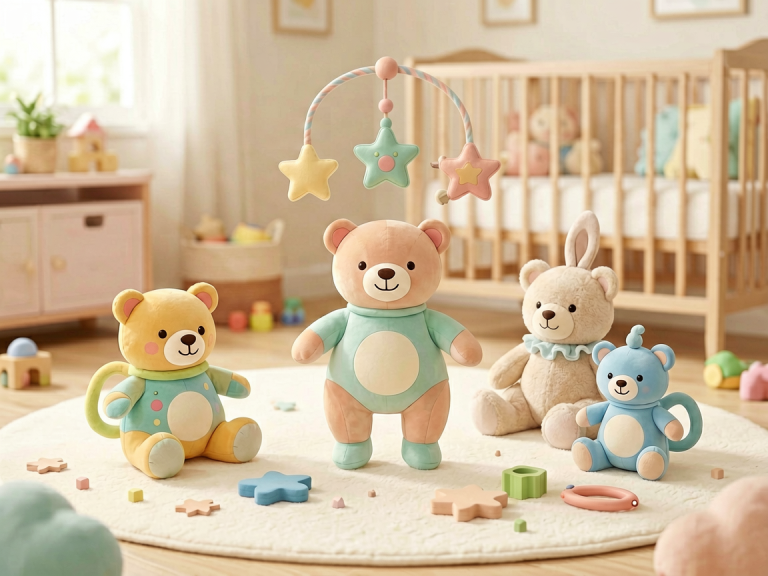
Musical Mobiles and Soothing Sound Toys can calm a fussy newborn. Instead of loud, jangling tunes, opt for mobiles with slow-moving, high-contrast shapes and lullabies that play for a limited time. Some modern options include white-noise mobiles or those that project gentle light patterns. Remember: mobiles should be removed once the baby can push up on their hands or sit, usually around 4–5 months, to avoid entanglement.
Motor Skill Development: Toys for Grasping and Kicking
A newborn’s movements are initially reflexive—the grasp reflex, the startle reflex—but within weeks, they begin to gain voluntary control. Toys that encourage reaching, batting, and kicking help build muscle strength and coordination.
Oball or Ring-Stackers (without the stacker part!) are excellent for tiny hands. The Oball is a plastic ball with many finger-sized holes, making it easy for a baby to grip, bat, and shake. Lightweight and chewable, it encourages bilateral hand use. Similarly, a set of large, interlocking plastic rings (like those from a stacker toy) can be offered individually. Babies love holding, mouthing, and dropping them—which also teaches object permanence and hand-eye coordination.
Activity Gyms and Play Mats are a staple for newborns. A well-designed gym features dangling toys that the baby can reach and kick. Look for a mat with a contrast pattern, a mirror (babies love faces), and hanging toys that are securely attached. Place the baby on their back first, then gradually introduce tummy time on the mat. The act of swatting at a hanging toy strengthens neck, arm, and core muscles. Some play mats come with pianos or lights triggered by kicks, adding an extra layer of motivation.
Tummy Time Toys deserve special mention. Many newborns dislike being on their belly, but it is critical for strengthening neck and shoulder muscles. Use a small, firm pillow or a rolled-up towel to prop the baby’s chest. Place a novel, shiny toy just out of reach—a small mirror, a textured ball, or a soft block. Some tummy time mats have built-in water-filled pads that move when the baby pushes, providing visual feedback. Rotate the toys regularly to keep the baby engaged.
Cognitive Engagement: Cause and Effect Toys
Around 3–4 months, babies begin to realize that their actions can produce interesting results. Simple cause-and-effect toys foster problem-solving and sustained attention.
Crinkle Paper and Texture Tags are low-tech but highly effective. A small cloth square with crinkly paper sewn inside or attached tags of different fabrics (velvet, corduroy, satin) invites exploration. The baby will bat, crumple, and chew the toy. Because the response is immediate—a sound or a texture change—it reinforces the connection between action and outcome.
Push-Button Sound Toys (age-appropriate versions) can be introduced around 6 months. Look for a toy with large, easy-to-press buttons that play a single note or a short melody. Some have flashing lights, which further captivate attention. Avoid toys with many complex buttons or loud, abrupt sounds—simplicity is key for this age. Even a simple “pop-up” toy, where the baby presses a large lever and a character springs up, can evoke giggles and curiosity.
Mirrors provide a fascinating form of cause-and-effect discovery. A shatterproof acrylic mirror attached to the side of the crib or play mat lets the baby explore facial expressions. At first, they see the reflection as another baby; later, they realize the movement is their own. This self-awareness milestone is supported by regular mirror play. Unbreakable mirrors are widely available and easy to clean.
Drop-and-Retrieve Toys, such as a soft ball that a baby can drop through a large hole in a box, teach object permanence. Initially, the baby may not understand where the ball went, but as they practice, they learn that objects continue to exist even when out of sight. A simple DIY version: a small plastic container with a hole cut in the lid and a soft ball tied to a string. Always supervise play with any container to prevent head entrapment.
Safety First: Choosing Age-Appropriate and Non-Toxic Toys
Safety is the non-negotiable foundation of any newborn toy. A toy that is not safe is not a toy at all—it is a hazard. When selecting or creating toys, keep these guidelines in mind.
Choking hazards are the primary concern. Any toy or part that can fit through a standard toilet paper roll (approximately 1.5 inches in diameter) is too small. Buttons, eyes on stuffed animals, small beads, and loose strings are all dangerous. Avoid toys with long cords or ribbons that could wrap around a baby’s neck. For mobiles and hanging toys, ensure the string is no longer than 12 inches and is securely attached.
Material and toxicity matter deeply. Babies mouth everything. Choose toys labeled BPA-free, phthalate-free, and lead-free. Wooden toys should have non-toxic, water-based paints. Fabric toys should be machine-washable and free from loose fibers. Avoid anything with strong chemical smells, as these may indicate off-gassing. Secondhand toys can be wonderful, but inspect them thoroughly for cracked plastic, peeling paint, or loose parts.
Age labeling is a helpful guide but not a guarantee. Manufacturers follow safety standards, but each baby develops at their own pace. If your 4-month-old can already roll and grasp, they may be ready for a toy labeled for 6 months, provided it has no small parts. Conversely, a toy for 12 months might have features that frustrate a younger baby. Use your judgment and always supervise play.
Cleaning and maintenance keep toys safe. Wash soft toys in hot water and dry thoroughly. Wipe hard plastic toys with a mild soap solution. Sanitize toys that go in the mouth regularly, especially during cold and flu season. Discard any toy that becomes cracked, broken, or develops sharp edges.
DIY and Budget-Friendly Toy Ideas
Not all excellent toys need to be store-bought. Parents can create simple, safe, and engaging toys from household items, saving money while adding a personal touch.
Sensory Socks are a quick project. Take a clean, soft baby sock and fill it with a few dried beans or rice (sealed in a small fabric pouch first to prevent leakage), then tie the end. The resulting “rattle” is gentle, easy to grasp, and completely mouth-safe if well-constructed. Make several with different textures: one with a jingle bell, another with crinkly plastic inside. Just ensure all fillings are securely enclosed.
Water Bottle Shakers are another favorite. Fill a small, clear plastic water bottle with a few tablespoons of dry rice, lentils, or glitter. Seal the cap tightly with super glue or duct tape. The baby will love watching the movement and feeling the weight. For extra visual interest, add a drop of food coloring to the rice or a few small beads (large enough to not be a choking hazard). Always check that the cap cannot be removed.
Texture Cards can be made from stiff cardboard (like a recycled cereal box). Cut into 4×6-inch rectangles, then glue on different fabrics: fleece, corduroy, satin, felt, or a small piece of faux fur. Laminate the cards or cover with clear contact paper to protect the fabric and allow wiping. These cards are lightweight, easy for a baby to hold, and provide rich tactile exploration.
A DIY Mirror Mobile can be created using an inexpensive unbreakable mirror and a wooden embroidery hoop. Attach the mirror to the hoop with strong thread, then hang it over a play mat. Add a few contrasting shapes (black-and-white felt circles) around the mirror. The baby will be drawn to their reflection, and the whole setup can be easily removed when no longer needed.
The beauty of DIY toys is that they can be customized to the baby’s current interests. If your newborn loves the sound of crinkling, make a crinkle toy from old potato chip bag wrappers (rinsed and dried) sealed inside a cloth pouch. If they respond to movement, tie a few lightweight ribbons to a wooden ring for a grasping toy. Always prioritize safety over convenience—no loose buttons, no long strings, no small items that could break off.
Conclusion
Selecting toys for a newborn is an opportunity to support the earliest stages of learning and bonding. From high-contrast cards that sharpen vision to simple rattles that build motor coordination, the best toys are those that respect the baby’s developmental pace and safety needs. Sensory stimulation, motor practice, and cause-and-effect play all weave together to form the foundation of future skills—language, problem-solving, and social interaction. Moreover, toys need not be expensive or elaborate. Homemade alternatives can be equally effective, sometimes even more so because they carry the warmth of a caregiver’s intention.
As you browse through stores or craft supplies, remember that a newborn’s attention span is fleeting, and their greatest joy often comes from interaction with a loving adult. A toy is a tool, not a substitute. So hold the rattle and shake it while you sing, lie on the play mat and show your baby how to kick the piano, or simply dangle a soft sock above their face and watch their eyes widen with wonder. In these moments, the toy becomes a bridge—connecting the baby’s curiosity to the world, and connecting you to each other. Choose wisely, play often, and enjoy every giggle, grab, and gurgle along the way.