From Cradle to Code: A Practical Guide to Choosing Coding Toys for Newborns
Introduction
The phrase “coding toys for newborns” may sound paradoxical at first. After all, newborns cannot hold a tablet, drag a block on a screen, or understand a single line of logic. Yet the foundational principles that make coding accessible to older children—pattern recognition, cause and effect, sequencing, and problem-solving—begin developing long before a child speaks their first word. For a newborn, every rattle, every black-and-white card, and every gentle musical mobile is, in a sense, a “code” being written into the neural pathways of their growing brain.
Choosing the right toys during the first few months of life is not about teaching syntax or algorithms. It is about creating an environment rich in the sensory inputs that build the cognitive scaffolding for later computational thinking. This guide will walk you through the key considerations for selecting developmentally appropriate, safe, and genuinely stimulating “coding” toys for newborns—toys that lay the groundwork for logical reasoning, attention, and curiosity.
—
Understanding Newborn Brain Development and the “Coding” Connection
Newborns are born with billions of neurons, but these neurons are not yet wired into efficient networks. Every sensory experience—sight, sound, touch, smell, and movement—strengthens certain synapses while pruning others. This process, known as synaptic plasticity, is the biological foundation for all future learning, including computational thinking.
When we talk about “coding” for a newborn, we refer to the earliest forms of pattern recognition and causal reasoning. A baby who hears a rattle shake every time they move their hand is learning a simple causal relationship: action → sound. A baby who watches a black-and-white spiral mobile rotate is tracking a repeating pattern. These are the same cognitive skills that later enable a child to understand “if this, then that” in a programming context.
Therefore, the best “coding toys” for newborns are those that:
- Offer high-contrast visual patterns to stimulate the developing visual cortex
- Provide simple, repeatable cause-and-effect feedback
- Encourage focused attention without overstimulation
- Engage multiple senses to build cross-modal connections
—
Key Features to Look for in Coding-Inspired Toys for Newborns
1. High Contrast and Simple Geometry
Newborns have limited visual acuity—they can focus best on objects 8–12 inches away and are most attracted to high-contrast black-and-white patterns. Toys with bold stripes, checkerboards, concentric circles, or simple facial features (like a bullseye or a smiley face) are excellent for visual development. These patterns help the brain learn to detect edges, contrast, and shape, which are the visual building blocks of pattern recognition in coding.
Look for:
- Black-and-white crib mobiles
- High-contrast cloth books with geometric patterns
- Black-and-white floor mats or play gyms
2. Simple, Predictable Cause and Effect
Coding is fundamentally about cause and effect: you give an instruction, and something happens. For a newborn, the simplest form of cause and effect is tactile or auditory. Toys that respond to the baby’s accidental movements—a rattle that shakes when the baby kicks a dangling toy, or a crinkle paper that makes a sound when touched—teach the baby that their actions have predictable consequences.
Important: The feedback must be immediate and consistent. Delayed or random responses are confusing for a newborn.
Look for:
- Soft, graspable rattles (with gentle sound)
- Activity gyms with hanging toys that move when batted
- Crinkle fabric blocks or tags
3. Gentle, Non-Overstimulating Sensory Input
Newborns have immature nervous systems. Too much stimulation—loud music, flashing lights, or too many colors—can cause stress, fussiness, or even withdrawal. The best “coding” toys for this age are those that offer one or two clear inputs at a time. A single, slow-moving mobile with black-and-white shapes is better than a blinking, multi-colored electronic toy.
The goal is to help the baby focus on one pattern or feedback loop, building attention span gradually.
Look for:
- Musical mobiles with a single lullaby (not a medley)
- Soft toys with one textured element (e.g., a satin tag)
- Uncluttered play mats with a few hanging elements
4. Safety Above All
Newborns explore with their mouths. Any toy must be:
- Made of non-toxic, BPA-free materials
- Free of small parts that could be a choking hazard
- Durable enough to withstand drool and washing
- Lightweight and soft to prevent injury if dropped on the baby
Always check age recommendations. Many toys labeled for “0+” are safe for newborns, but avoid anything with strings longer than 12 inches (strangulation risk) or batteries that could leak.
—
Top Types of “Coding” Toys for Newborns (and How to Use Them)
Black-and-White Pattern Cards and Books
These are the simplest and most effective coding toys. Place a card 8–12 inches from the baby’s face during tummy time or while they are lying on their back. Slowly move the card from side to side to encourage visual tracking. Change the card every few days to expose the baby to new patterns.
Why this is “coding”: The baby learns to predict that a certain pattern will appear in a certain location. Over time, they will begin to anticipate the next shape, a precursor to sequencing.
Activity Gyms with Hanging Elements
A play gym with a small, dangling toy that the baby can accidentally hit creates a powerful cause-and-effect lesson. Choose one with high-contrast shapes and a gentle sound (like a bell or a crinkle). Lie the baby underneath and let them discover their own ability to make the toy move.
Why this is “coding”: The baby learns that a specific motor action (kicking, batting) produces a specific outcome (sound, movement). This is the same logic as a simple computer command.
Soft Sensory Balls and Rattles
A soft, textured ball that makes a gentle jingle when squeezed is perfect for a 2- to 3-month-old who is beginning to reach. Look for balls with multiple textures (bumpy, smooth, ribbed) to encourage tactile exploration.
Why this is “coding”: The baby begins to associate a particular action (squeezing) with a sensory result (sound). They also learn that different textures feel different—a form of classification.
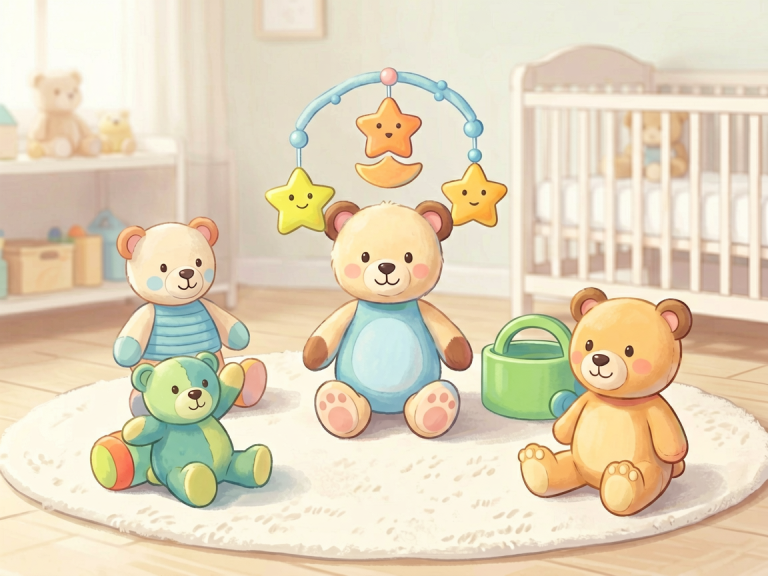
Musical Mobiles with Repeatable Melodies
A mobile that plays a short, simple lullaby when wound up (not electronic with flashing lights) teaches the baby about patterns in sound. The same melody repeated every time the mobile spins helps the baby recognize sequence.
Why this is “coding”: Music is essentially a pattern of notes in time. Recognizing that a certain set of notes follows another set is a basic form of algorithmic thinking.
Unbreakable Mirrors
A baby-safe mirror placed near the baby during tummy time allows them to see their own face. At first, they will not recognize themselves, but they will track the movement of the reflection.
Why this is “coding”: The mirror provides real-time feedback: the baby moves, and the reflection moves. This is a delayed form of cause and effect, teaching the baby that their actions have a mirrored consequence.
—
How to Introduce Toys and Encourage Early “Coding” Skills
- Observe the baby’s cues. If a toy makes the baby turn away, cry, or become agitated, it is too stimulating. Remove it and try a simpler alternative.
- Keep sessions short. Newborns have very short attention spans—2–5 minutes of focused interaction with a toy is plenty.
- Narrate the cause and effect. While the baby bats at a rattle, say, “You hit the rattle, and it made a sound! Let’s hear it again.” This language exposure, though not understood yet, builds neural connections linking action and speech.
- Rotate toys frequently. Newborns benefit from novelty, but not too much at once. Introduce one new toy per day and keep the rest out of sight to maintain curiosity.
- Be the “toy” yourself. Your face is the most interesting pattern to a newborn. Make exaggerated expressions, talk in a sing-song voice, and pause to see if the baby imitates your facial expressions. This back-and-forth interaction is the earliest form of turn-taking—a core component of collaboration in coding.
—
Safety Considerations: Non-Negotiables for Newborn Toys
- Choking hazards: Anything smaller than a toilet paper roll should not be given to a newborn unsupervised. Even rattles with small beads inside should be checked to ensure they are securely sealed.
- Chemical safety: Look for toys labeled “non-toxic,” “BPA-free,” “phthalate-free,” and “lead-free.” Avoid strong chemical smells.
- Strangulation risk: Never hang a mobile or toy with a long ribbon or cord directly over the crib where the baby can reach it. Mobiles should be out of arm’s reach.
- Cleaning: Newborn mouths explore everything. Choose toys that can be wiped clean or machine-washed without damaging them.
- Electronics: Avoid battery-operated toys for newborns. The few exceptions should have a sealed battery compartment, very low volume, and no flashing lights. As a rule, passive toys are far better for newborn brain development than active electronic ones.
—
Conclusion
Choosing “coding toys” for a newborn is not about preparing them for a future career in software engineering. It is about recognizing that the brain’s fundamental architecture is built in the first months of life, and that simple, well-designed toys can provide the right kind of stimulation to foster pattern recognition, causal reasoning, and focused attention—the very same skills that underpin all logical thinking, including coding.
When you hold a black-and-white card in front of your newborn and slowly move it from left to right, you are not just entertaining them. You are helping their brain learn to track a moving object, anticipate its path, and recognize a repeating visual sequence. That is the beginning of code.
So, choose toys that are simple, safe, and sensory-rich. Let your newborn discover the joy of making something happen—a rattle that sounds when they wave a hand, a mobile that spins when they coo. These small, joyful moments of cause and effect are the first lines of code written into a growing mind. And as your child grows, that foundation will support everything from reading to mathematics to creative problem-solving.
The best coding toy for a newborn? It is not a toy at all—it is a loving caregiver who pays attention, talks, and plays. But a few thoughtfully chosen objects can make that play even richer, one gentle pattern at a time.