The Digital Playground: How Coding Toys for Preschoolers Are Shaping the Next Generation of Thinkers
In an era where screens dominate much of our daily lives, a new category of educational tools has emerged that promises to bridge the gap between passive consumption and active creation for the youngest learners. Coding toys for preschoolers—colorful, tactile, screen-free or low-screen gadgets designed to introduce basic programming concepts—are rapidly gaining popularity among parents and educators alike. Far from being just another fad, these toys represent a thoughtful synthesis of developmental psychology, computer science, and play-based learning. They offer children as young as three or four the chance to develop computational thinking, logical reasoning, and problem-solving skills long before they can read or write a line of code. This article explores the multifaceted world of coding toys for preschoolers: why they matter, what types are available, how to select the best ones, and the critical role that adults play in guiding this digital exploration.
Why Coding Toys Matter for Early Childhood Development
The early years of a child’s life are a golden window for cognitive development, and coding toys are uniquely positioned to tap into that potential. Unlike traditional toys that focus on a single skill—like stacking blocks for fine motor skills or puzzles for spatial awareness—coding toys integrate multiple domains simultaneously. When a preschooler maneuvers a robotic bee along a path by pressing directional arrows, they are not just learning "forward" and "backward." They are internalizing the concept of sequencing, cause and effect, and debugging—a fancy term for figuring out why the robot didn't go where they wanted and trying again.
Research in developmental psychology suggests that children as young as three can grasp basic logic structures when presented in concrete, tangible forms. For instance, a toy that requires a child to plan a step-by-step route to a goal directly exercises what researchers call "executive function"—the set of mental skills that include working memory, flexible thinking, and self-control. These are the same cognitive muscles that later help children excel in mathematics, reading comprehension, and even social interactions. Moreover, coding toys foster resilience. In traditional play, a tower of blocks that falls can be frustrating, but a coding toy that "fails" to reach its target invites iteration: "Oh, I missed a turn; let me try a different sequence." This trial-and-error process normalizes mistakes as learning opportunities, a mindset that is invaluable in the 21st-century world.
Another crucial benefit is the demystification of technology. Preschoolers today are digital natives, but they often see computers and tablets as magical boxes. Coding toys peel back that magic, showing that behind every app or animation lies a set of instructions that people create. This early exposure can spark interest in STEM fields and, just as importantly, cultivate a sense of agency. Instead of being passive consumers of media, children become creators of their own small digital worlds. This shift in perspective has long-term implications for how they relate to technology throughout their lives.
Types of Coding Toys for Preschoolers: From Robots to Board Games
The market for coding toys aimed at the preschool set is surprisingly diverse. Understanding the categories can help parents and educators make informed choices. Here are the most prominent types, each with its own strengths and ideal use cases.
Robot-Based Coding Toys
These are perhaps the most iconic. Examples include the Bee-Bot, Botley the Coding Robot, and the Code-a-Pillar. Typically, these toys are shaped like friendly animals or vehicles and feature large, clearly labeled buttons on their backs. Children press buttons to input a sequence of commands—forward, backward, left, right, pause—and then press "go" to watch the robot execute the program. The immediate physical feedback is critical: the child sees their sequence come to life (or fail to) and can adjust. Many of these robots come with mats that have grids, roads, or environments, adding layers of challenge. For instance, the child might need to program the robot to travel from a starting point to a flower, avoiding obstacles. This type of toy is excellent for teaching sequencing, spatial awareness, and the concept of algorithms as step-by-step instructions.
Screen-Free Coding Kits
Some parents worry about screen time, and screen-free coding kits provide a perfect solution. These include physical coding blocks or cards that children arrange to create a program. For example, the Learning Resources Coding Critters set uses a booklet with codes; the child arranges plastic tiles in a line, and the toy animal "reads" the tiles and moves accordingly. Another popular product is Cubetto, a wooden robot that uses a physical programming board where children place blocks representing actions. The beauty of these kits is that they are entirely tactile, requiring no batteries beyond the robot itself. They allow group play, as multiple children can collaborate on a single sequence, and they eliminate the distracting glow of a screen. The downside is that they may have limited complexity compared to digital apps, but for preschoolers, that is actually a feature, not a bug.
App-Connected Coding Toys
Some toys bridge the physical and digital worlds. For instance, the Fisher-Price Code "n Learn Kinderbot uses a tablet app to control a physical robot, though the preschooler interacts mostly with the physical toy. Others, like the Osmo Coding Starter Kit, use a device's camera to recognize physical pieces placed in front of the tablet. The child arranges coding blocks on a mat, and the app responds with animations or game elements on the screen. These toys offer more dynamic feedback—the screen can show characters reacting to the child's code—but they do involve screen time, which requires careful moderation. Their advantage is engagement: the visual rewards can be highly motivating for young children who are used to bright, interactive media.
Board Games and Card Games
Not all coding toys need electronics. Simple board games like Robot Turtles (designed for ages 4 and up) use cards to represent commands like "forward" and "turn left." Players create a sequence of cards to guide their turtle to a jewel. Another example is Code Master, a logic puzzle game where players move tokens on a board. These games are excellent for family play, as they require no charging, no setup, and can be played anywhere. They teach the same fundamental concepts—sequencing, loops (when a player repeats a set of cards), and conditionals (if-then logic) in a context that feels like a game rather than a lesson. The social aspect of interacting with parents or siblings adds an extra layer of language development and collaborative problem-solving.
How to Choose the Right Coding Toy for Your Preschooler
Selecting the best coding toy is not a one-size-fits-all decision. The right choice depends on the child's age, developmental stage, interests, and the parent's educational goals. Below are key factors to consider.
Age Appropriateness
Most coding toys are labeled with an age range, but it is important to look beyond the box. For a three-year-old, a toy with large buttons and immediate, simple feedback (like a robot that moves one step per button press) is ideal. A child of that age may not yet understand sequencing beyond two or three steps. For a five-year-old, a toy that introduces conditionals (if the robot senses a wall, turn around) or simple loops (repeat an action three times) becomes appropriate. Overly complex toys can frustrate a preschooler and turn them off from coding entirely. Look for toys that have multiple levels of difficulty, so the child can grow with the toy.
Durability and Safety
Preschoolers are notorious for dropping, throwing, and chewing on toys. Ensure the coding toy is made of non-toxic, durable materials. Avoid small parts that could become choking hazards. Robot toys should have rounded edges and secure battery compartments. Many reputable brands like Fisher-Price, Learning Resources, and Wonder Workshop design their preschool products with these safety standards in mind. Also consider whether the toy requires batteries that are easy to replace or rechargeable, as nothing kills the learning momentum faster than a dead robot.
Open-Ended Play vs. Structured Challenges
Some coding toys come with a fixed set of challenges or missions—for example, a mat that has specific paths to complete. Others are more open-ended, allowing children to program the robot to move around freely without a goal. Both approaches have value. Structured challenges teach goal-oriented thinking and provide a clear sense of achievement when completed. Open-ended play encourages creativity and exploration; a child might try to make the robot dance or navigate an imaginary landscape. Ideally, the toy should offer both: a base set of guided activities and the freedom to experiment. Parental facilitation is often needed to shift between these modes.
Screen Time Management
If the toy requires a tablet or smartphone app, parents must decide how much screen time they are comfortable with. The American Academy of Pediatrics recommends limited, high-quality screen time for children aged 2 to 5, ideally co-viewed with a caregiver. App-connected toys can be a part of that, but they should not replace physical play. A good rule is to choose toys that are primarily physical, with the app serving as an enhancement rather than the core experience. Screen-free options like Cubetto or board games are excellent choices for families aiming to minimize screens while still teaching coding.
Budget and Long-Term Value
Coding toys can range from $20 for a simple card game to $150 for a sophisticated robot kit. Consider how long the toy will hold the child's interest. A $100 robot that is outgrown in six months may be less valuable than a $50 board game that can be played with siblings for years. Some toys offer expansion packs—additional mats, blocks, or challenges—which extend the life of the toy. Research online reviews and ask other parents about durability and longevity. Remember, the toy is a tool; the real value comes from the conversations, questions, and problem-solving that happen around it.
The Role of Parents and Educators: Guiding the Digital Playground
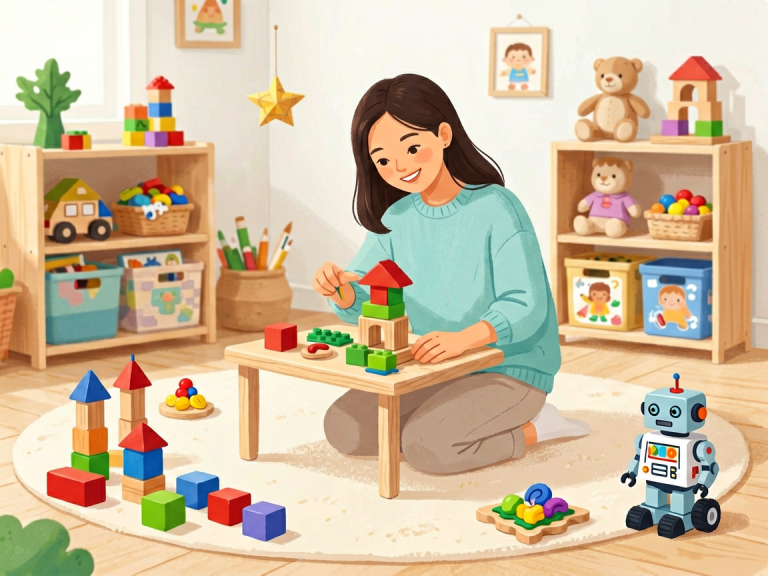
Coding toys are not magic. They do not automatically transform a preschooler into a junior programmer. The effectiveness of any educational toy is heavily dependent on the involvement of adults. A parent who sits with their child, asks open-ended questions, and celebrates failures as learning opportunities will extract far more value from a coding toy than a parent who hands it over like a pacifier. Here are key strategies for adults.
Scaffolding Without Solving
When a child's robot repeatedly crashes into a wall, it is tempting for an adult to jump in and say, "You need to turn right here." But that robs the child of the discovery process. Instead, use scaffolding: ask "What happened? Why do you think the robot didn't get to the flower? What could you try next?" This kind of Socratic questioning helps the child develop metacognition—thinking about their own thinking. For very young children, you might model debugging by saying, "Let's count the spaces together. One, two… oh, we need one more turn. Let's add a left." The goal is to be a co-pilot, not a driver.
Integrating Language and Math
Coding toys are rich opportunities for language development. Use vocabulary like "sequence," "pattern," "command," "bug," "debug," "unexpected behavior." When a child successfully programs the robot to go around a block, you can say, "Wow, you wrote an algorithm! That's a set of steps to solve a problem." This exposure to academic language in a playful context strengthens both literacy and numeracy. Additionally, many coding toys involve counting steps, measuring distances, and recognizing shapes, which reinforces early math skills.
Encouraging Collaboration
Coding in real-world settings is rarely a solo endeavor. Encourage siblings or playmates to work together on a single coding challenge. They will naturally negotiate whose turn it is to press a button, discuss strategies, and learn from each other's mistakes. This social dimension is crucial for developing communication skills, patience, and empathy. In a preschool classroom, teachers can set up coding stations where small groups rotate through activities. The discussions that arise—"No, I think we should go left first!"—are more valuable than any single correct answer.
Balancing Passion with Play
Not every child will fall in love with coding toys, and that is perfectly fine. The goal is not to create a generation of coders, but to expose children to a way of thinking that is broadly applicable. If a child shows little interest in a robot, there is no need to force it. Perhaps they prefer the block-based approach of a board game. Or perhaps they are more interested in art and storytelling—which can also be integrated by creating stories about the robot's journey. The key is to follow the child's lead. The most successful coding toy experiences are those where the child feels agency—they are playing, not being taught.
Conclusion: A Foundation for a Digital Future
Coding toys for preschoolers are much more than a trendy gift. They are thoughtfully designed tools that leverage the natural curiosity and hands-on learning style of young children to build foundational skills for the 21st century. By introducing concepts like sequencing, debugging, and logical thinking through play, these toys help children become not just consumers of technology, but creators. The variety available—from friendly robots to tactile tiles to board games—means there is a coding toy for nearly every family and classroom context.
However, it is crucial to remember that the toy is only as good as the environment around it. A coding robot sitting in a corner will teach nothing. But when a parent or teacher sits down with a child, asks probing questions, celebrates mistakes, and laughs together at the silly path the robot took, those moments become powerful learning experiences. The ultimate goal is not that every preschooler grows up to be a software engineer, but that they develop a mindset of persistence, creativity, and logical inquiry. In that sense, coding toys are not about preparing children for the future—they are about empowering them to shape it. As we continue to navigate an increasingly digital world, giving our youngest learners the tools to understand and influence that world is one of the most valuable gifts we can offer.