Introduction
Title: Age Appropriate Toy Checklist for Newborns: A Complete Guide for Stimulating Development Safely from Birth to 12 Months
Choosing the right toys for a newborn can feel overwhelming for new parents. With endless shelves of bright, noisy, and soft items, it is easy to fall into the trap of buying what looks cute rather than what actually supports a baby’s development. Yet the concept of “age appropriate toys” is not just a marketing phrase; it is a crucial framework that aligns a child’s growing cognitive, motor, and sensory abilities with playthings that are both safe and stimulating. For newborns—defined here as infants from birth through the first twelve months of life—the right toy can encourage visual tracking, hand-eye coordination, auditory awareness, and even early problem-solving. This checklist offers a month-by-month guide to help parents, caregivers, and gift-givers select toys that match each stage of infancy, while emphasizing safety standards such as avoiding small parts, toxic materials, and sharp edges. By following this age appropriate toy checklist, you will not only entertain your baby but also foster their natural curiosity and developmental milestones.
Why Age Appropriate Toys Matter for Newborns
Newborns are not simply miniature adults; their brains are developing at an astonishing rate, forming neural connections in response to sensory input. Toys that are too advanced can frustrate a baby, while toys that are too simple may fail to engage them. An age appropriate toy checklist ensures that the plaything matches the baby’s current abilities—for example, a newborn who cannot yet grasp objects will benefit from high-contrast black-and-white cards rather than a complicated shape sorter. Moreover, safety is paramount: toys for very young infants must be free of detachable parts, long strings, or any component that could pose a choking or strangulation hazard. The American Academy of Pediatrics recommends that parents always check the recommended age range on packaging and inspect toys regularly for wear. By using a structured checklist, you reduce guesswork and create a play environment that supports healthy development without unnecessary risk.
Birth to 3 Months: The Sensory Awakening Stage
During the first three months, a newborn’s vision is blurry (they can only focus on objects 8 to 12 inches away), and their movements are largely reflexive. The ideal toys for this stage target the senses—especially vision, hearing, and touch—without requiring active manipulation.
- High-Contrast Visual Cards or Mobiles: Black-and-white patterns with bold geometric shapes (circles, stripes, checkerboards) attract a newborn’s attention because their retina is most sensitive to high contrast. Hang a mobile above the crib or place cards within their line of sight during tummy time.
- Soft Rattles with Gentle Sound: A lightweight rattle that produces a soft, non-jarring sound helps develop auditory localization. Look for fabric rattles with no small beads that could come loose.
- Unbreakable Mirrors: A baby-safe mirror mounted on the side of the crib or used during tummy time helps the infant begin to recognize faces and follow movement.
- Soft, Textured Teethers: Although teeth are not yet emerging, textured silicone or cloth teethers provide oral stimulation and can be easily held by a parent during interaction.
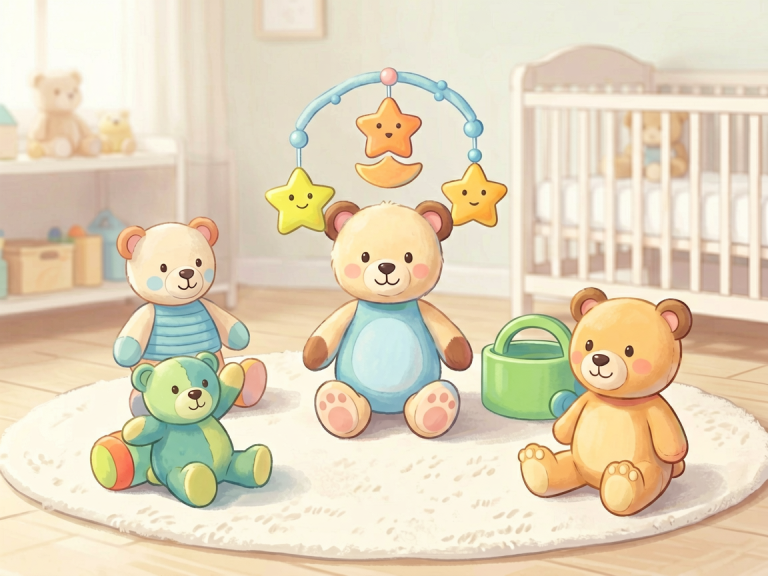
- Musical Toys with Soothing Melodies: A wind-up musical mobile or a plush toy that plays lullabies can calm a fussy newborn and introduce cause-and-effect when the parent activates it.
Safety note: Always avoid toys with strings longer than 12 inches, and ensure any fabric items are machine washable to keep them clean for a baby’s sensitive skin.
3 to 6 Months: The Grasping and Mouthing Phase
Between three and six months, babies begin to reach for objects intentionally, bring them to their mouths, and practice rolling over. Their vision improves, and they start to discriminate colors. Toys should now encourage grasping, tracking, and early cause-and-effect learning.
- Interlocking Rings or O-shaped Teethers: Simple plastic or silicone rings that are easy to grasp and chew. Multiple rings can be linked together for a later stage.
- Soft Activity Gym with Hanging Toys: A play mat with an arch and dangling toys (mirrors, crinkle fabrics, and soft plush) invites a baby to bat at objects, strengthening arm and hand muscles.
- Rattles with Different Grips: Look for rattles with varied textures (ridged, smooth, bumpy) and handles that are easy for small fists to hold. The sound reinforces the action of shaking.
- Crinkle Books or Fabric Books: Brightly colored fabric pages with crinkly paper inside and simple images (faces, animals) stimulate hearing and vision. They are also safe for mouthing.
- Sensory Balls: Soft, lightweight balls with nubs, bumps, or ridges allow a baby to explore different textures while practicing grasping. Some can be squeezed to produce a squeak.
6 to 9 Months: The Sitting Up and Reaching Stage
As babies learn to sit unsupported and begin to scoot or crawl, their world expands. They become more intentional in their play, transferring objects from hand to hand, banging toys together, and showing interest in cause-and-effect.
- Stacking Cups or Nesting Blocks: A set of brightly colored cups that stack inside each other or build a tower. Babies enjoy knocking them down and later will learn to stack themselves.
- Simple Shape Sorters with Large Pieces: Choose a sorter with only two or three large shapes (circle, square, triangle) that are chunky and easy to grasp. The child may not yet sort correctly, but they will enjoy putting pieces in and out.
- Activity Cubes or Busy Boxes: A cube with various interactive elements—spinning beads, sliding doors, mirror, squeaky buttons—promotes fine motor exploration.
- Push-Pull Toys (stationary use): For babies who are not yet walking, a stationary activity panel with sliding beads, gears, or knobs can be mounted on a playpen or floor.
- Soft Balls with Bells Inside: A soft, fabric ball with an embedded bell encourages auditory tracking as the baby rolls or pushes it.
9 to 12 Months: The Mobile Explorer Stage
Between nine months and the first birthday, many babies crawl, cruise along furniture, and may even take their first steps. They also develop pincer grasp (thumb and forefinger) and love to imitate actions. Toys should now support mobility, problem-solving, and social interaction.
- Pull-Along Toys: A wooden or plastic animal on wheels that babies can pull as they crawl or walk. Ensure the pull string is short and sturdy.
- Stacking Rings on a Base: A cone-shaped stacker with graduated rings. This classic toy teaches size sequencing and hand-eye coordination.
- Board Books with Real Photos: Sturdy cardboard books with simple, clear images of familiar objects (balls, dogs, bottles) help build vocabulary and interest in reading.
- Cause-and-Effect Toys: Pop-up toys where the baby pushes a button to make an animal jump, or a simple xylophone that produces notes when struck. These teach that actions produce results.
- Push Walkers (with brakes): A sturdy, weighted push-walker that provides stability for first steps. Avoid those with removable parts that could become choking hazards.
General Safety Considerations Across All Stages
No matter which toys you select from this age appropriate toy checklist, always adhere to these universal safety rules:
- Choking hazard check: Use a small-parts tester (or a toilet paper tube) to ensure no component can fit through. Any toy labeled “for ages 3+” is unsuitable.
- Material safety: Choose toys made of BPA-free plastic, non-toxic paint, and organic cotton whenever possible. Avoid phthalates and lead.
- Durability: Inspect for loose threads, cracks, or broken seams. discard any toy that shows signs of wear.
- Volume control: For electronic toys, keep sound levels low to protect a baby’s sensitive hearing.
- Supervision: Always supervise play, especially with toys that have moving parts or strings.
Conclusion
An age appropriate toy checklist for newborns is more than a shopping list—it is a roadmap for nurturing a baby’s development through purposeful play. From the high-contrast patterns that captivate a two-week-old to the push walker that aids a ten-month-old’s first steps, each toy serves a specific role in building neural pathways, motor coordination, and confidence. Remember that the best toy is often the simplest: a loving parent’s face, your voice, and your presence are the most stimulating “toys” of all. However, by using this checklist as a guide, you can beautifully complement that natural interaction with safe, engaging objects that grow with your child. Happy playing, and happy growing.