Introduction: Redefining Graduation for the Tiniest Learners
The Ultimate Guide to Screen-Free Graduation Gifts for Newborns: Celebrating Milestones Without Digital Distractions
When we hear the word “graduation,” we typically picture cap-and-gown ceremonies, diplomas, and the closing of one chapter before embarking on the next. But for newborns, every tiny milestone—rolling over, sitting up, speaking a first word, or simply surviving the first month of life outside the womb—is a graduation of its own. These fleeting moments deserve to be celebrated with intention, meaning, and a deep awareness of what truly nurtures a developing brain.
In an age where screens are ubiquitous, from smart phones to baby tablets, a growing number of parents and caregivers are consciously choosing to delay digital exposure. The American Academy of Pediatrics recommends zero screen time for children under 18 months (except for video chatting), emphasizing that hands-on, sensory-rich interactions are vital for neural wiring. This is where the concept of “screen-free graduation gifts for newborns” becomes not just a niche trend but a powerful statement. These gifts honor a baby’s natural way of learning—through touch, sound, movement, and human connection—while freeing parents from the pressure of handing their child a glowing rectangle.
This article will explore why screen-free gifts matter, offer a curated list of thoughtful options across different developmental domains, and explain how each gift supports a newborn’s first “graduations.” Whether you are a grandparent, a friend, or a parent looking for gift inspiration, you will find that the best presents for a new life are often the simplest, most tactile ones.
—
Why Screen-Free? The Science of Early Brain Development
Before diving into specific gift ideas, it is essential to understand *why* avoiding screens in infancy is so critical. A newborn’s brain is a marvel of plasticity—it forms up to one million new neural connections every second during the first few years. These connections are built through direct, multi-sensory experiences: grasping a textured rattle, hearing a parent’s voice, feeling the weight of a wooden block, or gazing at a high-contrast black-and-white mobile. Screens, by contrast, provide passive, two-dimensional stimulation that does not engage the same neural pathways.
The risk of early screen exposure is well documented. Studies link excessive screen time in infancy to delayed language development, reduced attention span, and poorer executive function later in childhood. More subtly, screens can displace the very interactions babies need—eye contact, turn-taking, and responsive caregiving. A baby who stares at a flashing digital toy is not practicing the vital skill of joint attention, nor are they learning cause and effect as they would when shaking a bell and hearing its sound.
Graduation gifts that are screen-free send a clear message: we value your baby’s natural development, we trust in the power of real-world exploration, and we want to support a childhood that is immersive, not immersive in blue light. These gifts also serve parents, reducing the temptation to hand over a device as a quick distraction and encouraging more hands-on play. In a world where “educational” apps market themselves as essential for early learning, choosing a wooden puzzle or a set of organic cotton dolls becomes a quiet act of rebellion—one that benefits everyone.
—
Top Screen-Free Graduation Gift Categories for Newborns
The best screen-free gifts are those that grow with the child, offering different layers of engagement as the baby reaches new milestones. Below are five categories, each with specific recommendations that align with a newborn’s developmental journey from birth through the first year.
1. Sensory Stimulation Kits and Textured Toys
A newborn’s first “job” is to make sense of a chaotic world. Their senses are raw and hungry for input, but they need gentle, varied, and safe stimulation. Screen-free sensory gifts are designed to engage touch, sight, hearing, and even taste (safely) without overwhelming the baby.
- High-contrast black-and-white cloth books: Newborns see best in high contrast for the first few months. Cloth books with bold patterns, like checkerboards, stripes, and simple faces, captivate their attention and encourage visual tracking. Unlike a screen, these books can be crumpled, chewed, and cuddled. Brands like Wee Gallery offer beautiful, screen-free options.
- Natural rubber teethers and grasping toys: Toys made from 100% natural rubber (like those from Sophie la Girafe or Hevea) are soft, safe, and have appealing textures. A ring-shaped teether with ridges provides tactile feedback and can be easily grasped by tiny hands. This type of toy supports fine motor development and oral exploration.
- Silk scarves or crinkle fabric squares: Often overlooked, a simple square of silk or a crinkle fabric toy can provide hours of fascination. Babies love the gentle sound, the way light filters through the fabric, and the feeling of draping it over their face (supervised). These are perfect for peek-a-boo games, which teach object permanence—a major cognitive graduation.
2. Musical Instruments That Require Real Action
Music is a universal language, and for newborns, it is a gateway to rhythm, emotional bonding, and auditory processing. Screen-free musical gifts are those that the baby (or parent) must actively produce sound from, rather than a button that plays a pre-recorded tune.
- Egg shakers and small maracas: Lightweight, easy to grip, and made from wood or plastic-free materials, egg shakers introduce the concept of cause and effect. A baby who shakes an egg hears a sound; this simple loop is endlessly rewarding. For older newborns (around 4–6 months), a small hand-held wooden drum with a mallet encourages arm coordination.
- Kalimba or gentle chimes: A kalimba (thumb piano) played softly by a parent can create a calming atmosphere. Its pure, resonant tones are far more soothing than a digital lullaby played through a speaker. The baby learns to associate human hands with beautiful sounds—a lesson in intentionality.
- Musical mobiles with real wind-up mechanisms: Instead of a battery-operated mobile that plays tinny melodies, choose a wind-up wooden mobile. The gentle, mechanical ticking and the act of winding it yourself invites the baby to watch and anticipate. Some mobiles even feature interchangeable wooden characters that move as the mechanism turns.
3. Wooden or Fabric Building Blocks
Block play is arguably the most versatile and developmentally rich gift you can give a newborn. While it may be years before they can stack a tower, the early stages of block exploration are just as important.
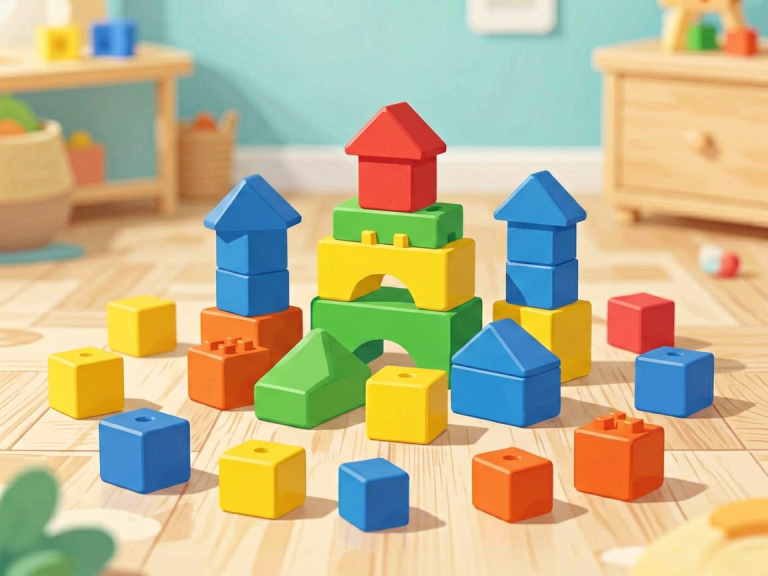
- Unpainted, organic wooden blocks: Newborns will naturally mouth them, so it is vital that blocks are finished with non-toxic oils or left raw. The varied shapes (cubes, cylinders, arches) offer different sizes and weights, helping babies develop proprioception. Later, when they begin to stack, blocks teach balance, symmetry, and spatial reasoning—all without a single pixel.
- Soft fabric blocks with mirrors or bells: For very young infants, fabric blocks with built-in crinkle corners, a small mirror, or a hidden rattle are ideal. They can be shaken, dropped, and chewed. The mirror inside (safe and infant-friendly) lets the baby discover their own reflection—a classic milestone of self-awareness.
- Block sets with pattern cards: As the baby grows into a toddler, pattern cards (simple images of objects like a house or a flower) become a challenge to replicate. This is a screen-free version of a puzzle game, encouraging visual discrimination and problem-solving.
4. Books That Demand Interaction, Not a Battery
Books are the ultimate screen-free gift. They are portable, tactile, and portable; and they create a ritual of closeness between caregiver and infant. But not all baby books are created equal. Look for those that prioritize sensory engagement and avoid batteries, lights, or sound buttons.
- Texture touch-and-feel books: Titles like *Pat the Bunny* or *That’s Not My Puppy* allow babies to stroke fur, scratch a bumpy surface, or lift a flap. Each page is a small tactile adventure. These books support fine motor skills (paging, grasping) and vocabulary acquisition as the adult narrates the textures.
- Board books with cut-out shapes: Books where pages have finger holes or die-cut windows encourage babies to reach through, poking fingers and surprising themselves. They also teach part-to-whole relationships. For example, a page with a round hole for a “wheel” on a car leads to peek-a-boo fun.
- Storytelling props: A set of small felt animals or a storytelling puppet (like a soft hedgehog or bear) transforms a book into a live performance. Parents can use the prop to act out the story, making it a multi-sensory experience. This is especially powerful for language development because the baby sees the object and hears the word simultaneously.
5. Nature-Inspired and Open-Ended Play Objects
Finally, consider gifts that connect the baby with the natural world—objects that have no fixed purpose but invite exploration. These are the antithesis of plastic, single-purpose toys with flashing lights.
- A smooth wooden or silicone stacking ring: Classic stacking rings (without numbers or characters) allow the baby to explore sizes and order. They can also be used as teethers, or the rings can be rolled and chased. The open-ended nature means a twelve-month-old may use them as bracelets, and a two-year-old may use them as wheels for a toy car.
- Cotton or wool play mats with patterns: A hand-knitted play mat depicting a garden, a road, or an ocean provides a backdrop for imaginative play. Unlike a tablet game with predetermined scenes, the mat invites the child to create their own narratives using blocks, animals, or their own body.
- Simple wooden cars or animals: A set of unpainted wooden animals or vehicles encourages the creation of sound effects (vroom, baa) and storylines. Because there are no batteries, the child must invent the movement and sound themselves—a powerful cognitive workout.
—
How to Choose the Right Gift: A Checklist for Givers
Selecting a screen-free graduation gift for a newborn can feel overwhelming given the sheer number of options. Keep these criteria in mind to ensure your gift is both cherished and developmentally appropriate:
- Safety first: Ensure the gift is BPA-free, phthalate-free, and has no small parts that could become choking hazards. For newborns, choose items that are large enough to prevent swallowing and made of materials that can be washed or wiped.
- Open-ended potential: Does the toy have a single purpose, or can it be used in multiple ways? The more flexible the toy, the longer it will engage the child. A wooden block is infinitely more open-ended than a plastic shape-sorter with fixed holes.
- Parent-approved: While the baby is the recipient, parents are the gatekeepers. Consider gifting something that makes *their* life easier or more joyful, like a set of organic cotton bibs with fun patterns, or a baby carrier without electronic features. Screen-free doesn’t mean boring—many parents welcome gifts that reduce noise and clutter.
- Social-emotional value: Does the gift encourage interaction between the baby and the caregiver? A puppet that the parent uses to tell a story fosters connection; a screen-based gadget isolates. Choose gifts that build relationships, not walls.
- Sustainability: Newborns grow fast. Opt for gifts that are durable, timeless, and perhaps even gifted down to siblings or friends. Wood, cotton, wool, and natural rubber are excellent choices that also reduce plastic waste.
—
Conclusion: The Graduation That Matters Most
A newborn’s journey is not marked by degrees or certificates, but by the soft accumulation of skills—a first smile, a grasp, a tentative crawl toward a beloved toy. These graduations are microscopic and monumental at once, and they deserve to be celebrated with gifts that honor the slowness and richness of early childhood. Screen-free graduation gifts are not a rejection of technology; they are a deliberate embrace of what babies truly need: touch, sound, movement, human presence, and the freedom to explore without a pixel in sight.
By choosing a hand-carved wooden rattle over an electronic toy tablet, you are casting a vote for a childhood that values imagination over instant gratification. You are telling the parents, “I see you. I support your choice to raise a child who knows the weight of a real stone, the sound of a real bell, and the warmth of a real book in your lap.” And to the baby, you give the best gift of all—the chance to graduate into a world that respects their innate wisdom, one sensory experience at a time.
So the next time you search for a gift for a newborn’s milestone, remember: the most memorable gifts are those that leave no digital footprint, yet leave an indelible mark on a child’s heart and mind. Screen-free is not a limitation—it is liberation.