The Ultimate Math Toys Guide for Parents: Turning Play into Powerful Learning
As parents, we all want to give our children a head start in life, and mathematics is a subject that often sparks both excitement and anxiety. The good news is that you don’t need formal lessons or expensive tutors to build a strong mathematical foundation. Math toys—carefully selected and thoughtfully used—can transform playtime into a rich, joyful learning experience. This guide will walk you through why math toys matter, how to choose the right ones for each age, which types offer the most value, and how you can make the most of them at home. By the end, you’ll feel confident in turning your child’s natural curiosity into a lifelong love for numbers, patterns, and problem-solving.
Why Math Toys Matter: Building a Strong Foundation
Mathematics is not just about counting or memorizing multiplication tables; it’s a way of thinking. It involves recognizing patterns, understanding spatial relationships, reasoning logically, and solving problems creatively. Math toys help children develop these cognitive skills naturally, through hands-on exploration. Unlike worksheets or screen-based apps, physical toys engage multiple senses—touch, sight, and even sound—which strengthens neural connections and deepens understanding.
Research in early childhood education has shown that children who play with math-related toys from an early age develop better number sense, spatial awareness, and executive function skills. Moreover, math toys reduce the fear of failure. When a child builds a tower that collapses, they learn about balance and gravity without feeling “wrong.” They experiment, adjust, and try again—a process that mirrors real mathematical inquiry. By making math tangible and fun, these toys create positive associations that last a lifetime.
But not all toys labeled “educational” are created equal. The best math toys are open-ended, encourage multiple solutions, and grow with the child. They allow for both guided play and independent discovery. As a parent, your role is not to teach but to facilitate—to ask questions, provide challenges, and celebrate the journey. This guide will help you navigate the vast market and choose toys that truly deliver on their promise.
Choosing the Right Math Toys by Age
One of the most common mistakes parents make is buying a toy that is either too simple or too advanced for their child’s developmental stage. A toy that offers no challenge leads to boredom; one that is too complex causes frustration. Here’s a breakdown by age group to help you match toys to your child’s growing abilities.
Ages 3–5: The Age of Sensory Exploration and Early Number Sense
At this stage, children are learning to count, recognize numbers, and understand basic concepts like “more” and “less.” Their play is heavily sensory and motor-driven. Look for toys that involve sorting, stacking, and simple matching. Excellent choices include:
- Counting bears or animal counters: These colorful, tactile pieces allow children to sort by color or size, count them, and create simple patterns.
- Number puzzles with large, easy-to-grip pieces: Wooden puzzles with numbers 1–10 help children associate numerals with quantities.
- Shape sorters and pattern blocks: These develop spatial reasoning and introduce geometric shapes.
- Simple dice games: Roll a die and count the dots; then move a game piece that many steps. Games like “Hi Ho! Cherry-O” integrate counting in a fun context.
Avoid toys with too many small pieces or complex instructions. Instead, focus on open-ended exploration. At this age, parent involvement is key—count aloud, ask “How many bears do you see?” and celebrate every small discovery.
Ages 6–8: Building Arithmetic and Logical Thinking
Children in early elementary school are ready for addition, subtraction, basic multiplication, and more complex patterns. They also begin to understand place value and measurement. Math toys for this age should challenge them without overwhelming them. Top picks include:
- MathLink Cubes (or similar connecting cubes): These versatile blocks can be used for counting, adding, subtracting, and even introducing multiplication as repeated addition. They also help visualize place value (e.g., a rod of ten cubes).
- Fraction circles or pizza fractions: Hands-on fractions are far more intuitive than abstract symbols. Let your child “share” a pizza among friends to understand halves, thirds, and quarters.
- Board games with numbers: Games like “Sum Swamp” or “Monopoly Junior” require adding and subtracting small numbers. “Pair-a-Dice” challenges players to match sums.
- Tangrams and geoboards: These toys develop spatial visualization and geometry. Geoboards let children create shapes with rubber bands, exploring area and symmetry.
Encourage children to play with these toys in different ways. For example, with MathLink Cubes, challenge them to build a tower that is exactly 13 cubes high, or to find two different ways to make 10.
Ages 9–12: Abstract Reasoning and Strategic Thinking
Older children can handle more abstract concepts like negative numbers, fractions, decimals, ratios, and algebraic thinking. Their play should involve strategy, logic, and multi-step problem-solving. Excellent choices include:
- Prime Climb: A beautiful board game that reinforces multiplication, division, and prime numbers. It’s deeply strategic and can be played at multiple difficulty levels.
- Blokus or Qwirkle: These strategy games require spatial reasoning, pattern recognition, and planning ahead—all mathematical skills.
- Equate (math version of Scrabble): Players create equations using number and operation tiles, reinforcing mental arithmetic and order of operations.
- Rubik’s Cube and other twisty puzzles: These develop spatial memory, algorithmic thinking, and persistence. Many online tutorials teach solve methods that involve patterns.
- Geometry construction sets like Zometool or K’NEX: These allow children to build complex 3-D structures, exploring angles, symmetry, and structural integrity.
At this age, children can play independently or with peers. However, parents can still ask thought-provoking questions: “How many different ways can you make 24 using these four numbers?” or “What happens to the perimeter if you double the side length?”
Types of Math Toys to Look For
Beyond age-specific recommendations, it helps to understand the main categories of math toys and what each one teaches. When browsing online or in stores, keep an eye out for these types:
Counting and Number Toys
These focus on numeral recognition, one-to-one correspondence, and basic arithmetic. Examples: abacus, number lines, counting frames (like 10-frames), and “money” sets (play coins and bills). They are especially useful for building automaticity with number facts.
Shape and Space Toys
Geometry comes alive through toys that let children manipulate shapes in 2-D and 3-D. Think tangrams, pattern blocks, geoboards, magnetic tiles, and 3-D shape nets. These toys improve spatial reasoning which is a strong predictor of later success in STEM fields.
Logic and Strategy Toys
Puzzles, brainteasers, and strategy games teach logical deduction, planning, and systematic thinking. Sudoku for kids, rush hour traffic jam puzzles, and board games like “Catan Junior” or “Ticket to Ride” all require mathematical thinking without explicit numbers.
Measurement and Fraction Toys
Understanding measurement—length, weight, volume, time—is a core math skill. Toy measuring tapes, scales, kitchen measuring cups, sand timers, and fraction sets can make these concepts concrete. For example, baking cookies together using measuring cups is a natural math activity.
Pattern and Sequence Toys
Pattern recognition is the heart of algebra. Toys like bead sequencing kits, pattern block cards, and color-coded pegboards encourage children to identify and extend patterns. Even simple building blocks (like LEGO) can be used to create repeating patterns.
How to Use Math Toys Effectively: Tips for Parents
Buying the right toys is only half the battle. How you use them matters even more. Here are practical strategies to maximize learning:
- Follow the child’s lead. Let your child explore the toy in their own way first. If they want to use pattern blocks to make a flower instead of a geometric design, that’s fine. Later, you can gently steer toward a mathematical observation: “I noticed your flower has 6 petals—that’s an even number!”
- Ask open-ended questions. Instead of “What’s 2+3?”, try “How many different ways can you arrange these 5 blocks to make a rectangle?” or “What if you added one more? What would happen?” These questions encourage experimentation.
- Incorporate math into daily routines. Use math toys alongside everyday activities. While setting the table, have your child count out the correct number of plates. At snack time, ask them to divide a granola bar into halves or quarters using a toy fraction set.
- Create challenges. After your child has mastered basic play, introduce friendly challenges. “Can you build a tower that is taller than this book?” “Let’s see who can make the longest number pattern.”
- Rotate toys. Children get bored if they see the same toys every day. Keep a small selection out and rotate them every few weeks. This keeps the play fresh and rekindles curiosity.
- Emphasize process over answer. When a child makes a mistake, avoid correcting them immediately. Instead, ask “Why do you think that happened?” or “What could you try differently?” Mathematical resilience is built through trial and error.
Conclusion: Play, Explore, and Grow Together
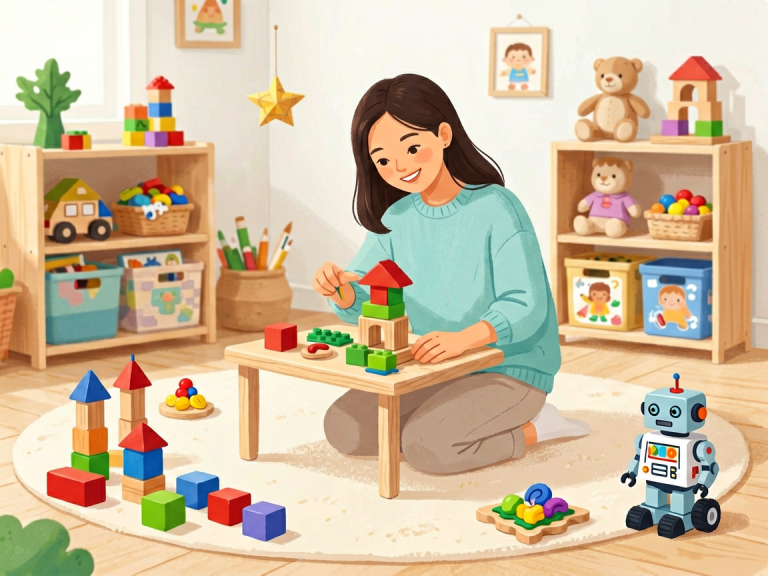
Math toys are not magic; they are tools that, when paired with thoughtful adult interaction, unlock a world of exploration and understanding. The best “math toy” you can give your child is your time, attention, and enthusiasm. Sit on the floor with them, ask silly questions, marvel at their discoveries, and let them teach you something. Remember that every child learns at their own pace—some will love counting, others will fall in love with shapes. By providing a variety of quality math toys and a supportive environment, you are giving your child a gift far greater than academic success: you are nurturing a curious, resilient, and creative mind that will serve them in all areas of life.
So go ahead—stock your playroom with pattern blocks, dice, tangrams, and building cubes. But more importantly, stock your parenting toolkit with patience, questions, and a sense of wonder. The math adventure begins with a single toy, and it never really ends. Happy playing!