The Power of Play: How Math Toys Foster Foundational Skills in Elementary Children
Mathematics is often viewed as a daunting subject—a world of abstract symbols, memorized formulas, and timed tests that can leave young children feeling anxious rather than curious. Yet the same children who struggle with a worksheet can effortlessly count Pokémon cards, calculate the angles of a Lego structure, or strategize their next move in a board game. This discrepancy reveals a simple truth: children learn math best when they are playing. Math toys for elementary kids bridge the gap between the abstract and the concrete, transforming complex concepts into tangible, joyful experiences. In this article, we will explore why math toys are essential, examine the different categories available, discuss how to choose the right ones, and provide practical advice for integrating them into home and classroom settings.
Why Math Toys Matter: Beyond Rote Memorization
Traditional math education in early elementary years often emphasizes speed and memorization—flashcards for addition, timed drills for multiplication, and endless repetition of number facts. While these methods have their place, they can inadvertently teach children that math is a chore rather than a tool for thinking. Math toys, by contrast, invite children to explore mathematical ideas on their own terms. A child playing with a set of colorful counting bears is not just “practicing counting”; she is discovering one-to-one correspondence, classifying objects by color and size, and beginning to grasp the concept of sets. These foundational skills are the bedrock of number sense, and they emerge naturally through play.
Research in developmental psychology and neuroscience supports this approach. The work of researchers such as Kathy Hirsh-Pasek and Roberta Michnick Golinkoff has shown that guided play—where adults provide toys and a rich environment but allow children to direct their own exploration—promotes deeper learning than direct instruction alone. When children manipulate physical objects, they engage multiple senses: sight, touch, and even movement. This multisensory engagement creates stronger neural connections. For example, a child who builds a tower with unit blocks is learning about spatial relationships, balance, and symmetry, all of which are precursors to geometry and measurement. Moreover, play reduces the fear of failure. In a game, a wrong answer is simply a step toward a better strategy, not a mark of inadequacy. This low-stakes environment encourages persistence, creativity, and a growth mindset.
Math toys also address a critical issue: the math anxiety that often begins in elementary school. A 2012 study published in the *Journal of Experimental Psychology* found that children as young as first grade can experience math anxiety, and it correlates with lower performance. Toys that make math fun can break this cycle. When a child associates mathematical thinking with the joy of a game or the satisfaction of building something, the subject becomes less intimidating. In short, math toys are not just educational supplements; they are powerful tools for shaping positive attitudes toward mathematics.
Categories of Math Toys and Their Developmental Benefits
Not all math toys are created equal. Different toys target different aspects of mathematical thinking, and understanding these categories can help parents and educators make informed choices. Below, we explore four broad categories, each with specific developmental benefits for elementary-aged children.
Counting and Number Sense Toys
The foundation of all mathematics is number sense—the ability to understand, relate, and manipulate numbers. For children in kindergarten through second grade, toys that emphasize counting, quantity, and basic operations are invaluable. Classic examples include counting bears, linking cubes (such as Unifix or Snap Cubes), and abacuses. These toys allow children to physically move objects as they count, add, or subtract, which grounds abstract symbols in concrete experience. For instance, a child who lines up ten bears and then removes three can see and feel that seven remain. This visual and tactile feedback is far more memorable than a worksheet showing “10 – 3 = 7.”
More advanced number sense toys introduce place value. Base-ten blocks, for example, come in units (ones), rods (tens), flats (hundreds), and cubes (thousands). A child can build a number like 243 by grouping two flats, four rods, and three units. This hands-on modeling makes the concept of regrouping—so often a stumbling block in addition and subtraction—intuitively clear. Similarly, toy cash registers with play money teach coin values and making change, while number lines and hundred charts can be turned into floor games where children physically step from one number to another. The key benefit here is that children develop a sense of magnitude: they begin to understand that 100 is much larger than 10, not just a symbol on a page.
Geometry and Spatial Reasoning Toys
Geometry is often taught as the memorization of shape names and properties, but true spatial reasoning involves understanding how shapes interact, transform, and fit together. Toys in this category include tangrams, pattern blocks, magnetic tiles, and construction sets like LEGO or wooden blocks. For early elementary children, tangrams—a Chinese puzzle made of seven geometric pieces—challenge them to form specific shapes using all pieces. This requires mental rotation, symmetry awareness, and problem-solving. Pattern blocks, with their hexagonal, triangular, and rhombus shapes, allow children to explore tessellations, fractions (e.g., how many triangles make a hexagon?), and congruence.
Magnetic tiles have become particularly popular in recent years, and for good reason. These translucent tiles with magnetic edges let children build 2D and 3D structures. When a child constructs a cube from six square tiles, they are not just playing—they are internalizing the properties of a cube: six faces, twelve edges, eight vertices. They can see that a square is a 2D face of a 3D shape. Moreover, building with tiles encourages planning and estimation: how many tiles will I need to make a tower that is four stories high? This is geometry in action.
Another excellent option is geoboards—pegboards with rubber bands. By stretching bands around pegs, children create polygons of various shapes and sizes. They can explore area and perimeter by counting the squares inside a shape or the length of its boundary. These hands-on explorations lay the groundwork for more formal geometry in later grades. Studies have shown that children who engage in spatial play early on perform better in STEM subjects, partly because spatial reasoning is a strong predictor of success in mathematics and science.
Logic and Problem-Solving Toys
Mathematics is not just about numbers and shapes; it is fundamentally about patterns, sequences, and logical reasoning. Toys that develop logic and problem-solving skills are essential for elementary children, as they train the brain to think systematically. Puzzles of all kinds fall into this category: jigsaw puzzles, Sudoku for kids, Rubik’s cubes (simplified versions), and strategy games. For example, a simple “pattern block logic puzzle” where a child must fill a given outline using only certain tiles encourages deductive reasoning.
Board games such as “Mastermind” (or its child-friendly versions) teach logical deduction: the player makes guesses and receives feedback, then uses that information to narrow down possibilities. Similarly, “Mancala” is an ancient game that involves counting, strategy, and forward planning. Another powerful tool is the “balance scale” or “pan balance” toy. Children place weights or objects on each side to achieve balance, which introduces algebraic thinking: if I put a 5-gram weight on the left and three 2-gram weights on the right, do they balance? This is a precursor to solving equations.
Coding toys have also emerged as logic-builders. Products like “Botley the Coding Robot” or “Cubetto” allow children to sequence commands using physical blocks, teaching cause-and-effect, debugging, and algorithmic thinking. Even without a screen, these toys teach children that a sequence of steps must be precise—a mistake means the robot goes the wrong way. This is pure logic, presented as an engaging challenge.
Math Board Games and Card Games
Finally, a category that often gets overlooked: classic board and card games that naturally incorporate mathematical thinking. Games like “Monopoly Junior” (money management), “Sequence” (pattern recognition), “Qwirkle” (shape and color matching with scoring), and “Blokus” (spatial strategy with fractions of board coverage) are rich with math. Card games like “War” (comparison of numbers), “Go Fish” (matching in sets), and “Rummy” (sequencing and grouping) reinforce number sense and probability awareness.
What makes these games especially valuable is that they are social. Children learn to take turns, cooperate, and handle winning and losing—all while doing mental math. For instance, in “The Game of Life” junior version, children spin a wheel, move a car, and make decisions about spending or saving. They constantly add or subtract from their money pile. The social context adds motivation: no one wants to be the first to go bankrupt. Many teachers have incorporated “math game time” into their weekly routine, observing that children who avoid pencil-and-paper drills willingly play math games for hours.
How to Choose the Right Math Toy for Your Child
With the market flooded with educational toys, selecting the right one can be overwhelming. The most important guideline is to match the toy to the child’s developmental stage and interests, not just to an age label. For a kindergartener who is still learning to count reliably, a simple set of counting animals or a number puzzle is appropriate. For a second grader who can already add and subtract, a toy that introduces multiplication concepts—such as “array” building sets or a “multiplication bead board”—might be more engaging.
Consider the toy’s “open-endedness.” Open-ended toys, like unit blocks or loose parts, allow for multiple uses and grow with the child. A set of wooden blocks can be used for counting, sorting, building, and even exploring fractions as the child gets older. By contrast, a toy that only does one thing—like a electronic singing number pad—may lose its appeal quickly. Also, look for toys that offer a balance of challenge and success. If a toy is too easy, the child will be bored; if too hard, they may become frustrated. The “Goldilocks” principle applies: the toy should be just beyond the child’s current ability, encouraging them to stretch without feeling overwhelmed.
Another critical factor is the toy’s potential for adult involvement. While independent play is valuable, the best learning often happens when an adult or older sibling plays alongside, asking questions like “What happens if you add one more?” or “How many different ways can you make a rectangle with these blocks?” This guided interaction deepens the child’s understanding. Therefore, choose toys that come with play ideas or that naturally invite conversation. Finally, consider durability and safety. Elementary children can be rough on toys, so wooden or high-quality plastic options that withstand repeated use are worth the investment.
Integrating Math Toys into Home and Classroom
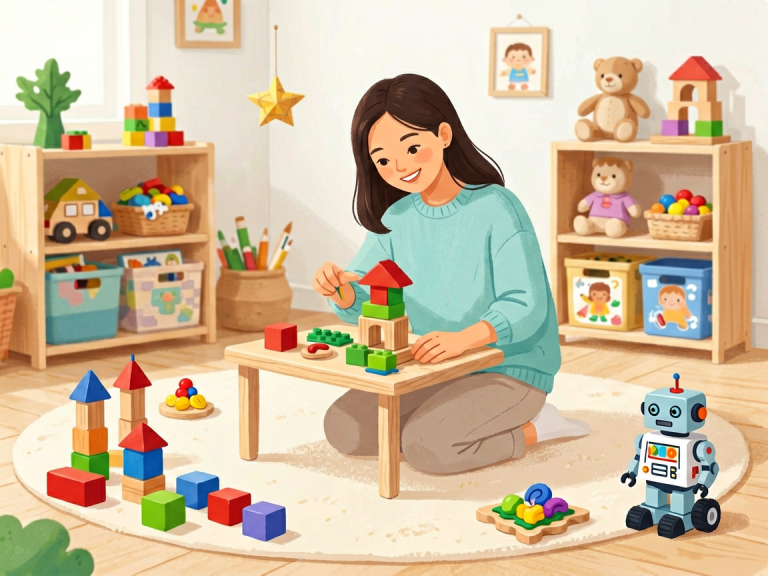
Having the toys is only the first step; using them effectively is what makes the difference. At home, parents can designate a “math play corner” with a small shelf of rotating toys. This creates a dedicated space where math is associated with fun. Simple routines like “Math Monday” or a daily 15-minute game time can establish consistency. For example, after dinner, the family might play a quick round of “Uno” (which reinforces number recognition and matching) or a game of “Sum Swamp” (a board game that practices addition and subtraction). The key is to keep it light—there is no need to quiz the child or turn play into a test.
In the classroom, teachers can integrate math toys into center-based learning. During a math workshop, one station might have tangrams, another might have a counting game, and a third might have a balance scale. Students rotate through the stations, giving them exposure to different concepts. Teachers can also use toys for whole-group instruction. For instance, when introducing fractions, a teacher might have each pair of students a set of fraction tiles. They can physically compare 1/2 and 2/4, discovering that they are equivalent. This hands-on lesson is far more effective than a diagram on the board.
Importantly, math toys can support students with different learning styles. Kinesthetic learners, who need to move and touch, thrive with building toys. Visual learners appreciate colorful pattern blocks and magnetic tiles. Auditory learners may enjoy games that involve verbal counting or singing number songs. By offering a variety of toys, educators ensure that every child has a pathway to understanding. Moreover, toys can be used as intervention tools for struggling students. A child who cannot grasp subtraction on paper may suddenly understand when they physically “take away” counters from a set.
Technology also plays a role, but physical toys should remain the priority for younger children. Screen-based math apps can be useful supplements, but they lack the tactile feedback that is so crucial for developing number sense. A child swiping a screen to count virtual apples is not the same as holding a plastic apple in their hand. Therefore, while we embrace useful apps, we must not neglect the power of real, manipulable objects.
Conclusion: The Joyful Path to Mathematical Thinking
Mathematics is not a mountain to be conquered but a landscape to be explored. Math toys for elementary kids are the compass and the map—they guide children through the terrain of numbers, shapes, and logic in a way that feels like play. From counting bears to magnetic tiles, from board games to geometric puzzles, these tools do more than teach specific skills; they cultivate a love for learning and a confidence that “I can do math.” As parents and educators, our role is to curate a rich environment of playful mathematical experiences and then step back, observe, and join in when invited. When a child proudly announces, “I built a tower with fifty blocks!” or “I figured out the pattern!”, we are witnessing the birth of a mathematical mind. And that is the greatest achievement of all: not a correct answer, but a curious and capable thinker. So let the play begin.