Screen-Free Science Toys: Rediscovering the Joy of Hands-On Discovery
In an era dominated by glowing screens, algorithm-driven content, and digital saturation, a quiet revolution is taking place in children’s bedrooms, classrooms, and living rooms. Parents, educators, and even child psychologists are increasingly turning to screen-free science toys — tangible, physical objects that invite children to touch, build, experiment, and fail without the buffer of a digital interface. These are not just nostalgic relics of a pre-digital past; they are powerful pedagogical tools that foster deep cognitive engagement, fine motor skills, patience, and a genuine sense of wonder. This article explores the world of screen-free science toys, their educational underpinnings, practical examples, and why they matter more than ever in the 21st century.
The Case for Going Screen-Free in Science Education
The allure of screens is undeniable. A well-designed science app can demonstrate molecular dynamics, simulate a volcanic eruption, or quiz a child on the periodic table with dazzling graphics and instant feedback. Yet research consistently shows that passive screen consumption — even when labeled “educational” — often fails to produce the same depth of learning as hands-on manipulation. The reason lies in how our brains process information. When a child physically turns a gear, feels the resistance of a spring, or mixes baking soda and vinegar on the kitchen table, multiple sensory pathways are activated simultaneously: touch, sight, smell, and even sound. This multimodal engagement creates more robust neural connections.
Screen-free science toys also eliminate the distractions that come with digital devices. A tablet can be a science lab one moment and a game console the next; notifications, pop-ups, and the temptation to swipe away are ever-present. Physical toys, by contrast, offer a bounded environment: the child is fully present with the materials at hand. There is no “undo” button, no autosave — only the real consequences of their actions. This built-in friction encourages problem-solving, resilience, and iterative thinking. When the tower falls, the child must decide whether to rebuild it stronger or try a different design. That decision, made in real time without a screen, is a miniature lesson in the scientific method.
Classic Categories and Modern Innovations
Screen-free science toys come in many forms, ranging from ancient classics to clever modern designs that integrate concepts from physics, chemistry, biology, and engineering. Here are several key categories that have stood the test of time or are gaining new relevance.
Construction and Mechanical Kits
The humble construction set — whether wooden blocks, metal erector sets, or modern magnetic tiles — is perhaps the most fundamental of all science toys. These toys teach principles of balance, load distribution, tension, and compression. A child stacking blocks is unconsciously learning about center of gravity. A teenager assembling a gear-driven crane from a Meccano set is grappling with torque, gear ratios, and mechanical advantage. More advanced kits today, such as those from Thames & Kosmos or Engino, include working pulleys, levers, and even simple hydraulic systems. The beauty of these toys is that they produce immediate, tangible feedback: the crane either lifts the weight or it doesn’t. There is no placeholder, no simulation — only reality.
Chemistry and Physics Experiment Sets
Traditional chemistry sets have been revived and reinvented with safety in mind. Modern kits use household-safe chemicals, non-toxic indicators, and clear instructions to guide children through classic experiments: growing crystals, making slime, testing pH levels, or building a simple battery with pennies and zinc washers. Similarly, physics experiment sets might include a miniature wind tunnel, a solar-powered car, or a set of mirrors and prisms to explore reflection and refraction. What makes these toys “screen-free” is not just the absence of a display, but the emphasis on process rather than outcome. The child must measure, mix, observe, record, and often start over when something goes wrong. That iteration is the heart of real science.
Biological Exploration Tools
A microscope, a set of insect-catching jars, a butterfly net, or a plant-growing kit — these are time-honored screen-free science toys that connect children directly with living systems. Modern versions have improved optics and durability, but the essential experience remains unchanged: peering through a lens at the cellular structure of an onion skin or watching a bean sprout push through soil. These tools instill patience, observation skills, and a respect for the complexity of life. They also encourage outdoor exploration, pulling children away from the indoors and into gardens, parks, and forests — a benefit that no app can replicate.
Puzzle-Based and Logic Toys
Science is not always about beakers and gears; it is also about patterns, logic, and deduction. Toys such as tangrams, Rubik’s cubes, shape-sorters, and even simple board games like “Gravity Maze” fall into this category. They challenge children to think spatially, plan ahead, and test hypotheses. A marble run, for instance, forces the child to consider slope, momentum, and timing. These toys sharpen executive functions — working memory, cognitive flexibility, and inhibitory control — in ways that passive screen time cannot.
Developmental and Cognitive Benefits
The advantages of screen-free science toys extend far beyond subject knowledge. When children interact with these toys, they develop a constellation of skills that are increasingly rare in a world of instant gratification.
Fostering Deep Focus and Flow
Physical manipulation requires sustained attention. A child building a complex LEGO structure or calibrating a homemade catapult must concentrate for extended periods, entering a state of flow that is self-rewarding. This is the antithesis of the rapid, attention-fragmenting cycles of social media and short videos. Over time, regular engagement with screen-free toys can help lengthen attention spans and improve the ability to concentrate on difficult tasks — a skill desperately needed in modern education.
Encouraging a Growth Mindset
Screen-free science toys are inherently unforgiving: you cannot reload a failed experiment with a tap. The child who tries to build a bridge that collapses must decide whether to give up or try again. This low-stakes failure is the perfect training ground for a growth mindset. The child learns that “I can’t do it yet” is a temporary state, not a fixed identity. As Carol Dweck’s research shows, praising effort rather than outcome leads to greater resilience. A screen-free toy provides countless opportunities for this kind of praise — not because the child succeeded, but because they persisted.
Strengthening Fine Motor and Spatial Skills
Manipulating small parts, aligning gears, and inserting wires into tiny holes all demand precise hand-eye coordination. These fine motor skills are foundational for handwriting, typing, and countless practical tasks. Additionally, three-dimensional construction toys greatly enhance spatial reasoning — a predictor of success in STEM fields. Studies have repeatedly found that children who play with construction toys score higher on tests of mental rotation and spatial visualization.
Promoting Cooperative and Intergenerational Play
Screen-free toys often invite collaboration. A family gathered around a chemistry set, a group of friends building a balloon-powered car, or a grandparent teaching a child to use a compass — these are social moments that digital screens rarely facilitate. The physical nature of the toy creates a natural context for conversation, explanation, and shared discovery. Children learn to articulate their ideas, listen to others, and negotiate roles. This social dimension is another layer of learning that goes beyond the science content itself.
Integrating Screen-Free Science Toys into Modern Life
Despite the benefits, many parents struggle to incorporate screen-free toys in a world already saturated with screens. The key is intentionality and environment design.
Curating a “Maker Space” at Home
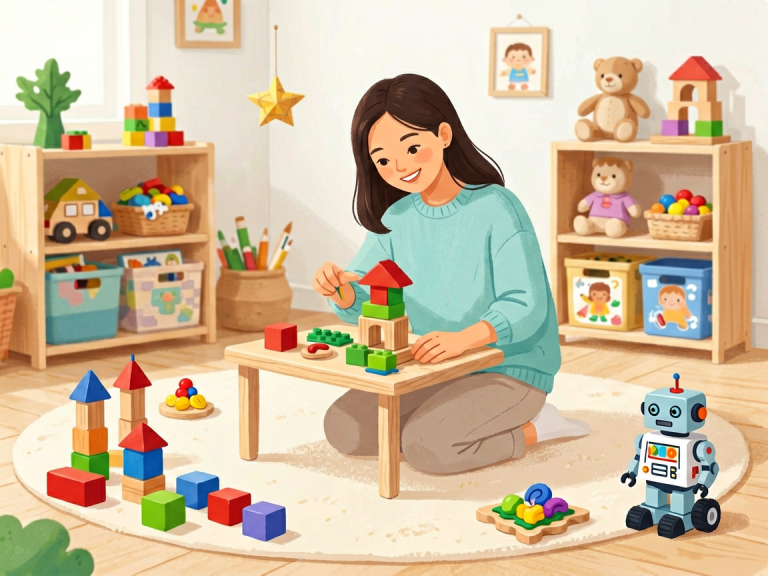
Dedicate a low table or a corner of a room to science exploration. Stock it with basic supplies: magnifying glasses, measuring cups, pulleys, magnets, a simple electric circuit kit, and a few construction sets. Rotate the materials every few weeks to maintain novelty. The presence of a dedicated space signals to the child that this is valuable, serious play — not a last-resort activity when the Wi-Fi is down.
Modeling Screen-Free Curiosity
Children imitate what they see. If a parent pulls out a smartphone to answer every question, the child learns that knowledge comes from a screen. Instead, when a child asks “Why is the sky blue?”, the parent can pick up a prism and a flashlight, showing how white light splits into colors. Or they can walk outside with a clear glass of water and a mirror to create a rainbow. These small, screen-free demonstrations are more powerful than any YouTube video because they happen in the moment, with real objects in the child’s world.
Balancing Digital and Physical Learning
The goal is not to eliminate screens entirely — they are useful research tools, especially for older children. Rather, it is to establish a healthy equilibrium. One practical rule: before a child can use a tablet for a science-themed game, they must first build a related physical model. For example, before exploring circuits on a simulation app, they should wire a real battery, bulb, and switch. The physical experience anchors the digital learning, making the abstract concepts more concrete.
Conclusion: The Timeless Value of Tangible Discovery
Screen-free science toys are not a regression to a primitive past; they are a reclaiming of something essential. In a world where information is instantaneous and answers are always a click away, these toys restore the joy of the journey — the slow, messy, often frustrating but deeply satisfying process of figuring things out for yourself. They remind us that science is not a subject to be consumed but a practice to be lived. Whether it is the simple thrill of watching a vinegar-and-baking-soda rocket launch across the backyard or the quiet concentration of assembling a wooden gear train, these experiences plant seeds of curiosity that can bloom into a lifelong love of learning.
As we navigate an increasingly digital future, let us not forget the child who, without a screen, holds a magnet in one hand and a paperclip in the other, eyes wide with wonder. That moment — pure, physical, and real — is the beginning of all science. And it is available to every child, in every home, right now — if we choose to provide the toys that make it possible.