Silent Wonders: The Art of Selecting Quiet Time Toys for Your Newborn
Introduction: Why Quiet Time Matters
The first few months of a newborn’s life are a whirlwind of sensory discovery. Every sound, sight, texture, and movement is brand new. But amid this explosion of stimuli, quiet time plays a surprisingly vital role. Quiet moments—free from loud music, flashing lights, or jarring noises—allow a baby’s nervous system to rest, process information, and build foundational self-regulation skills. Choosing the right quiet time toys can transform these calm intervals into rich opportunities for bonding, exploration, and developmental growth. However, not all toys marketed as “quiet” truly serve a newborn’s needs. This guide will walk you through the essential considerations for selecting quiet time toys that are safe, developmentally appropriate, and genuinely soothing for your little one.
Understanding Newborn Sensory Needs
Newborns are born with an immature sensory system. Their vision is blurry, their hearing is acute but easily overwhelmed, and their sense of touch is incredibly sensitive. During quiet time, the goal is to provide gentle stimulation that engages the senses without overloading them. A toy that is too visually busy, too loud, or too demanding can trigger fussiness rather than calm. Conversely, a toy that offers subtle, predictable interactions can help a baby feel secure and focused. For example, a soft black-and-white contrast card held at a 20–30 cm distance is far more soothing than a flashing electronic toy. Understanding these sensory thresholds is the first step in making wise toy choices.
Key Criteria for Choosing Quiet Time Toys
Safety Above All
Before considering any aesthetic or educational value, safety must be the absolute priority. Newborns explore primarily with their mouths, so every toy must be free of small parts that could become choking hazards. Look for toys made from non-toxic, BPA-free materials that are certified by recognized safety standards (such as ASTM or EN71). Avoid toys with sharp edges, loose buttons, long strings that could wrap around tiny necks, or any detachable components. Also, consider the weight of the toy—a newborn has no control over their arms, so a heavy rattle dropped on the face can be dangerous. Lightweight, soft fabric toys are ideal.
Appropriate Auditory Level
Quiet time toys should produce sounds that are soft and natural, not jarring. A whisper-quiet crinkle sound from a fabric tag, the gentle chime of a wooden bell rung softly, or the subtle rustle of silk are all excellent choices. Test any sound-producing toy at arm’s length—if you can hear it clearly from across a room, it may be too loud for a baby’s sensitive ears. Remember that newborns are especially sensitive to high-pitched and sudden noises, which can startle them and disrupt their calm state.
Tactile Variety Within Limits
Touch is a primary way newborns learn about their environment. Offer toys with diverse textures—soft fleece, smooth wood, bumpy silicone, silky ribbon loops—but keep the number of different textures in a single toy limited to two or three. Overly complex textures can confuse or overstimulate a baby. The best quiet time toys have one or two contrasting textures that invite gentle exploration. For example, a wooden ring with a fabric loop attached gives the baby two distinct tactile experiences in one simple object.
Visual Simplicity
A newborn’s vision is not fully developed. At birth, they see best at a distance of about 8–12 inches, and they are drawn to high-contrast patterns (black, white, and red) rather than pastel shades. However, for quiet time, even high-contrast images should be kept simple—think a bold geometric shape or a single face-like pattern. Avoid toys with many small details or rapidly moving parts. A toy that slowly rotates a black-and-white spiral is far less calming than a static card that the baby can study at their own pace.
Weight and Graspability
Newborns have a reflexive grasp, but they cannot hold a toy on their own for more than a few seconds. Choose toys that are light enough to be draped over their hand or placed near their fingers. Fabric rattles with tiny handles, crinkle toys that are flat and easy to bat, and soft plush balls that are small enough to be cradled are all excellent. Heavier toys will frustrate the baby because they cannot lift them, leading to crying instead of calm.
Types of Quiet Time Toys for Newborns (by Age)
0–2 Months: The Mouth and Gaze Stage
In the earliest weeks, newborns are mostly interested in looking at faces and listening to their parents’ voices. The best quiet time toys for this stage are simple and passive:
- High-contrast black-and-white cloth cards or mobiles. Hang a mobile above the diaper-changing station with bold patterns. Keep it stationary or moving very slowly—gentle swaying is enough.
- Soft, unpatterned muslin squares. These can be draped over the baby’s face (under supervision) for a peek-a-boo game later, but initially they just provide a soft, familiar texture to hold against the cheek.
- Silk scarves in primary colors. A single silk scarf can be gently floated over the baby’s field of vision, then allowed to drift down. The slow movement and soft material are calming.
2–4 Months: The Batting and Grasping Stage
As the baby begins to swipe at objects and intentionally bring hands to mouth, toys should invite action without demanding too much:
- Crinkle toys with a pocket for your hand. Place one on the baby’s chest during tummy time; the crinkle noise will draw their attention, and they will try to bat it.
- Wooden or fabric teethers with multiple surfaces. Look for ones with a simple ring shape made of natural beech wood and a silicone or fabric part. The weight is manageable, and the baby can gum the different surfaces.
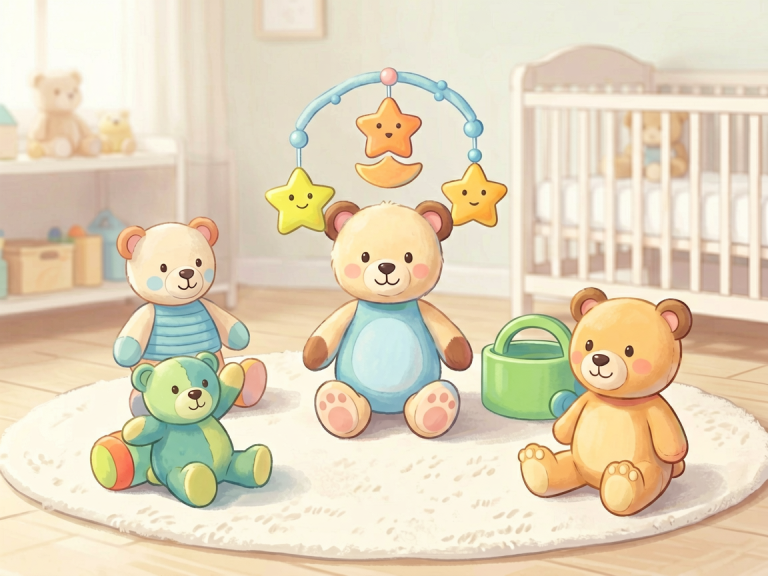
- Soundless baby gyms. Instead of electronic hanging toys, choose a wooden or cloth gym with dangling objects that are purely visual and tactile: a wooden ring, a felt star, a ribbon spiral attached with simple clips.
4–6 Months: The Discovery Stage
Now babies are more deliberate. They can grasp, shake, and transfer objects from hand to hand. Quiet time toys should support these emerging skills:
- Soft block sets made of fabric or silicone. Two or three blocks are plenty. They can be stacked by the parent while the baby watches, then knocked over for a gentle surprise.
- Activity mats with quiet features. Look for mats that have interesting pockets, tags, and removable toys—avoid those that play music or make electronic sounds. A mat with a mirror (unbreakable) and a few crinkle tags is ideal.
- Simple wooden shakers (filled with very few beads). The sound should be a subtle rattle, not a loud shake. Let the baby hold one end while you shake the other, demonstrating cause and effect without overwhelming.
What to Avoid When Choosing Quiet Time Toys
- Electronic toys with flashing lights and loud songs. Even if they have a “quiet mode,” the artificial beeps and bright LEDs can overstimulate a newborn’s developing visual and auditory systems.
- Toys with an overwhelming number of parts. A busy cube with buttons, levers, and pop-up doors is too complex for a newborn. Keep it simple: one function per toy.
- Heavy plastic toys that can be dropped on a baby’s face. Always opt for lightweight, soft materials.
- Toys with small detachable pieces (like beads or sequins). Even if they seem securely attached, a baby’s suction can pull them off.
- Fragrant or chemically-treated toys. Avoid anything with artificial scents or claims of being “scented to calm.” Essential oils can be irritating to a newborn’s respiratory system, and synthetic fragrances are best avoided.
Tips for Using Quiet Time Toys Effectively
Even the perfect toy won’t work if not introduced correctly. Here are practical tips for making quiet time truly relaxing:
- Follow the baby’s cues. If the baby is fussy, do not introduce a new toy. Instead, offer a familiar, comforting object like a soft cloth that smells of you.
- Keep sessions short. Newborns have short attention spans. Quiet time with a toy should last only a few minutes—any longer and it becomes overwhelming.
- Use toys as part of routine. A special quiet toy used only during story time or after a bath can become a powerful cue for winding down.
- Rotate toys. Babies get bored with the same toy very quickly. Rotate a small selection of 3–4 quiet toys each week to keep their interest fresh without introducing too many options at once.
- Be present. Quiet time is not about leaving the baby alone with a toy. Sit nearby, talk softly, or sing a lullaby. The toy is a partner in the calm, not a replacement for connection.
Conclusion: Less Really Is More
When it comes to quiet time toys for newborns, the most important principle is restraint. A single wooden ring, a black-and-white cloth, or a simple silk scarf can provide more developmental benefit than an entire play mat covered in electronics. By choosing toys that are safe, soft, simple, and sensory-appropriate, you are not only calming your baby—you are nurturing their ability to focus, self-soothe, and appreciate the world one gentle interaction at a time. Remember that your voice and your presence are the most powerful “quiet time toys” of all. Use these material objects as tools to enhance connection, not replace it, and your newborn will learn that quiet moments are safe, sweet, and full of wonder.