Stoking the Spark: A Guide to Choosing Imaginative Toys for Newborns
When we think of imaginative play, our minds often leap to toddlers building castles with blocks or preschoolers hosting tea parties with stuffed animals. Yet the truth is that imagination does not suddenly appear at age two—it begins to germinate in the very first weeks of life. For a newborn, whose brain is forming 700 to 1,000 new neural connections every second, every sensory experience is a seed that will eventually blossom into creativity, problem‑solving, and symbolic thought. Choosing toys for a newborn, therefore, is not merely about keeping the baby occupied; it is about laying the groundwork for a lifetime of imaginative thinking. But how do we select toys that genuinely nurture imagination in a child who cannot yet grasp, crawl, or speak? This guide will walk you through the principles, the science, and the practical considerations for choosing imaginative toys for newborns.
Understanding the Newborn’s Brain: Why Imagination Matters from Day One
Before diving into toy recommendations, it is essential to understand what “imagination” means for a newborn. At birth, a baby’s brain is an extraordinarily plastic, unfinished organ. The neurons are present, but the connections (synapses) are formed through experience. Imagination, in its most primitive form, begins with the ability to perceive, differentiate, and anticipate. A newborn who tracks a moving object learns that things exist even when they move out of sight—a precursor to object permanence and, later, to the ability to imagine something not physically present. Similarly, a baby who hears a familiar lullaby and calms down is forming auditory expectations and emotional associations, which are the building blocks of creative storytelling. Thus, imaginative toys for newborns are those that stimulate the senses in a rich, varied, and predictable-yet-surprising manner. They encourage the brain to make connections, to predict, and to explore.
The Three Pillars of Imaginative Toy Design for Newborns
Imaginative toys for newborns are not miniature versions of what older children use (toy phones, plastic food, or dollhouses). Instead, they are carefully designed objects that engage the senses while leaving room for the baby’s own discoveries. To choose well, keep three pillars in mind: sensory richness, open‑endedness, and safety.
Sensory Richness means the toy engages multiple senses—sight, hearing, touch, and sometimes smell or taste (with safe materials). A single toy that combines high‑contrast patterns, gentle crinkling sounds, and a soft velvety texture offers far more neural stimulation than a plain rattle.
Open‑endedness refers to a toy that can be used in many ways. For a newborn, this might mean a soft block that can be looked at, grasped (or attempted), mouthed, and later stacked. The toy does not force a specific outcome; the baby creates the interaction.
Safety is non‑negotiable. Newborns explore primarily through mouthing. Toys must be free of small parts, toxic chemicals (BPA, phthalates, lead), sharp edges, and long strings that could pose a strangulation hazard. Always check for ASTM or EN71 certification.
Sensory‑Rich Materials: Texture, Weight, and Temperature
One of the most overlooked aspects of imaginative toys for newborns is the variety of textures and material properties. A toy that is always smooth and plastic does not provide the tactile diversity that a newborn’s developing somatosensory cortex craves. Choose toys made from multiple natural or safe synthetic materials:
- Organic cotton or muslin: Soft, breathable, and gentle for mouthing. Cloth books with crinkly pages or attached tags offer texture variation.
- Wood (untreated or food‑safe finish): Wood has a distinct weight, temperature, and grain. A simple wooden ring or teether provides a different tactile experience than plastic.
- Silicone (food‑grade): Flexible, soft, and easy to clean. Silicone teethers with varied bumps, ridges, and shapes encourage oral exploration.
- Fleece, velvet, and woven fabrics: Different weaves (ribbed, smooth, rough) help the baby discriminate textures.
- Natural rubber: Used in some rattles and graspable toys; it is slightly tacky and warm to the touch.
When you combine textures—for example, a stuffed animal with a silky tag, a bumpy silicone foot, and a corduroy ear—you are giving the newborn a small universe of tactile data to process. This lays the foundation for fine motor skills and, crucially, for later imaginative play where children re‑create textures in their pretend worlds.
Visual Stimuli: Contrast, Pattern, and Movement
Newborns have limited visual acuity—they see best at 8–12 inches and are drawn to high contrast. Black‑and‑white patterns (stripes, checkerboards, bullseyes) are most effective in the first weeks because their retinas and visual cortex are still maturing. As they grow (around 2–3 months), they begin to prefer primary colors and more complex patterns. For imagination, the key is to provide visual stimuli that invite the baby to focus, track, and anticipate.
Look for toys that offer:
- High‑contrast cards or mobiles: A black‑and‑white mobile with simple geometric shapes suspended over the crib allows the baby to practice tracking and focusing. As they stare at a spiral or a series of concentric circles, their brain is building the neural pathways for pattern recognition—a skill vital for imagining sequences later.
- Gradually more complex patterns: After the first month, introduce toys with red, yellow, and blue elements. A soft cube with contrasting faces (stripes, dots, a smiling face) encourages the baby to shift gaze and compare.
- Mirrors (unbreakable, baby‑safe): A mirror is an incredibly imaginative toy for a newborn. The baby sees a face (their own) that moves in synchrony, sparking early self‑awareness and the concept of reflection—a precursor to understanding representation and symbol.
- Toys that move or can be moved: A gentle rattle that the parent shakes, or a ball that slowly rolls, teaches cause‑and‑effect. The baby begins to anticipate movement, which is an early form of mental imagery.
Auditory Toys: The Soundscape of Imagination
Hearing is highly developed at birth—babies recognize their mother’s voice and the rhythm of familiar songs. Auditory toys for newborns should offer a range of gentle, varied sounds that are not overwhelming. Avoid loud, jarring electronic noises that overstimulate and leave no room for the baby’s own interpretation.
Excellent auditory choices include:
- Soft rattles: A wooden or cloth rattle produces a gentle shaker sound. When the baby accidentally moves their hand and hears a sound, they begin to connect action with result—a core cognitive step.
- Crinkle toys: Many soft books or fabric squares have crinkly plastic inside. The sound is novel and intriguing; babies will often pause, turn their head, and try to locate the source, building auditory localization skills.
- Bells: A small, securely sewn bell inside a fabric ball or stuffed animal offers a clear, pleasant chime. Over time, the baby learns that shaking the toy produces the sound.
- Whistle or chime toys (for parents to use): A gentle wind chime or a softly whistled tune can become a cue for interaction. The parent can whistle a simple two‑note pattern before nursing or changing a diaper; the baby soon anticipates, which is an imaginative leap—forming a mental expectation of what comes next.
- Music boxes: A wind‑up music box with a calm, repetitive melody (e.g., Brahms’ Lullaby) provides a predictable auditory experience. The baby might learn to wait for the end of the tune, building temporal imagination.
The key is to let the baby control the experience when possible. A toy that makes sound only when the baby touches or moves it teaches agency and intentionality—both critical for later pretend play.
Open‑Ended Toys: Less is More
In the realm of imaginative toys for newborns, the simplest objects often have the greatest potential. Avoid toys with flashing lights, pre‑recorded phrases, or rigid stories. These “close‑ended” toys dictate the play; the baby is a passive recipient. Instead, choose open‑ended toys that the baby can explore in multiple ways as they grow.
Examples of powerful open‑ended toys:
- A soft scarf or piece of fabric: A 100% cotton muslin square can be used to play peek‑a‑boo, to feel different textures when crumpled, to catch a breeze, or to cover and uncover the baby’s face (with supervision). This simple item introduces concepts of hide‑and‑seek, disappearance, and reappearance—the essence of imaginative object permanence.
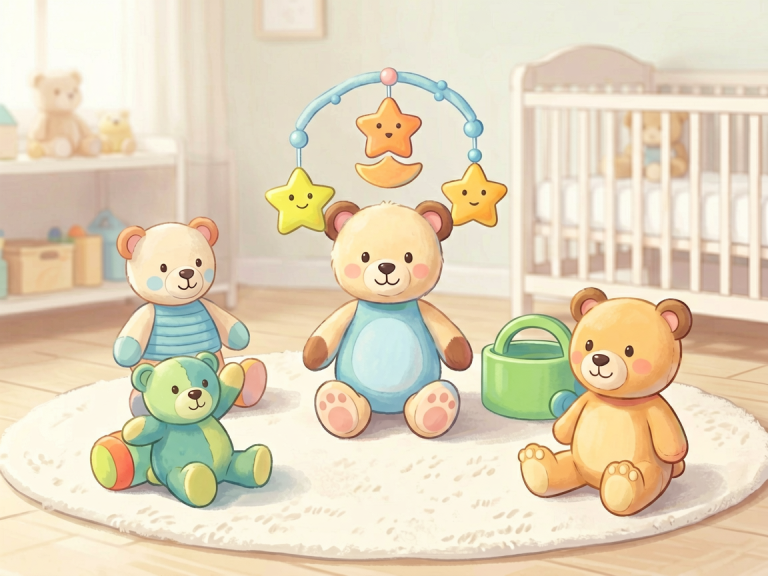
- Grasping rings: A set of wooden or silicone rings in different sizes and colors can be mouthed, shaken, stacked (later), and rolled. The baby decides which ring to hold, whether to bang them together, or to drop them.
- Soft blocks: Fabric blocks with different textures, patterns, and perhaps a bell inside some. At first, the baby will stare at them, then begin to bat them, then later grab and eventually stack. Each stage reveals a new imaginative possibility.
- Activity gym or play mat: Choose one with dangling toys that are removable and interchangeable. The baby can swat at a toy, grasp it, and watch it swing. The open structure invites the parent to change the configuration, keeping the environment novel.
The Role of the Adult: Co‑Imagination
No toy, no matter how thoughtfully designed, can replace the human element. The most imaginative toy for a newborn is a responsive, engaged adult. When you hold up a black‑and‑white card and say, “Look—a spiral! It’s spinning, spinning, spin…” you are already using language to frame the baby’s experience. You are modeling imagination: treating a simple pattern as if it were a story.
To truly choose imaginative toys, you must also consider how you will use them. A simple wooden ring becomes an imaginative toy when you gently tap it on the baby’s palm and say, “Here’s a little drum. Ratta‑tatta‑tatta!” The baby may not understand the words, but the tone, rhythm, and emotional warmth create a narrative context. Over time, the baby will associate objects with feelings and stories—the root of all imaginative play.
Therefore, when you evaluate a potential toy, ask yourself: Can I use this toy to connect with my baby? Can it be part of a song, a game of peek‑a‑boo, a gentle story? If yes, it is likely a good choice.
Practical Buying Guide: What to Look For and What to Avoid
To summarize the practical steps:
- Age labeling: For newborns, look for “0+ months” or “suitable from birth.” Avoid toys labeled for 3+ months that may contain small parts.
- Washability: Newborns drool, spill milk, and mouth everything. Choose toys that can be wiped clean or machine‑washed.
- Weight: Toys should be lightweight enough for a newborn to lift or push accidentally. Heavy wooden items might be better for later stages.
- No batteries: Avoid battery‑operated toys unless they are extremely simple (e.g., a gentle light projector) and have a minimal role. Batteries often mean noises, lights, and forced interactions that reduce imaginative possibilities.
- Multi‑sensory in one toy: A toy that offers a visual pattern, a crinkle sound, and a teether tab is more efficient than three separate toys.
- Natural materials preferred: Wood, organic cotton, food‑grade silicone, and natural rubber are not only safer but also more varied in sensory properties.
- Avoid over‑stimulation: A toy with too many features at once can overwhelm a newborn. Simplicity allows the baby to focus on one element at a time, which is how the brain builds focused attention.
Conclusion: Nurturing the Seed of Creativity
Choosing imaginative toys for newborns is not about finding the trendiest brand or the most expensive gadget. It is about curating a small collection of safe, sensory‑rich, open‑ended objects that invite curiosity and connection. A few soft blocks, a contrast card, a crinkly book, a gentle rattle, and a mirror—these humble items are enough to create a world of neural growth. The real magic, however, happens when you sit with your baby, hold up a toy, and talk, sing, or play. Your voice, your attention, and your own imagination are the strongest catalysts. In those early months, you are not just choosing toys; you are choosing the first threads of a tapestry that will one day become your child’s ability to dream, invent, and imagine a world beyond the one they see. Choose wisely, play gently, and watch the spark ignite.