Top Building Toys That Foster Independent Play and Creativity in Children
Introduction
In an age of screens and structured activities, the value of independent play has never been more important. When children play alone, they learn to entertain themselves, solve problems on their own terms, and develop a deep sense of focus and self-reliance. Among the most powerful tools for encouraging this kind of autonomous exploration are building toys. Unlike electronic gadgets that dictate outcomes, building toys are open-ended, allowing a child’s imagination to take the lead. They invite trial and error, spatial reasoning, and fine motor development, all without adult intervention. The best building toys for independent play are those that are durable, versatile, and endlessly engaging. Below are five standout categories that consistently keep children absorbed for hours, nurturing creativity and independence every step of the way.
—
LEGO Classic Bricks – The Timeless Creativity Builder
No list of building toys would be complete without LEGO. While themed sets with step-by-step instructions can be fun, it is the classic brick boxes – the ones filled with nothing but colorful standard pieces – that truly shine for independent play. With a simple assortment of bricks, plates, wheels, and windows, a child becomes the sole architect of their world. There are no right or wrong builds; a pile of bricks can become a spaceship, a castle, a robot, or a futuristic vehicle in the span of ten minutes. This freedom is crucial for independent play because it eliminates the need for a parent to explain steps or correct mistakes. Children learn to problem-solve on their own: if a tower keeps falling, they experiment with a wider base; if a door won’t fit, they adjust the frame. LEGO Classic bricks also scale with age – a three-year-old might stack towers while an eight-year-old creates intricate mechanisms using gears and axles from complementary sets. The sensory satisfaction of snapping bricks together and the pride of a completed creation made entirely by oneself cultivate a profound sense of accomplishment. Because LEGO pieces are nearly indestructible and endlessly combinable, a single box can provide years of solo creative play, making it one of the most reliable investments for fostering independence.
—
Magna-Tiles – Magnetic Masterpieces for Little Engineers
Few toys captivate young children as instantly and sustainably as Magna-Tiles. These translucent, magnetic geometric shapes are designed to click together effortlessly, making them ideal for children as young as three who are still developing fine motor control. What sets Magna-Tiles apart for independent play is the sheer intuitiveness of the magnetic connection. There is no frustration with pieces that won’t stay together; the magnets do the work, leaving the child free to focus on design and structure. Kids can build flat creations like mandalas and animal shapes, or rise into three-dimensional structures such as castles, rockets, and igloos. The lightweight nature of the tiles means that even ambitious towers rarely cause injury when they topple, which reduces the need for adult supervision. Moreover, Magna-Tiles are translucent, allowing light to pass through and create beautiful color patterns when placed near a window or lamp – an accidental artistic exploration that sparks further solo discovery. Because the tiles are open-ended and can be combined in infinite ways, children often spend long stretches experimenting with balance, symmetry, and engineering principles. A child might try to build a bridge sturdy enough to hold a toy car, adjusting the angle of tiles repeatedly until it works. That iterative process is pure independent learning. Parents consistently report that Magna-Tiles are one of the few toys their children play with completely alone for over an hour at a time, making them a top choice for encouraging focused, self-directed play.
—
Wooden Unit Blocks – The Foundation of Open-Ended Play
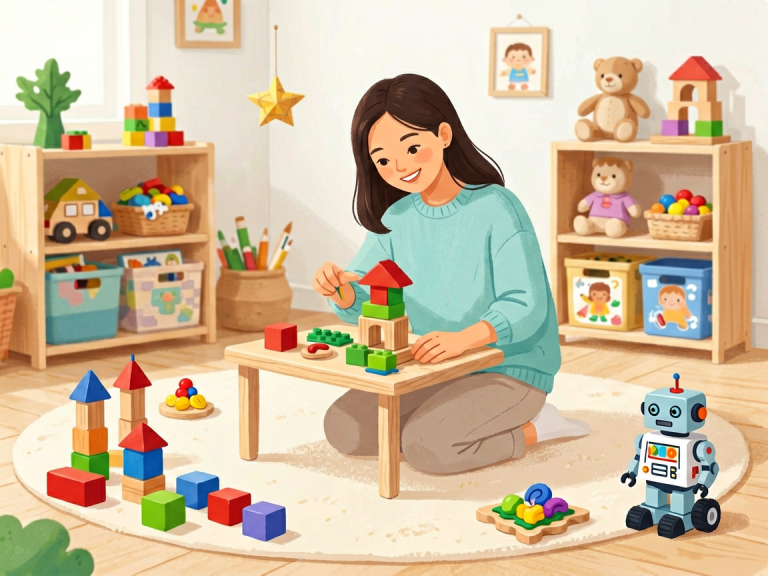
Before plastic and magnets, there were wooden unit blocks – and they remain unsurpassed in their ability to support deep, imaginative independent play. Unlike many modern building toys with predefined connectors or shapes, unit blocks are simple rectangular prisms, cylinders, arches, and triangles made from smooth hardwood. Their simplicity is their superpower. With just a set of blocks, a child can construct an entire city, a ramp for toy cars, or a maze for marble runs. There are no instructions, no colors to sort, no wrong way to stack them. This absolute lack of structure forces children to rely entirely on their own planning and problem-solving skills. A child who wants to build a tall tower learns to align the blocks carefully and to adjust the foundation when it wobbles. Because wooden blocks are heavy and solid, they provide immediate physical feedback – a block that is placed off-center will fall, teaching balance and gravity without a word from an adult. Furthermore, wooden blocks are incredibly durable and can be passed down through generations. They also integrate seamlessly with other toys: a block castle becomes the backdrop for a stuffed animal’s adventure, or a line of blocks becomes a train track for a small toy engine. The open-ended nature of wooden unit blocks means that a child’s play scenario can evolve organically without interruption. This type of sustained, self-directed narrative building is exactly what developmental experts recommend for nurturing executive function skills like planning, focus, and self-regulation.
—
Plus-Plus – The Versatile Puzzle-Building System
For children who enjoy more meticulous, pattern-based construction, Plus-Plus offers a unique building experience that is perfectly suited for independent play. The system consists of tiny, single-shaped pieces that look like a plus sign (+) with a slight curve. They fit together in multiple directions, allowing builders to create both flat mosaics and three-dimensional sculptures. What makes Plus-Plus exceptional for independent play is its portability and the meditative quality of the building process. Because the pieces are small and uniform, a child can sit quietly at a table or on the floor and build a single figure like a dinosaur or a flower over the course of an hour. There are no batteries, no screens, no noisy motors – just a calming, repetitive motion that promotes focus and patience. Children quickly learn to plan their designs in advance, counting pieces and visualizing colors. The challenge of keeping a structure stable while adding tiny pieces encourages fine motor precision and perseverance. Additionally, Plus-Plus sets come in various sizes, from large pieces for toddlers to mini pieces for older children, ensuring the toy grows with the child. Because the building possibilities are virtually endless – a child could make a replica of a favorite animal, a piece of jewelry, or an abstract sculpture – Plus-Plus never fails to provide a fresh, self-driven challenge. Many parents note that after the initial introduction, their children prefer to work alone with Plus-Plus, as the detailed nature of the assembly requires concentration that is easily disrupted by others.
—
Bristle Blocks – Sensory-Friendly Construction Fun
Younger children and those with sensory sensitivities often thrive with Bristle Blocks, a building toy that uses bristle-like projections to interlock at almost any angle. Unlike traditional blocks that require precise alignment, Bristle Blocks can be pushed together in any direction – sideways, upside down, at an angle – and they will stay connected. This flexibility is liberating for independent play because it eliminates frustration. A child who is still developing hand-eye coordination can quickly create shapes without needing adult help to align tabs and slots. The bristles also provide a pleasing tactile sensation that many children find calming, which encourages longer periods of solo engagement. Bristle Blocks are lightweight and quiet, making them ideal for a child to play with in a bedroom or playroom without disturbing others. Because they can be attached at virtually any point, children can build whimsical creatures with legs sticking out in all directions, or construct simple buildings that defy gravity. The lack of right angles and the forgiving nature of the bristles mean that every creation is a success, which builds confidence and reinforces a child’s desire to play independently. Additionally, Bristle Blocks are easy to clean and durable, and they often come in large sets that inspire a child to build a whole village or zoo. For parents seeking a building toy that encourages solitary exploration without the need for constant intervention, Bristle Blocks are an excellent and often underrated choice.
—
Conclusion
The best building toys for independent share common traits: they are open-ended, durable, intuitive, and endlessly adaptable to a child’s imagination. Whether it’s the classic appeal of LEGO bricks, the magnetic magic of Magna-Tiles, the timeless simplicity of wooden blocks, the meticulous charm of Plus-Plus, or the sensory-friendly flexibility of Bristle Blocks, each of these toys gives children the tools to become the architects of their own play. By stepping back and allowing kids to build, fail, rebuild, and create entirely on their own, parents nurture not only creativity but also resilience, focus, and self-confidence. Investing in quality building toys is an investment in a childhood rich with independent discovery – and in the quiet satisfaction of a child who says, “Look what I made, all by myself.”