Top STEM Gifts for 12-Year-Olds: Sparking a Lifelong Love for Science and Discovery
The transition from childhood to early adolescence is a pivotal moment for intellectual growth. At age 12, young minds are no longer satisfied with simple, passive toys; they crave challenges, real-world applications, and the thrill of creating something themselves. STEM (Science, Technology, Engineering, and Mathematics) gifts are the perfect solution—they combine entertainment with education, turning screen time into productive exploration and hands-on problem solving. Whether your 12-year-old is a budding engineer, a future coder, or a curious scientist, the right gift can ignite a passion that lasts a lifetime. Below are carefully selected STEM gifts that balance fun, complexity, and learning, each explained in detail to help you make an informed choice.
1. Programmable Robotics Kits: The Ultimate Gateway to Coding and Engineering
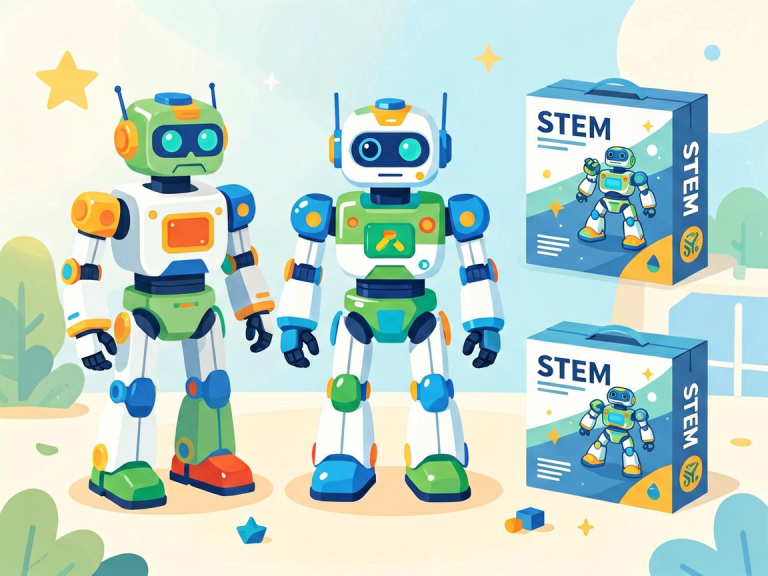
A programmable robot kit is more than just a toy—it’s a complete introduction to robotics, coding, and logical thinking. For a 12-year-old, kits like the LEGO® MINDSTORMS® Robot Inventor or the Makeblock mBot2 offer a perfect blend of building and programming. These kits come with sensors, motors, and a customizable chassis, allowing the child to construct various robot forms—from a rover that avoids obstacles to a claw machine that picks up objects. The programming interface is often block-based (like Scratch) but also supports Python, making it scalable as the child’s skills grow. Why is this ideal for a 12-year-old? At this age, abstract reasoning and multi-step planning are developing rapidly. Building a robot requires following instructions, debugging errors, and iterating on design—all essential skills in STEM. Moreover, the tangible result (a moving, reacting robot) provides immediate feedback and a sense of accomplishment that no app can match. The educational value extends beyond coding: children learn about gear ratios, torque, and power management while troubleshooting mechanical issues. Some advanced kits even include AI modules, letting kids experiment with machine learning basics. For a gift that grows with the child and offers endless replayability, a programmable robotics kit is hard to beat.
2. Advanced Chemistry Sets: Safe, Messy, and Mind-Blowing Experiments
While classic chemistry sets have been around for decades, modern versions are far more sophisticated and safety-conscious. For a 12-year-old, consider sets like the Thames & Kosmos Chem C3000 or the National Geographic Mega Crystal Growing Lab. The Chem C3000, for example, includes over 450 experiments, covering topics from acids and bases to electrochemical reactions and chromatography. It comes with real lab equipment—test tubes, beakers, a bunsen burner (with safety features), and chemicals that are carefully selected to be non-hazardous when used as directed. What makes this an excellent STEM gift? Chemistry is often the first true experimental science a child encounters. At 12, they can understand concepts like pH, density, and stoichiometry, but they still learn best by doing. Watching a solution change color, seeing crystals form overnight, or creating a small volcanic eruption teaches cause-and-effect in a visceral way. The set also encourages careful record-keeping, following procedures, and predicting outcomes—skills that are foundational for any scientific career. Parents appreciate that these kits include detailed manuals that explain the “why” behind each reaction, not just the “how.” And because many experiments require planning (e.g., growing a crystal over several days), it nurtures patience and delayed gratification. Just be sure to provide adult supervision for certain experiments, as part of the learning is about safety and responsibility.
3. 3D Printing Pens: From Imagination to Tangible Reality in Minutes
A 3D printing pen is a remarkably intuitive tool that bridges the gap between digital design and physical creation. Unlike a 3D printer that requires CAD software and long wait times, a 3D pen lets the user draw in three dimensions by extruding heated plastic filament that cools and hardens instantly. For a 12-year-old, models like the MYNT3D Pro or the 3Doodler Start+ are user-friendly and safe (using low-temperature, non-toxic filament). The pen allows them to create freeform sculptures, repair broken objects, build architectural models, or even solder simple circuits. Why is this STEM-worthy? It teaches spatial reasoning, design thinking, and material properties. A child must consider structural integrity (will a thin bridge collapse?), balance, and aesthetics while drawing. Moreover, they can create prototypes of inventions—a custom phone stand, a gear for a machine, or a miniature bridge—and test their ideas. Unlike traditional crafts, 3D printing encourages iterative design: if a creation fails, they can remelt and reshape it. The pen also introduces basic concepts of engineering, such as the importance of support structures and layer adhesion. For a 12-year-old who loves art, this merges creativity with engineering. For a future engineer, it’s a low-barrier way to prototype. The portability and low cost (filament refills are cheap) make it a gift that keeps on giving.
4. Advanced Model Rocket Kits: Physics and Aerodynamics in Action
Building and launching a model rocket is a quintessential STEM experience that combines precision, patience, and pure excitement. Kits like the Estes Tandem-X or the Quest Superbird are designed for ages 12 and up, requiring assembly of the rocket body, fins, parachute, and engine mount. The child learns about aerodynamics (fin shape affects stability), thrust-to-weight ratio, and Newton’s third law (action-reaction). Launching the rocket—often with a small, safe engine—transforms theory into a spectacular event. Why is this gift so effective? It teaches project management: the building phase requires following detailed instructions, sanding edges for smoothness, and ensuring the parachute deploys correctly. On launch day, the child must check wind conditions, set up the launch pad, and count down. Recovery involves tracking the rocket and analyzing why it flew higher or lower than expected. Some kits include altimeters or allow payloads (like an egg or a small camera) for added challenge. For a 12-year-old, the mix of craftsmanship, science, and outdoor activity is unbeatable. It also introduces the concept of failure analysis—when a rocket crashes, you learn from the wreckage. Safety is built in (launch controllers and low-power engines), and many clubs host competitions. This gift can spark interest in aerospace engineering, physics, or simply a lifelong hobby.
5. Circuit and Electronics Kits: Building the Foundation of Modern Technology
Understanding how electricity works is fundamental to modern STEM literacy. For a 12-year-old, an electronics kit like the Snap Circuits Pro or the Arduino Starter Kit offers hands-on learning without needing a soldering iron. Snap Circuits use snap-together components to create hundreds of projects: a lie detector, a radio, a doorbell, or a voice-activated lamp. The child learns about resistors, capacitors, transistors, and integrated circuits by building—and, more importantly, by troubleshooting when a circuit doesn’t work. Why is this suitable for 12-year-olds? By this age, children have enough fine motor skills to handle small parts and enough abstract thinking to understand concepts like current flow and voltage division. The kits include manuals that explain the science behind each project, reinforcing school lessons in physics. For those ready to level up, the Arduino kit introduces microcontroller programming. They can write simple code to control LEDs, sensors, and motors, which is a direct path to robotics and Internet of Things (IoT). This gift builds confidence in tinkering—if a circuit fails, they diagnose the problem (a loose wire? a blown component?). It demystifies the devices around them, making technology less of a black box and more of a tool they can control.
6. Astronomy and Telescope Kits: Exploring the Universe from Your Backyard
For the 12-year-old who looks up at the night sky with wonder, a quality telescope or an astrophotography kit can be a transformative gift. Options range from the Celestron StarSense Explorer LT 114AZ (which uses a smartphone app to guide you to celestial objects) to the Orion StarBlast 4.5 Astro Reflector, which offers a balance of portability and image quality. But the best STEM gift isn’t just the telescope—it’s the bundle that includes a star chart, a moon filter, and maybe a journal for recording observations. Why is astronomy a powerful STEM field? It requires geometry (calculating angles), physics (light, optics, gravity), and pattern recognition (identifying constellations). A 12-year-old can learn to align the finder scope, calculate magnification, and understand why planets appear to move retrograde. Modern telescopes can even connect to a tablet for guided tours of the sky, making it accessible. The gift encourages outdoor activity, patience (waiting for a clear night), and a sense of scale that humbles and inspires. Some kits include a solar filter for safe sun observation or a camera adapter for basic astrophotography. This is a gift that can evolve—starting with the moon and planets, then moving to deep-sky objects like nebulae and galaxies. It also ties into school science: the child can track Jupiter’s moons, observe Saturn’s rings, or even photograph a lunar eclipse. For a child with an insatiable curiosity about the cosmos, a telescope is a gateway to a lifelong passion.
7. Math and Logic Puzzles: Sharpening Analytical Skills Through Play
Not all STEM gifts involve technology. Classic logic puzzles, strategy games, and math building sets are equally powerful tools for developing critical thinking. Consider the Gravity Maze (a marble-run logic puzzle that teaches spatial reasoning), the Prime Climb math game (a board game that reinforces arithmetic and prime factors), or even a high-quality set of wooden geometric puzzles like the Soma Cube. For older tweens, the Turing Tumble set is a brilliant mechanical computer that uses marbles to simulate logic gates—essentially a physical representation of binary computation. Why are these gifts valuable for 12-year-olds? They train the brain in pattern recognition, deductive reasoning, and strategic planning without the distractions of screens. A logic puzzle like “Rush Hour” or “Kanoodle” forces the child to think ahead and test hypotheses. Math games show that math can be fun, not just abstract. The Turing Tumble, in particular, provides an intuitive understanding of Boolean logic, which is the foundation of all modern computing. These gifts are also portable, social (many can be played with friends or family), and they build patience and frustration tolerance—crucial skills for any STEM career. For a child who says they dislike math, a well-chosen game can change their perspective entirely.
8. Coding and Game Design Platforms: Combining Creativity with Technical Skills
While physical gifts are wonderful, digital tools can also be powerful STEM education aids—especially when they involve creation rather than passive consumption. For a 12-year-old, consider a subscription to a platform like Tynker, Code.org, or Scratch, or better yet, a physical gift card for a game design course like those offered by Outschool or the Raspberry Pi Foundation. But the best coding gift might be a dedicated device, such as the Kano Computer Kit or the Raspberry Pi 4 starter kit, which lets the child build a real computer from scratch and program it to do anything—create a retro gaming console, a weather station, or a home automation controller. Why is coding a worthy STEM gift? It teaches logical sequencing, debugging, and problem decomposition. At 12, children can move beyond block-based coding to text-based languages like Python or JavaScript. Building a game or app requires creativity, user experience consideration, and project management. The Raspberry Pi, for example, exposes them to Linux, electronics (GPIO pins), and networking—skills that are directly transferable to engineering and computer science. This gift also encourages self-directed learning: if they want to add a feature, they search for tutorials and experiment. In an age where screens are everywhere, a coding gift transforms a child from a consumer into a creator.
9. Geology and Fossil Excavation Kits: Hands-On Earth Science
For the child who loves rocks, gems, or dinosaurs, a geology kit can be a fantastic STEM gift. Options include the National Geographic Mega Fossil Dig Kit (which includes real fossils embedded in a brick for excavation) or the Break Your Own Geode Kit. More advanced sets like the Thames & Kosmos Geology Experiment Kit come with tools for testing hardness, streak, and acid reaction to identify minerals. Why is geology a good choice for 12-year-olds? It introduces the scientific method in a very tactile way: they form a hypothesis about what a rock is, test it, and confirm or revise. Collecting and classifying specimens nurtures attention to detail and observation skills. Geodes, when cracked open, reveal stunning crystals that teach about crystal structure and formation. Fossil kits connect to biology and Earth history. For a 12-year-old who enjoys outdoors, these kits can be combined with field trips to find their own rocks, creating a lifelong appreciation for Earth sciences. Plus, the “treasure hunt” aspect—finding a hidden gem or fossil—is intrinsically motivating.
10. Mechanical Engineering Kits: Gears, Levers, and Real-World Machines
Finally, consider a mechanical engineering kit that focuses on simple machines and mechanisms. Kits like the Engino Discovering Stem Mechanics, the K’NEX Education Intro to Simple Machines, or the Ugears wooden model kits (e.g., a mechanical clock or a truck) allow children to build working models of elevators, cranes, catapults, and more. The Ugears kits are particularly impressive: they are made of laser-cut plywood, require no glue, and produce intricate, moving models such as a working cylinder lock or a wooden bicycle with a chain drive. Why are these gifts excellent STEM choices? They teach the laws of physics in a tactile way—a child can feel how a gear train reduces speed but increases torque, or how a lever multiplies force. They also develop patience and fine motor skills. For a 12-year-old, understanding these mechanical principles is key to advanced engineering. The satisfaction of seeing a self-assembled model actually function—a lock that clicks, a pendulum that swings, or a vehicle that rolls—builds confidence and a sense of mastery. Many kits also include educational booklets explaining the science behind each mechanism. This is a gift that bridges the gap between toy and tool.
Conclusion: Choosing the Right Gift for Your Young Innovator
Selecting the perfect STEM gift for a 12-year-old depends on their existing interests and temperament. A child who loves building and taking things apart will thrive with a robotics kit or a mechanical engineering set. A dreamer who gazes at stars will cherish a telescope. A tinkerer who always wants to understand how things work will be captivated by an electronics or chemistry set. The common thread among all these gifts is that they are active, not passive. They require effort, creativity, and perseverance—qualities that are far more valuable than any single piece of knowledge. Moreover, these gifts often encourage social interaction: siblings can compete in rocket launches, friends can collaborate on a 3D pen project, or parents can join in building a circuit. As you shop, look for kits that offer a progression of difficulty, clear instructions, and, most importantly, room for the child to make mistakes and learn from them. The best STEM gift isn’t the one with the most bells and whistles—it’s the one that makes a 12-year-old say, “Wow, I want to learn more.” And that spark is the greatest gift of all.