Building Blocks of the Mind: How Newborn Toys Can Spark Early Math Skills
Introduction: The Surprising World of Newborn Mathematics
When we think of mathematics, we often imagine complex equations, geometric proofs, or the anxiety of a timed multiplication test. But long before a child can count to ten or recognize a triangle, the foundations of mathematical thinking are already being laid. Even for newborns—those tiny, seemingly helpless beings who spend most of their days sleeping, feeding, and gazing into the unknown—the brain is actively absorbing patterns, quantities, sequences, and spatial relationships. The question is not whether newborns can learn math, but how we can gently nurture their innate mathematical curiosity using the simplest of tools: toys.
The first three months of life are a period of explosive neural development. During this time, a newborn’s brain forms about one million new neural connections every second. Every sight, sound, touch, and movement helps wire the brain for future learning. Early math skills are not about flashcards or drilling numbers; they are about developing number sense, pattern recognition, spatial awareness, and logical reasoning through sensory experiences. The right toys can act as catalysts, turning everyday interactions into mini math lessons that feel like play. This article explores the science behind early mathematical development and provides a comprehensive guide to choosing and using toys for newborns that build a strong foundation for numeracy.
The Neuroscience of Newborn Number Sense
Innate Numerical Abilities
Research in developmental psychology has revealed that humans are born with an approximate number system (ANS). Even infants as young as a few days old can distinguish between small quantities—for example, they will look longer at a display of four dots after becoming habituated to two dots, indicating they notice the change in numerosity. This innate ability to perceive quantities without counting is the bedrock of all later math learning. Newborns also show sensitivity to patterns, such as regular versus irregular rhythms, and to the size and shape of objects, which leads to early geometric intuition.
Critical Windows and Sensory Input
The first few months are a critical window for developing the neural pathways that support mathematical reasoning. The brain is particularly receptive to sensory input that involves contrast, movement, repetition, and variation. Toys that provide clear visual patterns (like black-and-white stripes or checkerboards), auditory sequences (like rattles that make rhythmic sounds), and tactile differences (like soft versus rough textures) help the infant’s brain categorize and compare stimuli. These basic comparisons—bigger/smaller, more/less, same/different—are the precursors to understanding numbers, measurement, and classification.
The Role of Parental Interaction
It is crucial to note that toys alone are not enough. The most powerful mathematical learning occurs when a caregiver actively engages with the infant, narrating actions, pointing out patterns, and responding to the baby’s cues. A rattle becomes a counting tool when you shake it three times and say, “One, two, three!” A mobile becomes a lesson in symmetry when you slowly move it from side to side while humming a steady beat. The toy is the medium; the interaction is the message.
Key Early Math Concepts for Newborns
Before diving into specific toy recommendations, it is helpful to understand which mathematical concepts are developmentally appropriate for newborns (birth to approximately three months). These include:
- Number and Quantity: Recognizing differences between small sets (e.g., one versus two objects).
- Pattern and Sequence: Noticing repeating visual or auditory patterns (e.g., black-white-black-white stripes).
- Spatial Awareness: Tracking moving objects, understanding near versus far, and reaching for objects.
- Comparison and Classification: Noticing differences in size, shape, texture, or sound.
- Cause and Effect: Understanding that an action (shaking a rattle) produces a predictable outcome (sound), which is a precursor to logical reasoning.
Toys That Build Early Math Skills: A Practical Guide
High-Contrast Visual Stimulation Toys
Newborns have limited visual acuity—they see best at a distance of about 8 to 12 inches, and they are drawn to high-contrast patterns, especially black and white. Why does this matter for math? These patterns help the brain learn to detect edges, boundaries, and symmetry. A simple black-and-white mobile with geometric shapes (circles, squares, triangles) introduces the infant to basic forms. When the mobile slowly rotates, the baby practices visual tracking, which is essential for later concepts like counting objects in a line and understanding spatial relationships.
Recommended toys: High-contrast flash cards, black-and-white cloth books with simple shapes, mobiles with alternating black-and-white geometric figures. For an extra mathematical twist, choose a mobile with shapes of different sizes (a large circle next to a small circle) to encourage size discrimination.
Rattles and Sound-Making Toys
Sound is a powerful medium for number sense. A rattle that produces a clear, rhythmic noise can be used to demonstrate one-to-one correspondence—the idea that each shake corresponds to one sound. Shake the rattle twice and say “two shakes!”; shake it three times and say “three!” Even though the baby will not understand the words, the auditory pattern of “sound – pause – sound – pause” lays the groundwork for counting sequences.
Recommended toys: Simple wooden rattles (avoid electronic ones with chaotic noises), shaker eggs, bells on a wristband. Pay attention to the variety of sounds: a rattle that makes a soft “sh-sh-sh” versus one that makes a loud “ding-ding” helps the baby learn to compare and categorize auditory qualities.
Textured Play Mats and Sensory Gymnasiums
The sense of touch is deeply connected to mathematical thinking. When a baby lies on a play mat and feels a fuzzy circle next to a smooth square, they are engaging in tactile classification. Reaching for a dangling toy involves depth perception and hand-eye coordination, which are spatial skills. A play mat with different fabrics, shapes, and attached toys offers countless opportunities for comparison.
Recommended toys: Activity gyms with hanging toys of various shapes (stars, hearts, circles) and textures (satin, corduroy, fleece). Some mats include crinkly parts or mirrors—mirrors are excellent for teaching symmetry and self-awareness.
Mobiles with Sequential Movement
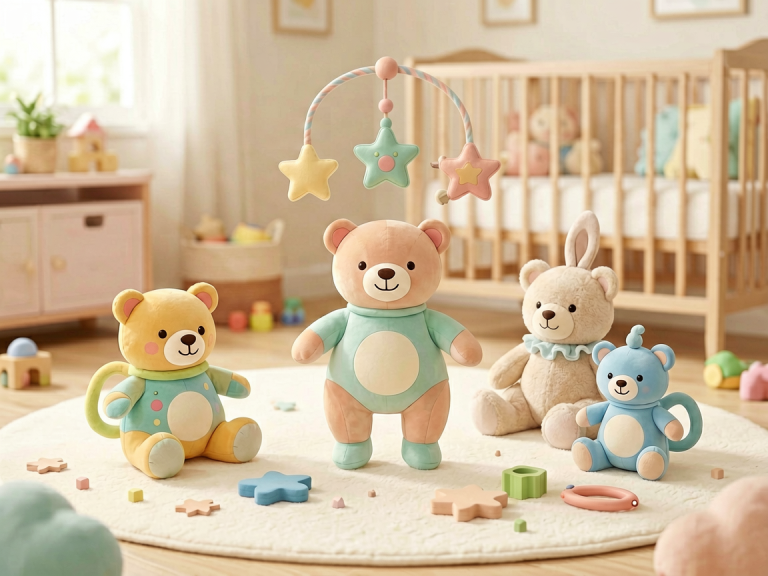
A mobile that moves in a predictable, repeating pattern teaches the concept of sequence and rhythm. For example, a mobile where four animals slowly rotate in a circle, one after another, helps the infant anticipate the next animal’s appearance. This is an early form of pattern recognition. Over time, the baby learns that the sequence repeats—a foundational idea in mathematics.
Recommended toys: Hand-cranked mobiles (rather than battery-operated ones) allow the caregiver to control the speed and rhythm. Choose mobiles with distinct, contrasting figures (e.g., a bird, a fish, a butterfly) so the baby can differentiate them.
Unstructured Natural Objects
Sometimes the best math toys are not toys at all. A piece of crinkled parchment paper, a smooth wooden spoon, or a soft cotton ball can be more mathematically rich than a plastic gadget. The key is variation in shape, size, weight, and texture. For instance, hold up two objects of different sizes (a large ball and a small ball) and let the baby’s eyes follow them. This simple “big versus small” demonstration is a lesson in comparison.
Recommended items: Silicone teething rings (different diameters), soft fabric balls, wooden blocks (too large for mouthing but safe for supervised visual exploration). Always ensure safety—no small parts that could be a choking hazard.
How to Use Toys to Teach Math: Practical Strategies
Narrate Everything
Talk to your baby while playing. Use mathematical language naturally: “Look, there are two red rings on the mobile—one, two!” “This ball is big, and this ball is small.” “Can you hear the rattle? I’m shaking it three times: shake, shake, shake!” Even if the baby does not understand, the repetition of numbers and comparisons creates neural associations.
Play Simple Turn-Taking Games
Cause and effect is a logical precursor to mathematics. Shake a rattle, then pause and wait for the baby to vocalize or move, then shake again. This establishes a pattern of action and response. Over time, the baby learns that their own actions can produce consistent outcomes—a concept central to mathematical logic (if A then B).
Vary the Pace and Sequence
When using a mobile, sometimes make it spin fast, sometimes slowly. When shaking a rattle, sometimes use a steady beat (1-2-3, 1-2-3) and sometimes use an irregular pattern (1-2, 1-2-3, 1). The baby will notice the difference, which sharpens pattern recognition. You can also pause mid-pattern to see if the baby anticipates the next sound—a sign of growing mathematical intuition.
Incorporate Mirror Play
Hold the baby in front of a safe, unbreakable mirror. Point to their reflection and say, “Look, that’s you! Where is your nose? Here is one nose.” Mirrors help with understanding symmetry (the left side matches the right) and body awareness, which ties into spatial reasoning.
The Role of Repetition and Novelty
Newborns thrive on repetition because it helps them make predictions and feel secure. The same toy used in the same way over several days will eventually become familiar, and the baby will begin to anticipate the pattern. However, novelty is also important. Introduce a new toy or a new way of playing with an old toy to keep the brain challenged. For example, after several days of shaking a rattle twice, suddenly shake it three times—the baby may show surprise, which indicates they have formed a numerical expectation.
The balance between repetition and novelty is the essence of early math learning: we build schemas (mental frameworks) through repeated exposure, then refine them through novel variations.
Safety and Age Appropriateness
For newborns, safety is paramount. All toys should be:
- Free of small parts that could be swallowed or choked on.
- Made from non-toxic materials (BPA-free, phthalate-free).
- Easily washable.
- Free of sharp edges or long strings that could pose a strangulation risk.
- Used under supervision at all times.
Avoid overstimulation. While high-contrast patterns are beneficial, too many competing stimuli (loud music, flashing lights, multiple moving toys) can overwhelm a newborn’s nervous system. Stick to one or two toys at a time, and watch for cues of overstimulation: looking away, fussing, or closing eyes.
Beyond Toys: Everyday Math in Routine Care
Toys are wonderful tools, but they are not the only way to build early math skills. Everyday caregiving routines are rich with mathematical opportunities:
- Feeding: Count the number of sucks during breastfeeding or the number of spoonfuls during feeding.
- Diapering: Talk about left versus right, front versus back.
- Bathing: Pour water from one cup to another, discussing “full” and “empty.”
- Dressing: Compare the size of socks (this sock is big for Daddy, this one is small for baby).
These interactions require no special equipment and can happen multiple times a day. They reinforce the idea that math is not a separate subject but a way of describing the world.
Conclusion: Planting Seeds for a Lifetime of Numerical Fluency
The first months of life are a golden window for planting the seeds of mathematical thinking. Toys designed for newborns—high-contrast visuals, rhythmic rattles, textured play mats, and simple mobiles—are not just entertainment; they are the first textbooks in a child’s mathematical education. When used with intention, narration, and loving interaction, these toys help an infant build number sense, pattern recognition, spatial awareness, and logical reasoning.
The key is to remember that math for a newborn is not about teaching facts but about creating an environment rich in patterns, comparisons, and sequences. A baby who experiences the rhythm of a rattle, the symmetry of a mobile, and the contrast of black-and-white shapes is building neural pathways that will later support counting, arithmetic, geometry, and problem-solving.
As caregivers, we have the privilege and responsibility to ignite this spark. So next time you pick up a rattle or hang a mobile, think of it not as a simple toy, but as a tiny mathematical universe waiting to be explored—one shake, one pattern, one number at a time. The journey of a thousand mathematical concepts begins with a single, playful encounter. And it can start today, in the arms of a newborn who is already, quietly, figuring out the world.