The Ultimate Guide to the Best Educational Toys for 5-Year-Olds: Fostering Growth Through Play
Introduction
The age of five is a remarkable window of cognitive, social, and physical development. Children at this stage are transitioning from the world of toddlerhood into a more structured environment, often preparing for kindergarten or its equivalent. Their curiosity is boundless, their language skills are blossoming, and their ability to engage in cooperative play is emerging. The right educational toys can harness this natural energy and channel it into meaningful learning experiences. However, with an overwhelming array of options on the market, parents and caregivers may find it challenging to distinguish between mere entertainment and genuine educational value. This article explores the best educational toys for 5-year-olds, categorized by developmental domain, to help you make informed choices that promote growth, creativity, and a lifelong love of learning. Each recommendation is grounded in current child development research and practical classroom experience, ensuring that playtime becomes a powerful tool for education.
—
STEM Toys: Building Foundations in Science, Technology, Engineering, and Math
STEM (Science, Technology, Engineering, and Math) education is critical for 5-year-olds because it teaches problem-solving, logical reasoning, and the basics of cause and effect. At this age, children are ready to move beyond simple stacking blocks and engage with more complex building systems.
Magnetic Building Tiles are among the most versatile STEM toys for this age group. Sets like Magna-Tiles or PicassoTiles allow children to construct 3D structures while intuitively learning about geometry, symmetry, and magnetism. The transparent, colorful pieces appeal to visual learners, and the tactile experience of clicking magnets together strengthens fine motor skills. Unlike traditional blocks, magnetic tiles encourage open-ended exploration—children can build towers, castles, bridges, or even abstract sculptures. Many sets also include wheels, enabling the creation of cars or trains, which introduces basic engineering concepts such as stability and balance.
Another outstanding STEM toy is Simple Coding Kits, such as the "Code-a-Pillar" or "Botley the Coding Robot." These screen-free coding toys teach young children the fundamentals of sequencing, loops, and logical thinking through physical commands. By arranging directional tiles or pressing buttons, children program a robot to move through a maze or follow a path. This hands-on approach demystifies technology and builds confidence in problem-solving. Moreover, coding toys encourage persistence: if the robot doesn't reach its goal, children must debug their sequence—a skill that translates directly to academic and real-world challenges.
Pattern and sequencing puzzles, like those from Melissa & Doug or Learning Resources, also fall under STEM. These toys require children to recognize repeating patterns, predict the next shape, or complete a grid—activities that directly prep for early math skills. Many sets come with activity cards that increase in difficulty, allowing the toy to grow with the child. Combining these puzzles with conversation (e.g., "What comes after red, blue, red?") strengthens vocabulary and mathematical reasoning simultaneously.
—
Language and Literacy Toys: Sparking a Love for Reading and Writing
Five-year-olds typically have a vocabulary of around 2,000 to 3,000 words and are beginning to recognize simple sight words. Toys that support literacy should focus on phonemic awareness, letter recognition, and storytelling—without feeling like a drill.
Alphabet and Word-Building Games are exceptional for this stage. Products like "Zingo! Word Builder" or "Scrabble Junior" use tile-matching and picture cues to help children construct simple words. These games are social by nature, encouraging turn-taking and cooperative learning. For solo play, magnetic letter boards with dry-erase surfaces allow children to practice writing letters and words. The act of physically moving letters reinforces the connection between visual symbols and sounds. Look for sets that include both uppercase and lowercase letters, as well as common digraphs (e.g., "sh," "ch") to expand their repertoire.
Interactive Storybooks and Listening Centers also play a crucial role. Audio-enabled books, such as those from "LeapFrog" or "VTech," let children follow along with narration while highlighting words on the page. This multi-sensory approach—hearing the word while seeing it—strengthens reading comprehension. Some devices even allow children to record their own voices, turning them into storytellers. A less tech-heavy alternative is felt storyboards, where children use felt characters to retell classic tales or invent their own. This fosters narrative sequencing (beginning, middle, end) and vocabulary development as they describe the actions.
Don't underestimate the power of simple writing tools. A set of chunky crayons, child-safe scissors, and a "journal" with blank pages encourages children to draw pictures and attempt to label them. Even if the writing is scribbled, the intention to communicate meaning is a monumental step toward literacy. The key is to provide open-ended materials without the pressure of "correct" spelling. Praising their attempts builds confidence and a positive association with writing.
—
Creative Arts and Crafts: Unleashing Imagination and Fine Motor Skills
Artistic expression is not just about fun; it develops hand-eye coordination, spatial awareness, and emotional regulation. Five-year-olds are entering a "representational" stage—they want their drawings to look like real objects, yet they still benefit from process-oriented art.
Play-Doh and Modeling Clay Sets remain timeless for good reason. Squishing, rolling, and shaping clay strengthens the small muscles in the hands that are essential for writing. Themed sets with cookie cutters, rolling pins, and extruders offer scaffolded challenge. For example, a "Play-Doh Doctor Kit" lets children create pretend bandages and casts, connecting art to imaginative play. More advanced modeling compounds, like "Crayola Model Magic," air-dry into lightweight creations that children can paint. This introduces planning: a child must decide what to make, form the base, add details, and wait for it to dry—a lesson in patience and iterative design.
Mosaic and Sticker-by-Number Kits are excellent for developing fine motor precision. Children peel small stickers and place them on a numbered grid to reveal a picture. This activity demands concentration and pincer-grip control, directly assisting pencil grip. Many kits feature animals, vehicles, or scenes that align with a child's interests, making the effort rewarding. Similarly, lacing beads and sewing cards teach hand-eye coordination and pattern recognition. Threading a string through a hole is a precursor to tying shoelaces and buttoning.
For open-ended creativity, a quality art supply kit is indispensable. Include watercolor paints, washable markers, construction paper, glue sticks, and child-safe scissors. Instead of dictating what to make, provide prompts like "Create a creature that lives in a tree" or "Use only purple and green to make a garden." These constraints stimulate creative problem-solving. Equally important is display space—hanging a child's art on the refrigerator validates their effort and encourages future attempts.
—
Pretend Play and Social-Emotional Toys: Developing Empathy and Cooperation
Five-year-olds are increasingly aware of social dynamics. They engage in complex pretend scenarios that mimic adult roles, such as playing house, grocery store, or doctor. These experiences are crucial for emotional intelligence, conflict resolution, and language development.
Play Kitchens and Grocery Sets are classic choices that never lose their educational value. A well-equipped kitchen with pots, pans, play food, and a cash register allows children to practice sequencing (cooking a meal), math (counting money), and social skills (taking orders). When two children play together, they must negotiate roles—"I'll be the chef, you be the customer"—and resolve disagreements. Adding a simple timer or menu board introduces early literacy. For more structured play, consider themed sets like a "veterinarian clinic" or "fire station," which include props specific to the job. These toys help children understand community helpers and alleviate fears about real-world experiences (e.g., visiting a doctor).
Dress-Up Costumes and Puppets tap into emotional exploration. When a child dresses as a superhero, they experiment with bravery; when they become a princess, they explore kindness and etiquette. Puppets, in particular, offer a safe distance for expressing feelings. A child might use a hand puppet to say "I'm angry" when they can't articulate it directly. Puppet sets that include multiple characters (family members, animals, fantasy creatures) enable storytelling about conflicts and solutions. Parents can use puppets to model empathetic language: "The bunny is sad because her carrot got taken. What can we do to help her feel better?"
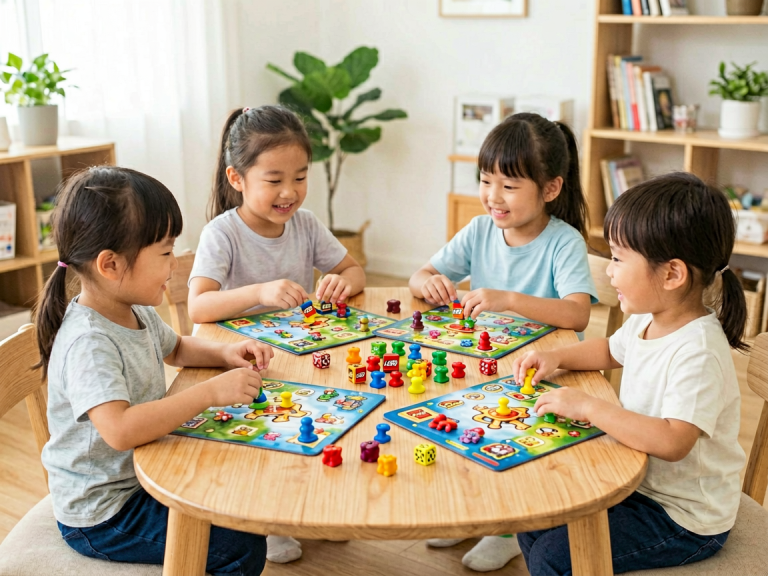
Board Games for Cooperation, such as "Hoot Owl Hoot!" or "The Sneaky, Snacky Squirrel Game," are superior to competitive games at this age because they emphasize teamwork. Players work together to achieve a common goal (e.g., get all the owls home before sunrise). These games teach turn-taking, following rules, and coping with frustration when the game doesn't go as planned. Unlike games where one child wins and others lose, cooperative games build a sense of shared accomplishment—a vital foundation for future group projects in school.
—
Active Play and Outdoor Toys: Encouraging Physical Development
Gross motor skills are still maturing at age five. Children need plenty of opportunities to run, jump, climb, and balance. Outdoor toys that promote physical activity also support cognitive development by increasing blood flow to the brain and improving attention span.
Balance Bikes and Tricycles are excellent for developing coordination and leg strength. A balance bike (without pedals) teaches the fundamentals of steering and leaning, which directly transfers to a regular bicycle. Riding outdoors also encourages spatial awareness—children learn to avoid obstacles, judge distances, and navigate turns. For a more compact option, a scooter with a wide deck and three wheels provides stability while still allowing for speed. Many scooters have adjustable handlebars to accommodate growth.
Obstacle Course Sets or simple playground equipment like a slide, swing, or climbing dome offer full-body workouts. Creating an obstacle course at home using cones, hula hoops, tunnels, and stepping stones allows parents to vary the challenge. For instance, set up a course that requires hopping, crawling, and balancing a beanbag on the head. This improves motor planning and confidence. A trampoline with an enclosure net (designed for young children) is another fantastic tool; the rhythmic bouncing strengthens the vestibular system, which is linked to balance and even reading readiness.
Sports-Inspired Toys like a child-sized basketball hoop or a tee-ball set introduce the concept of rules and turn-taking in physical play. Adjustable heights ensure the child can experience success without frustration. The act of throwing, catching, and hitting a ball develops hand-eye coordination that benefits both sports and fine motor tasks. For quieter active play, consider yoga cards or animal movement cards that prompt children to "stretch like a cat" or "hop like a frog." These integrate mindfulness and body awareness.
—
Conclusion
Choosing the best educational toys for a 5-year-old does not require a huge budget or the latest gadget. Instead, it demands thoughtful consideration of the child's current developmental stage and interests. The most effective toys are those that are open-ended, encourage active participation (rather than passive watching), and provide just enough challenge to inspire growth without causing frustration. Whether it's a set of magnetic tiles that teach geometry, a puppet that unlocks emotional expression, or a balance bike that builds confidence in movement, each toy serves as a portal to learning. By rotating toys periodically and engaging with the child during play—asking questions, offering gentle guidance, and celebrating their discoveries—parents can maximize the educational potential of every play session. Remember, the goal is not to accelerate learning but to nurture a curious mind that sees every experience as an opportunity to explore. With the right toys in hand, your five-year-old will be well on their way to a joyful, well-rounded foundation for life.