Beyond the Glow: Why Screen-Free Toys Are Essential for Newborn Development
Introduction
In an era where digital devices dominate nearly every aspect of daily life, the temptation to hand a smartphone or tablet to a fussy infant is understandable. Many parents, exhausted and seeking a moment of peace, may wonder: *What harm could a few minutes of a colorful animation do?* Yet a growing body of pediatric research and early childhood development expertise tells us that for newborns—babies from birth to approximately three months, and by extension, all infants under twelve months—the answer is clear: screen exposure offers no developmental benefit and may even hinder crucial early growth. The antidote is not a fancier app or a brighter screen, but something far more ancient and profound: screen-free toys. These simple, tactile, and often nature-inspired objects form the bedrock of sensory, cognitive, and emotional development. This article explores why screen-free toys are indispensable for newborns, what types of toys best support their needs, and how parents can create a rich, screen-free environment that lays the foundation for a lifetime of healthy learning.
—
Why Screen-Free Matters for Newborns
Newborns enter the world with brains that are extraordinarily plastic—every sight, sound, touch, and movement wires neural connections at a staggering rate. During the first year, the brain doubles in size, and the foundation for vision, language, motor skills, and social-emotional regulation is laid. Screen-based stimuli, however, are fundamentally different from real-world interactions.
First, screens provide *passive* stimulation. A newborn watching a moving image on a tablet is not actively engaging with the environment; the baby’s eyes follow light and sound without the need to reach, grasp, or manipulate. This passivity delays the development of cause-and-effect understanding. In contrast, when a newborn bats at a dangling wooden rattle and hears a gentle clink, the brain registers: *“I moved my hand—a sound happened.”* That simple feedback loop is the beginning of agency and problem-solving.
Second, screens overload the immature visual system. Newborns have limited visual acuity—they see best at a distance of 8–12 inches, and they prefer high-contrast patterns like black-and-white stripes or simple faces. Screens bathe the eyes in rapidly flickering pixels, confusing the developing visual cortex and potentially contributing to later issues with attention and focus. The American Academy of Pediatrics recommends no screen time for children under 18 months (except for video chatting) *specifically* because the rapid scene changes in screen media interfere with a baby’s ability to process information at a natural pace.
Third, screens replace human interaction. The most critical nutrient for a newborn’s brain is *responsive caregiving*—a parent’s face, voice, touch, and emotional mirroring. When a screen is present, even in the background, studies show that parents speak fewer words to their babies, make less eye contact, and respond less promptly to cues. Screen-free toys, by contrast, invite shared attention: a parent shaking a soft bell, rolling a ball back and forth, or holding a textured cloth for the baby to explore creates a reciprocal dance of communication that screens cannot replicate.
—
Key Developmental Benefits of Screen-Free Toys
Sensory Integration and Motor Skills
Newborns explore the world through their senses—touch, taste (safely, via mouthing), smell, sight, and hearing. Screen-free toys are uniquely suited to provide *multi-sensory* input. For example, a wooden teether offers a smooth, cool surface; a crinkly fabric toy produces sound while feeling soft; a black-and-white mobile with simple geometric shapes stimulates visual tracking. These experiences help the brain integrate sensory information, which is crucial for later skills like balance, coordination, and even reading.
Cause-and-Effect Learning
As mentioned, a newborn’s earliest understanding of causality comes from physical interaction. Toys that respond to a baby’s actions—a rattle that sounds when shaken, a squeaky toy that squeaks when squeezed, a push-and-go toy that moves away—teach the concept of agency. This is the same cognitive foundation that later supports understanding that pressing a button turns on a light, or that saying “mama” brings a caregiver closer. Screen-based toys (if interactive) often provide delayed or random feedback, confusing this learning.
Language and Social Development
Screen-free toys do not “talk” for themselves; rather, they create opportunities for *joint attention* between parent and baby. When a parent holds up a soft puppet and says, “Look, bunny! The bunny is hopping! Hop, hop, hop!” the baby sees the toy, hears the words, and watches the parent’s facial expressions. This three-way connection—baby, toy, caregiver—is the optimal environment for language acquisition. Research shows that babies learn words best when they appear in real, meaningful contexts, not from a disembodied voice on a screen.
Emotional Regulation and Focus
A screen’s constant changing stimuli can over-excite a newborn’s still-forming nervous system, leading to fussiness and difficulty self-soothing. Screen-free toys, especially those with gentle, predictable stimuli (a smooth wooden ball, a soft fabric block), allow babies to calm themselves through repetitive exploration. For example, a baby may repeatedly mouth a silicone teether, finding comfort in its texture and temperature. This self-regulation skill is essential for later emotional health.
—
Types of Screen-Free Toys for Newborns (by Developmental Stage)
Birth to 3 Months: High Contrast, Simple, and Soft
At this stage, newborns have limited motor control but are intensely curious about the world immediately around them. Ideal toys include:
- High-contrast black-and-white picture cards or books – These stimulate vision without overwhelming the brain. Propped a few inches from the baby’s face during tummy time, they encourage visual tracking.
- Soft, unbreakable mirrors – Babies are fascinated by faces, especially their own. A shatterproof floor mirror placed near the play mat helps them discover self-awareness.
- Gentle rattles and wrist bands with bells – Lightweight rattles that a newborn can hold (with assistance) produce sound when moved, strengthening the grasp reflex and auditory processing.
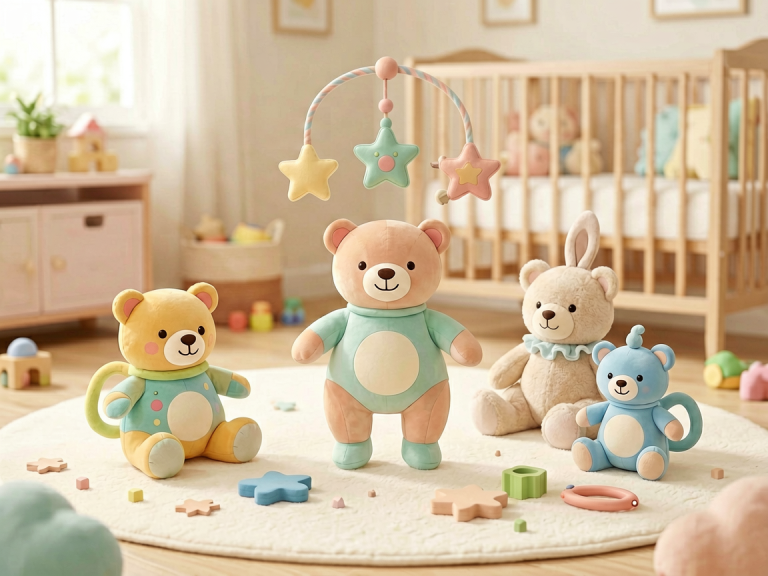
- Mobiles with simple, contrasting shapes – A wooden mobile with black, white, and red geometric forms hung above the crib encourages focusing and visual scanning. *Avoid mobiles that play electronic music; a gentle wind-up music box or a caregiver’s humming is far better.*
3 to 6 Months: Grasping, Mouthing, and Cause-and-Effect
Now babies begin to intentionally reach, grab, and bring objects to their mouths. Key toy types:
- Teethers of varying textures – Silicone, wood, and natural rubber teethers with bumps, ridges, and smooth sections soothe gums while providing tactile variety.
- Crinkle toys and soft cloth books – The satisfying crinkle sound, combined with bright fabrics and simple pictures, captivates babies and encourages exploration.
- Activity gyms or play mats with hanging objects – A simple wooden arch with dangling rings, a bell, and a soft plush toy invites reaching and batting. *Avoid plastic arches with flashing lights or electronic sounds.*
- Easy-to-grasp rattles and shakers – Look for shapes with handles or rings that tiny hands can wrap around. A wooden egg-shaped rattle is perfect.
6 to 12 Months: Problem-Solving, Movement, and Imitation
As babies become mobile—rolling, sitting, crawling, standing—their play becomes more purposeful:
- Stacking and nesting cups – Simple wooden or silicone cups that can be stacked, nested, and knocked down teach spatial relationships, hand-eye coordination, and the concept of “fit.”
- Push-and-pull toys – A wooden animal on wheels that a baby can push along the floor encourages crawling and walking. The resistance and motion provide proprioceptive feedback.
- Simple shape sorters – A block sorter with large, easy-to-grasp shapes (circle, square, triangle) challenges cognitive matching. *Ensure the pieces are too large to swallow.*
- Soft building blocks – Lightweight, cloth-covered foam blocks or pure wood blocks with rounded edges allow babies to stack, knock down, and experiment with balance.
- Musical instruments – A small wooden drum, a pair of maracas, or a xylophone (with a mallet that is attached) teach rhythm, cause-and-effect, and fine motor control.
—
How to Choose Safe and Appropriate Screen-Free Toys
Safety is paramount. For newborns, toys must be:
- Free of small parts that could become choking hazards. Use a toilet paper tube as a gauge—anything that fits inside is too small.
- Made of non-toxic materials – Look for certifications like ASTM or EN71. Avoid toys painted with lead-based paint or made from soft plastics containing BPA, phthalates, or PVC. Natural materials such as untreated wood, organic cotton, and food-grade silicone are excellent choices.
- Easy to clean – Newborns mouth everything. Toys should be washable (machine-washable fabric toys, wipe-clean wood and silicone).
- Age-appropriate – A toy designed for a two-year-old with magnets or long strings can be dangerous for a newborn. Always check the manufacturer’s age label, but also use your judgment.
Beyond safety, consider *open-endedness*. The best screen-free toys are those that can be used in multiple ways. A simple silk scarf can be peek-a-boo material, a canopy for a play mat, or a sensory texture to grab. A set of wooden rings can be stacked, rolled, or strung. Avoiding toys that do only one thing (e.g., a plastic toy that plays a single song when a button is pushed) encourages creativity and longer attention spans.
—
Creating a Screen-Free Play Environment
Ultimately, toys are only part of the equation. A screen-free lifestyle for a newborn requires intentionality from caregivers:
- Designate a screen- and distraction-free zone for play—a corner of the living room or nursery where devices are not allowed.
- Rotate toys. Present only a few at a time (three to five) to prevent overwhelm and renew interest. Store the rest in a closed basket.
- Prioritize interaction. Sit on the floor with your baby, narrate what they are doing, and imitate their sounds. Let them lead the play.
- Resist the urge to “educate” through screens. No app, no video, no “educational show” can replace the rich, messy, unpredictable world of real objects, real people, and real discovery.
Conclusion
Newborns do not need screens. They need the warmth of a caregiver’s voice, the texture of a wooden block, the sound of a gentle rattle, and the freedom to explore the physical world at their own pace. Screen-free toys are not a rejection of modernity; they are a return to what developmental science has always known: that the most profound learning happens through hands, mouths, and hearts engaging with the real, the tangible, and the human. By choosing screen-free toys for our newborns, we give them the greatest gift of all—a rich, unhurried childhood where every sensory experience is a building block for a vibrant, curious, and resilient mind.
*(Word count: approximately 1,350 words)*