How to Choose Creative Toys for Newborns: A Guide to Stimulating Early Development
Introduction
Choosing toys for a newborn can be surprisingly challenging. Walk into any baby store, and you will be overwhelmed by bright colors, flashing lights, electronic sounds, and endless marketing claims about "brain-boosting" products. Yet the reality is that newborns—infants from birth to about three months old—have very specific developmental needs. Their vision is blurry, their movements are reflexive, and their primary mode of learning is through their senses. The best "creative" toys for this age are not complicated gadgets but simple, safe objects that invite exploration and stimulate natural curiosity. This article provides a practical, evidence-based framework for selecting toys that truly support a newborn's growth while encouraging creativity from the very beginning.
Understanding Newborn Development: Why Simplicity Matters
Before diving into toy selection, it is essential to understand what a newborn can actually see, hear, feel, and do. At birth, a baby's vision is limited to objects about 8 to 12 inches away—roughly the distance to a parent's face during feeding. They prefer high-contrast patterns, especially black and white, because their color vision is not yet fully developed. Their hearing is acute, but they are most responsive to familiar voices and gentle, rhythmic sounds. Physically, newborns have little control over their bodies; they move their arms and legs in jerky, uncoordinated motions and can grasp objects placed in their palm via the palmar reflex.
Creative toys for newborns are those that work with these natural limitations, not against them. A toy that requires deliberate hand-eye coordination (like a shape sorter) is useless at this stage. Instead, the goal is to provide gentle sensory stimulation that encourages the baby to look, listen, touch, and—most importantly—interact with a caring adult. Creativity in the newborn period is about building neural connections through repeated, positive sensory experiences.
Safety First: Non-Negotiable Criteria for Newborn Toys
Safety is the absolute priority when choosing any toy for a newborn. Infants explore by putting things in their mouths, so every item must meet strict safety standards. Look for toys labeled as BPA-free, phthalate-free, and made from non-toxic materials. Avoid anything with small parts that could become choking hazards—buttons, beads, or loose fabric pieces. All edges should be smooth, and any strings or ribbons should be shorter than 12 inches to prevent strangulation. Soft toys should be machine-washable, as newborns drool and spit up frequently. Additionally, ensure that any electronic toys have a secure battery compartment that cannot be opened by tiny fingers. When in doubt, choose toys that are specifically designed for age 0+ or "newborn" on the packaging.
Stimulating Vision: High-Contrast and Black-and-White Toys
One of the easiest and most effective ways to engage a newborn is through visual stimulation. Because their vision is still developing, high-contrast patterns are more visible and interesting to them than pastel colors or complex images. Black-and-white cards, soft books with bold geometric patterns (stripes, checkerboards, circles), and mobiles with simple black-and-white or red-and-white designs are excellent choices. These toys encourage visual tracking—the ability to follow a moving object with the eyes—which is a fundamental skill for later reading and attention.
A creative approach here is not to overwhelm the baby with too many patterns at once. Rotate a few cards or images every few days to maintain novelty. You can also make your own high-contrast toys by printing simple shapes on cardstock and laminating them. Remember that the best "toy" is your own face; babies love looking at human faces, especially when you make exaggerated expressions. So while store-bought visual toys are helpful, they should never replace face-to-face interaction.
Engaging Hearing: Soft Music, Rattles, and Gentle Sounds
Newborns are highly responsive to sound, and auditory stimulation plays a crucial role in language development and emotional bonding. Creative toys for hearing include soft rattles that produce a gentle, pleasant rattle rather than a loud clatter. Look for rattles made of fabric or silicone that are easy for tiny hands to hold (or for an adult to shake near the baby). Musical toys, such as wind-up music boxes or sensory balls that play lullabies, can be soothing and captivating.
However, be careful with volume. Many electronic toys for babies are surprisingly loud, and prolonged exposure to loud noises can damage delicate hearing. Always test a toy at the baby's ear level; if it sounds loud to you, it is too loud for the baby. A better alternative is to use your own voice—singing, humming, or making simple sounds like "shhh" or "buh buh buh." Pairing a rattle with a song creates a multi-sensory experience that fosters creativity by allowing the baby to associate sound with rhythm and movement.
Encouraging Touch and Tactile Exploration
Touch is one of the most developed senses at birth, and newborns learn a great deal through skin-to-skin contact and the feeling of different textures. Tactile toys for this age include soft fabric squares with varied textures (satin, corduroy, fleece, ribbed cotton), silicone teething rings, and crinkle toys that make a paper-like sound when squeezed. The key is variety—offer a few different textures during tummy time or while the baby is lying on their back, and allow them to explore with their hands and mouth.
A wonderful creative toy is a simple "sensory blanket" or "taggy blanket" with loops and tags around the edges. Newborns often gravitate toward these tags because they are easy to grasp and chew. You can also make a DIY sensory board by sewing different fabrics onto a piece of felt. Always supervise tummy time with any toy to ensure the baby can breathe comfortably and does not roll into an unsafe position.
Supporting Movement: Toys for Reflex and Unfolding Motor Skills
While newborns cannot yet intentionally grasp objects, they do have reflexes. The palmar grasp reflex means that if you place a small, soft toy in their palm, they will automatically curl their fingers around it. This reflex is the foundation for later voluntary grasping. Toys that are lightweight, easy to grip, and safe for mouthing can be placed in the baby's hand—either by you or during supervised play. Look for toys like small fabric dumbbells, soft rings, or wooden teethers (avoid ones with loose parts).
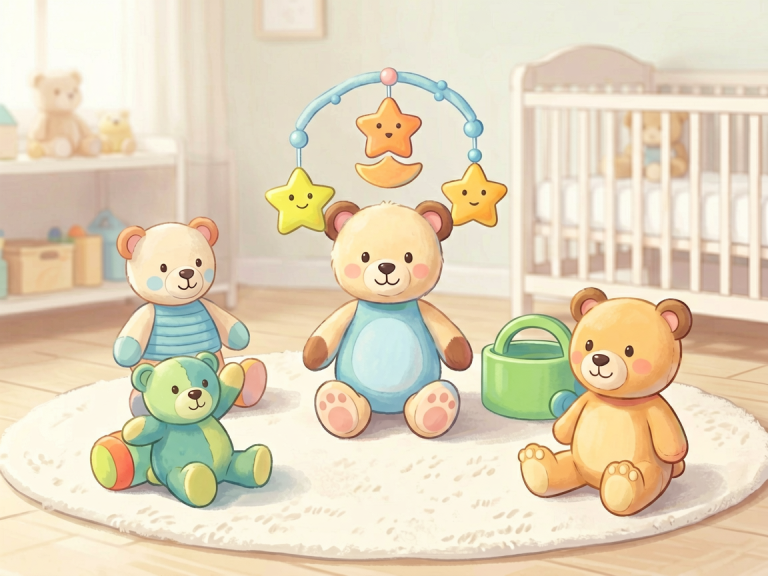
Another important area is visual-motor coordination. A "play gym" or activity mat with dangling toys that the baby can accidentally bat or kick encourages whole-body movement. The toys should be hung low enough that the baby can make contact with them, but not so low that they could entangle. Choose gyms with contrasting colors and a mix of textures. Even though the baby's movements are random at first, these interactions build the neural pathways for later purposeful reaching and kicking.
The Role of Parent Interaction: The Most Creative Toy of All
It is impossible to overstate the importance of the caregiver in newborn development. No toy, no matter how innovative, can replace a parent's voice, touch, and attention. When you present a toy to your baby, do so with enthusiasm and narration. For example, shake a rattle slowly while saying, "Listen! That's a gentle sound. Can you see it moving?" This kind of "serve and return" interaction is what truly promotes creativity, because it teaches the baby that their actions can elicit responses from the world.
Choose toys that facilitate this interaction, not replace it. Avoid electronic devices that talk or sing on their own without requiring any engagement from the parent. A simple puppet made from a sock, a cardboard box with a mirror taped inside, or a scarf that you drift over the baby's face—these are infinitely more creative and beneficial than a plastic screen that flashes lights. Remember, at this age, the baby's favorite "toy" is a smiling, talking, singing adult.
Avoiding Overstimulation: Quality Over Quantity
One common mistake new parents make is buying too many toys or choosing toys that are too busy. A newborn's brain is rapidly developing, but it can also become overwhelmed by too much sensory input. Signs of overstimulation include fussiness, turning away, yawning, or crying. Creative toys should be used in short bursts—just a few minutes at a time—and should be rotated so the baby does not become bored or overwhelmed.
A good rule of thumb is to have only two to three toys available at any given time. Focus on quality: each toy should serve a clear sensory purpose and be safe, simple, and beautiful. Minimalism is not just an aesthetic choice; it is a developmental one.
Conclusion
Choosing creative toys for newborns does not require a large budget or a trip to a specialty store. The best toys are those that respect the baby's developmental stage, prioritize safety, and encourage interaction with a loving caregiver. From high-contrast cards to soft rattles, textured blankets to gentle mobiles, the options are plentiful—but the guiding principle remains simple: less is more. Provide a few carefully chosen objects that invite looking, listening, touching, and moving, and then let your baby lead the way. In the first few months of life, the most creative thing you can do is to be present, responsive, and patient. That, more than any toy, is the true foundation for a lifetime of learning and imagination.