How to Choose Problem-Solving Toys for Newborns: A Comprehensive Guide for New Parents
Introduction
The first few months of a baby’s life are a whirlwind of growth and discovery. While newborns may seem like tiny, helpless bundles, their brains are already hard at work, absorbing every sight, sound, and sensation around them. Many parents wonder: when should I start introducing toys that actually “teach” something? The answer is earlier than you might think. Even in the newborn stage—typically the first three months—infants begin to develop early problem-solving skills through simple cause-and-effect interactions. A problem-solving toy, for a newborn, is any object that invites them to explore, react, and make connections—like shaking a rattle to hear a sound, or tracking a moving black-and-white pattern. However, with shelves overflowing with baby products, choosing the right toy can feel overwhelming. This guide will walk you through the science of newborn cognition, safety considerations, and practical selection tips to help you pick problem-solving toys that truly support your baby’s developmental journey.
—
Understanding Newborns’ Cognitive Abilities
To choose appropriate problem-solving toys, it’s essential to first understand what a newborn can actually perceive and process. At birth, a baby’s vision is blurry (limited to about 8–12 inches), and they prefer high-contrast patterns like black, white, and red. Their hearing is well-developed; they recognize familiar voices and may startle at loud noises. Movement is largely reflexive—grasping is involuntary, and they flail their arms and legs without conscious control. However, within the first two to three months, reflexes begin to be replaced by intentional actions. For instance, a newborn might accidentally swipe at a dangling toy and, upon hearing a chime, repeat the motion because they enjoy the sound. That is the very beginning of problem-solving: recognizing that “my action produces a result.” A good problem-solving toy for this age, therefore, does not require complex logic. Instead, it should offer a clear, immediate, and rewarding response to the baby’s exploration. The toy must be simple enough for the baby to interact with using their limited motor skills, yet engaging enough to hold their fleeting attention. Common examples include soft rattles, crinkle cloth books, or a black-and-white mobile. When parents understand the newborn’s developmental stage, they can avoid the common mistake of buying toys that are too advanced (which leads to frustration) or too passive (which leads to boredom).
—
Key Criteria for Selecting Problem-Solving Toys
Choosing the right toy involves more than just picking a cute animal on the shelf. There are several objective criteria that every parent should consider.
1. Safety First
Safety is non-negotiable for newborns, who explore the world primarily by mouthing objects. Look for toys labeled “BPA-free,” “phthalate-free,” and “non-toxic.” Avoid any small parts that could become choking hazards—a good rule of thumb is that if a toy or any of its components can fit inside a toilet paper roll, it is too small for a newborn. Ensure all seams are securely stitched and that there are no loose strings or ribbons that could wrap around tiny fingers or toes. Washability is also important; choose toys that are machine-washable or easy to wipe clean, because newborns drool and spit up constantly.
2. Sensory Stimulation
Newborns have a strong preference for high-contrast colors (black, white, red, and later primary colors). Toys with bold geometric patterns or sharp edges (like a classic black-and-white spiral) capture visual attention and encourage focusing, which is a early form of problem-solving (learning to track an object). Auditory stimulation is equally valuable: a gentle rattle sound, a soft crinkle, or a squeak—these sounds help babies associate an action with an effect. Textures also matter: plush, wooden, rubbery, and crinkly fabrics offer varied tactile feedback. The best problem-solving toys for newborns engage at least two senses simultaneously, such as a soft block that squeaks when squeezed and has a black-and-white checkerboard pattern.
3. Cause-and-Effect Features
The core of problem-solving is cause and effect. Look for toys that give a clear, immediate response to a simple action. For example: a baby gym with dangling rings that jingle when kicked; a grasping ring that plays music when shaken; a crinkle book that makes a loud rustle when the page is turned. The response must be predictable enough that the baby, after several repetitions, can learn to intentionally produce it. Avoid toys with variable or delayed responses—those are too confusing for a newborn’s developing brain.
4. Age-Appropriate Complexity
Newborns cannot press buttons or solve puzzles. Therefore, a “problem-solving” toy for them must be extremely simple. A toy that requires two steps (e.g., press button to hear music, then press again to change sound) is too advanced. Stick to single-step interactions: bat at a toy to make it sway; touch a patch of crinkly fabric to hear a sound; grasp a rattle and shake it. The toy should also be lightweight and easy to hold, with a surface that encourages gripping—even if the grip is still reflexive. Open-ended toys (like a soft blanket with different tags and textures) are ideal because they allow the baby to interact in their own way without a fixed “right” answer.
5. Parent-Child Interaction Potential
The best problem-solving toy is one that you can use together with your baby. Toys that encourage you to demonstrate an action (like shaking a rattle in front of your baby and then placing it in their hand) help bridge the gap between observation and action. Look for toys that come with simple guides for parents, or that naturally invite shared play, such as a scarf or a soft ball that you can roll gently toward the baby’s feet. The social engagement itself teaches the baby that their actions can influence another person’s behavior—an advanced form of problem-solving.
—
Top Types of Problem-Solving Toys for Newborns
Based on the criteria above, here are specific toy categories that dermatologists, pediatricians, and child development experts commonly recommend for newborns.
1. High-Contrast Visual Toys
Black-and-white cloth books, flashcards, or mobiles are excellent choices. They stimulate the visual cortex and encourage the baby to fix their gaze and eventually track movement. Place a high-contrast card about 10 inches from your baby’s face and slowly move it from side to side. The baby will eventually try to follow it—a simple tracking exercise that builds visual problem-solving. Tummy time mats with high-contrast patterns also give newborns a reason to lift their heads and explore.
2. Simple Grasping Rattles
A lightweight rattle with a smooth, thick handle (best if it is a ring shape) is a classic. Newborns have a palmar grasp reflex, so they will instinctively close their fingers around the ring. When they accidentally jolt their arm, the rattle makes a sound. Over time, they learn to shake it intentionally. Look for rattles with various textures (bumpy, smooth, rubbery) to add tactile variety. Avoid rattles that are too loud or jarring—a soft, pleasant chime is ideal.
3. Crinkle and Squeak Toys
Toys that incorporate crinkly fabric (like the wings of a soft butterfly) or a gentle squeaker (like a plush animal’s tummy) are perfect for newborns. The novel sound surprises the baby and encourages them to repeat the action that caused it—be it grabbing, squeezing, or even batting. The auditory feedback is immediate and satisfying. Many crinkle toys also have soft, teething edges.
4. Baby Activity Playmats and Gyms
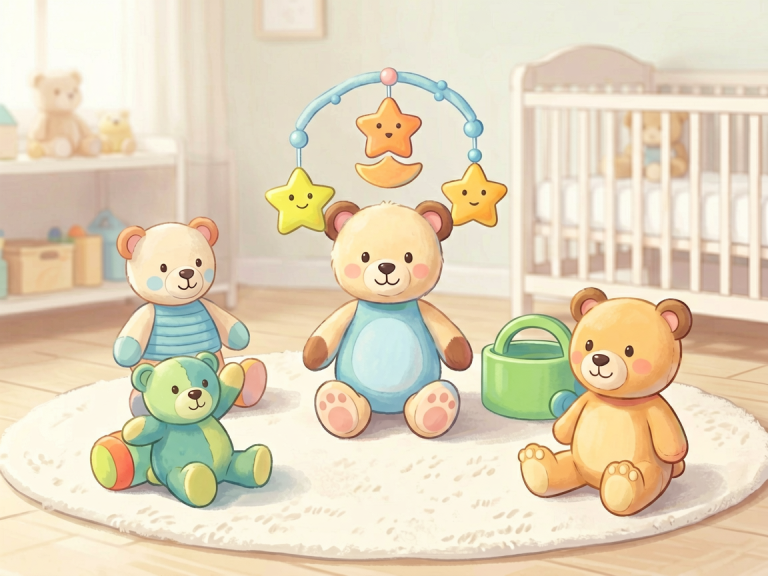
A playmat with an overhead arch and dangling toys offers a rich problem-solving environment. The baby lies on their back (and later on tummy) and can kick, bat, or grab at the hanging objects. Each time they successfully make contact, the toy may jingle, spin, or light up, reinforcing the cause-and-effect connection. Ensure the gym is stable and that the toys are securely attached. Rotate the toys occasionally to maintain novelty.
5. Safe Mirrors
Unbreakable, baby-safe mirrors (made of shatterproof acrylic) fascinate newborns. They initially see the reflection as another baby, but over time they learn that their own movements cause the reflection to move—a profound lesson in self-awareness and agency. Place a mirror on the playmat or lean it against a wall during tummy time. Always supervise because the baby might try to tilt or grab the mirror.
6. Soft Textured Balls
A soft, lightweight ball with different textures (ribbed, velvety, nubby) or a rattle inside is great. You can roll it gently toward the baby’s feet or hands. Even if they don’t actively roll it back, they will enjoy the sensation of the ball brushing against their skin or the sound it makes when kicked.
—
How to Introduce Toys to Maximize Problem-Solving Learning
Having the right toy is only half the battle; how you present it matters greatly. Follow these strategies to turn any toy into a problem-solving experience.
- Observe first. Watch your baby’s natural movements. Do they tend to bring their hands to their mouth? Kick their feet? Turn their head to one side? Choose toys that align with these current behaviors. For instance, if your baby loves kicking, hang a foot-accessible rattle on the playmat.
- Model the action. Before expecting the baby to interact, demonstrate the cause-and-effect yourself. Shake the rattle in front of them, then place it in their hand and gently guide their arm to shake it. Say “shake-shake” or “listen!” in an animated voice to build language association.
- Allow repetition. Problem-solving emerges from repetition. Let your baby shake the same rattle dozens of times without interruption. Each repetition strengthens the neural connection between action and outcome. Do not rush to introduce a new toy too quickly.
- Limit choices. Present only one or two toys at a time. Overwhelming newborns with many options leads to overstimulation and distraction. A single high-contrast card and a rattle are enough for a 10-minute play session.
- Respond with enthusiasm. When your baby successfully makes a toy produce a sound or movement, smile, clap, and say “You did it!” This social reinforcement teaches them that their actions are meaningful and valued.
—
Common Mistakes to Avoid
Even well-intentioned parents can accidentally hinder problem-solving development. Here are pitfalls to steer clear of:
- Choosing toys that are too advanced. Avoid electronic toys with multiple buttons, lights, and sounds that change randomly. A newborn cannot process that level of complexity and will either become frustrated or tune out. Stick to single-step reactions.
- Overloading the nursery. Too many toys hanging from the crib or scattered on the floor create sensory chaos. The baby cannot focus on any one item, and the concept of cause and effect gets lost. Keep the environment clean and simple.
- Ignoring safety. Toys with button eyes, glued-on ribbons, or batteries that can spill are dangerous. Always check for recalls or safety certifications. Never leave a newborn unsupervised with any toy, even a soft one.
- Forgetting tummy time. Many problem-solving toys are designed for supine (back-lying) play, but tummy time is crucial for developing the neck and upper body strength needed to eventually sit up and reach for objects. Use a small mirror or a crinkle toy placed just out of reach to motivate your baby to lift their head during tummy time.
- Pushing too hard. Problem-solving should be playful, not stressful. If your baby seems uninterested or fussy, put the toy away and try again later. Forced play can create negative associations.
—
Conclusion
Choosing problem-solving toys for newborns is not about buying the most expensive or sophisticated gadgets. It is about selecting simple, safe, and sensory-rich objects that invite your baby to experiment, repeat, and discover the joy of making things happen. From a black-and-white cloth book to a gentle rattle, every toy can become a mini-lesson in cause and effect when introduced with patience and enthusiasm. Remember that you, as the parent, are the most important “toy” of all—your voice, your face, and your reactions are the ultimate problem-solving tools. So relax, watch your little one closely, and let their natural curiosity guide you. The right toy is the one that makes their eyes light up and their hands reach out—because that is problem-solving in its purest, most beautiful form.