The Ultimate Guide to Choosing Outdoor Toys: What to Look For
—
Introduction
Outdoor play is an essential part of childhood. It fosters physical development, sparks creativity, and teaches children how to navigate the world beyond four walls. Yet not all outdoor toys are created equal. In an age of flashing screens and plastic gadgets that break after a single season, parents, caregivers, and educators must become discerning buyers. Choosing the right outdoor toy means more than grabbing the brightest package off the shelf. It requires careful thought about safety, durability, developmental value, and—most importantly—how that toy will inspire a child to run, climb, imagine, and grow. This guide explores the key factors you should evaluate before making your next purchase, ensuring that every outdoor toy earns its place in your backyard, park, or playground.
—
Safety First: Non‑Negotiable Standards
The first and most critical consideration when selecting any outdoor toy is safety. Unlike indoor playthings, outdoor toys are exposed to sun, rain, dirt, and rough handling. They must meet rigorous safety standards to prevent injuries.
Material Quality and Toxicity
Always check the materials used. Look for toys made from BPA‑free plastics, non‑toxic paints, and sustainably sourced wood that has been sanded smooth to prevent splinters. Avoid toys with sharp edges, small detachable parts that could be choking hazards for children under three, or long cords that could pose strangulation risks. Reputable manufacturers will clearly list safety certifications such as ASTM (American Society for Testing and Materials) or EN71 (European Safety Standard for Toys). If a product lacks these labels, treat it with caution.
Stability and Weight Limits
For larger equipment like swing sets, slides, or trampolines, stability is paramount. Check that the toy has a wide, sturdy base and that all bolts, screws, and joints are securely fastened. Every piece of climbing or jumping equipment should have a clearly stated maximum weight limit. Exceeding that limit not only risks breaking the toy but also endangers the child using it. Anchoring systems for items such as soccer goals or basketball hoops are also vital—unsecured goals have been known to tip over and cause serious accidents.
Impact Absorption
Consider the surface where the toy will be used. Hard ground like concrete or asphalt is never safe for active play. Ideally, place toys on grass, rubber mulch, sand, or specialized playground mats that absorb impact. If the toy itself is intended to be jumped on or fallen from—like a trampoline or climbing frame—enclosure nets and padded frames add an extra layer of security.
—
Age‑Appropriate Design: Matching Toy to Development
No matter how safe or well‑made a toy is, it will fail if it does not match the child’s developmental stage. A toy that is too advanced can frustrate a child and lead to misuse, while a toy that is too simple may quickly bore them.
Toddlers (Ages 1–3)
At this age, children are mastering gross motor skills such as walking, pushing, and pulling. Look for push‑and‑pull toys, small ride‑on vehicles without pedals, low‑to‑the‑ground sandboxes, and water tables. These toys should be lightweight, have no small parts, and encourage sensory exploration. Bright colors and simple shapes help stimulate cognitive development without overwhelming the child.
Preschoolers (Ages 3–5)
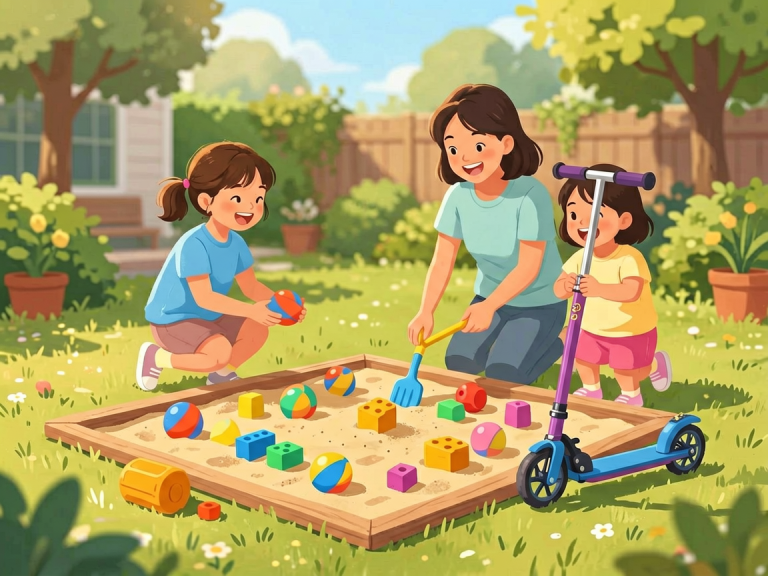
Preschoolers have more coordination and a growing imagination. They benefit from toys that combine physical activity with pretend play: tricycles, balance bikes, small climbing structures, playhouses, and gardening tools sized for small hands. At this stage, look for toys that can be used in multiple ways—for example, a sandbox that also doubles as a construction zone for toy trucks.
School‑Age Children (Ages 6–12)
Older children need challenges that build strength, endurance, and social skills. Choose toys that encourage team play, such as soccer goals, basketball hoops, jump ropes, or kite sets. Climbing ropes, slacklines, and larger swing sets satisfy their need for risk‑taking in a controlled environment. At this age, toys with adjustable features—like a basketball hoop that can be raised—extend the toy’s lifespan.
—
Developmental Benefits: More Than Just Fun
An excellent outdoor toy does not simply keep a child busy; it actively promotes growth across multiple domains.
Physical Development
The best outdoor toys get children moving. Look for options that build both gross and fine motor skills. Swinging, for example, develops balance and core strength; pedaling a tricycle builds leg muscles and coordination; digging in a sandbox strengthens hand muscles. Toys that require bilateral coordination—like hopscotch mats or jump ropes—are especially valuable because they engage both sides of the brain.
Cognitive and Problem‑Solving Skills
Outdoor play is naturally open‑ended. A simple bucket and shovel can become a tool for building a castle, digging for fossils, or mixing imaginary soup. Toys that involve construction, such as interlocking foam blocks or tinker sets designed for outdoor use, encourage planning, trial‑and‑error, and spatial reasoning. Even a classic game of tag or hide‑and‑seek sharpens memory and strategic thinking.
Social and Emotional Growth
Outdoor toys often become the centerpiece of group play. Swings, seesaws, and team sports equipment teach turn‑taking, sharing, negotiation, and empathy. A child who learns to pump her legs on a swing gains not only physical mastery but also a sense of accomplishment that builds self‑esteem. Look for toys that can be enjoyed by more than one child at a time—multi‑person seesaws, large parachutes, or ring‑toss games—to foster cooperation rather than competition.
—
Durability and Weather Resistance: Built to Last
Outdoor toys face relentless abuse from both weather and energetic children. A cheap toy that fades, cracks, or rusts within a few months is a poor investment.
Material Matters
Plastic toys should be made from high‑density polyethylene (HDPE) or similar UV‑stabilized materials that resist fading and shattering. Wooden toys require proper sealing with non‑toxic, weather‑resistant finishes to prevent rotting and warping. Metal components, such as swing chains or frame joints, should be galvanized or powder‑coated to deter rust. Avoid toys with exposed screws or staples that can work loose over time.
Assembly and Maintenance
Read reviews about the assembly process. Some toys come with poorly written instructions or flimsy parts that strip during tightening. Look for toys that include all necessary hardware and offer replacement parts. Also, consider how easy it is to clean—mold can develop on plastic sandbox covers or fabric canopies if not properly maintained. A toy that requires weekly maintenance may quickly become a burden rather than a joy.
Warranty and Brand Reputation
Reputable brands stand behind their products. A manufacturer that offers a warranty of at least one to three years on frames or key components is a good sign. Research online forums and consumer reports to see how well a toy holds up in real‑world conditions. Pay special attention to seams, hinges, and points of high stress like swing hangers or slide connections.
—
Encouraging Active Play, Not Passive Entertainment
In today’s digital age, the most important quality an outdoor toy can have is its ability to captivate a child away from screens. That means the toy should be inherently engaging without batteries or electronic bells and whistles.
Open‑Ended Play Potential
The best outdoor toys are those that can be used in dozens of different ways. A simple ball, for example, can be thrown, kicked, rolled, bounced, or used in a hundred invented games. A cardboard box—believe it or not—can become a spaceship, a fort, or a delivery truck. When shopping, ask yourself: “Will this toy still be interesting a month from now? A year from now?” Toys that allow for creativity and personalization (like a wooden playhouse that children can decorate with chalk) have staying power.
Physical Challenge and Risk
Children need opportunities to test their limits. A climbing wall, a balance beam, or a set of monkey bars provides appropriate risk—not danger—that helps children learn their own boundaries. These toys build confidence and resilience. Look for equipment that offers adjustable difficulty levels, such as climbing ropes with knots that can be moved lower or higher.
—
Social and Imaginative Play: Building Relationships
Outdoor play is often a social event. Even a solitary toy can spark group interaction if designed with collaboration in mind.
Multi‑User Features
Seesaws, giant trampolines, and team‑sport sets are obvious choices. But even a simple sprinkler or a bubble machine can draw a crowd. When selecting toys, consider whether they can accommodate siblings or friends. Toys that require multiple players—like croquet sets, badminton nets, or tug‑of‑war ropes—teach cooperation and sportsmanship.
Imaginative Themes
Children love to inhabit other worlds. A toy telescope can turn a backyard into an observatory; a set of child‑sized gardening tools can turn a patch of soil into a farm. Toy manufacturers have capitalized on this, offering everything from outdoor kitchen sets to pirate‑ship climbing frames. Look for toys that have a clear narrative hook but are not so prescriptive that they limit creativity. A generic play tent, for instance, can be a castle one day and a cave the next.
—
Environmental Considerations: Greener Choices
Outdoor toys interact directly with nature, so their environmental impact matters.
Sustainable Materials
Choose wooden toys certified by the Forest Stewardship Council (FSC) or made from recycled plastics. Avoid toys that come with excessive packaging, especially non‑recyclable plastic blister packs. Some companies now produce toys from bamboo, hemp, or other renewable resources that are both durable and biodegradable at end‑of‑life.
Non‑Toxic and Low‑Emission
Vinyl and certain soft plastics can off‑gas volatile organic compounds (VOCs), especially when heated by the sun. Opt for toys labeled as phthalate‑free and lead‑free. If you purchase inflatable toys (like bounce houses or water slides), make sure they are made from PVC‑free materials.
Longevity Reduces Waste
A toy that lasts for years is inherently more eco‑friendly than one that ends up in a landfill after a single season. Investing in quality—even if it costs more upfront—reduces overall consumption. Also, consider toys that can be passed down or resold.
—
Storage and Maintenance: Keeping the Fun Alive
An outdoor toy that is difficult to store or clean will quickly become a nuisance.
Compact and Foldable Options
If you have limited yard space, look for toys that can be disassembled or folded when not in use. Pop‑up soccer goals, foldable sandboxes with covers, and collapsible wagons are excellent space‑savers. For toys that must remain outdoors year‑round, choose designs that shed water easily—rounded tops on slides, for example, prevent puddles from forming.
Easy Cleaning
Outdoor toys attract dirt, mud, leaves, and sometimes insects. Choose toys with smooth surfaces that can be wiped down or hosed off. Sandboxes should come with a tight‑fitting cover to keep out animals and debris. Water tables often develop algae if not drained and scrubbed regularly; look for simple designs with drain plugs.
Parts Replacement Availability
Even the best toys wear out. Check whether the manufacturer sells individual replacement parts—a missing swing seat should not force you to buy a whole new swing set. Brands that offer spare hardware extend the useful life of the toy significantly.
—
Budget and Value: Spending Wisely
Finally, consider the cost in relation to the toy’s lifespan and benefits.
Initial Cost vs. Cost Per Use
A $50 plastic slide that cracks in six months and is used only a dozen times is far more expensive per use than a $200 wooden climbing set that lasts five years and is used daily. Calculate the “cost per play” before buying. Also factor in the hidden costs of accessories—like a separate carry bag, net, or safety mat.
Multi‑Season and Multi‑Age Use
The best value comes from toys that can be enjoyed in multiple seasons (a water table in summer, a sandbox in spring and fall) and that grow with the child. Adjustable features, such as a swing with straps that can be lengthened, allow a toy to serve a child from toddlerhood through elementary school.
Sales, Second‑Hand, and Community Swaps
Outdoor toys can be expensive, but they are often available second‑hand in excellent condition. Check local resale groups or thrift stores for gently used equipment. Be sure to inspect for safety issues—rust, cracks, missing parts—before purchasing. Community toy libraries or neighborhood swaps are also excellent ways to rotate toys without spending money.
—
Conclusion
Choosing outdoor toys is an act of investment—in a child’s health, happiness, and development. By focusing on safety, age‑appropriateness, developmental benefits, durability, and long‑term value, you can select toys that will become cherished memories rather than forgotten clutter. The perfect outdoor toy does not have to be the most expensive or the most advertised; it simply needs to invite a child outside, ignite their imagination, and stand up to the joyful chaos of real play. Remember: the best outdoor toy is the one that makes a child say, “Just five more minutes, please!”—and then stay outside for an hour longer.