From Crib to Code: The Best Coding Toys for Newborns That Spark Early Thinking
Introduction
When we hear the phrase “coding toys,” most of us instinctively picture colorful keyboards, robotic kits, or tablet-based apps aimed at school-aged children. Yet a growing body of research in early childhood development suggests that the foundational skills of coding—logical sequencing, pattern recognition, cause-and-effect reasoning, and problem-solving—begin forming long before a child can speak, walk, or even hold a crayon. For newborns, whose brains are developing at an astonishing rate of more than one million neural connections per second, the “toys” that surround them are not merely sources of comfort or amusement; they are the raw materials from which cognitive architecture is built.
So what exactly qualifies as a “coding toy” for a newborn? The answer lies not in microchips or screens, but in objects that introduce the infant to the basic laws of the physical and perceptual world in a structured, predictable way. The best coding toys for newborns are those that encourage the infant to notice patterns, anticipate outcomes, explore cause and effect, and engage in repetitive, sequenced interactions—all of which are the bedrock of computational thinking. This article explores the top categories of toys that nurture these nascent abilities, offering parents and caregivers a roadmap to selecting playthings that are both developmentally appropriate and intellectually stimulating.
—
1. The Foundation of Logic: Sensory Stimulation Toys
Before a newborn can understand that pressing a button produces a sound, they must first learn to discriminate between different sensory inputs. The earliest form of “coding” in the brain is simply pattern recognition: distinguishing light from dark, quiet from loud, smooth from textured. Sensory stimulation toys that present high-contrast visuals, varied textures, and gentle sounds serve as the first “input-output” systems for an infant’s burgeoning neural network.
High-contrast black-and-white toys are particularly effective. Newborns have limited color vision and visual acuity, but they are highly responsive to sharp boundaries and bold geometric patterns. Toys such as black-and-white cloth books, mobiles with alternating stripes, or soft blocks featuring checkerboard designs allow the infant to practice fixating on a stimulus, tracking it with their eyes, and eventually anticipating its reappearance. This is, in essence, a primitive form of pattern matching—the same skill that later allows a child to recognize that a loop in code repeats every five steps.
Similarly, toys with different textures—soft fleece, bumpy silicone, crinkly fabric—invite the infant to explore through touch. When a newborn touches a crinkly corner and hears a crunchy sound, they begin to build a mental model of the relationship between action and reaction. This is the earliest neural “algorithm”: if I press, then I hear. While the toy may look simple, it is laying down the synaptic pathways that will one day enable the child to understand conditional statements in programming languages.
Recommended toy types: high-contrast cloth books, black-and-white crib mobiles, textured sensory rattles, and soft crinkle toys. These are not “coding toys” in the traditional sense, but they are the essential primers for logical thought.
—
2. Cause and Effect: The First Step in Algorithmic Thinking
Around two to three months of age, a newborn begins to notice that their actions can produce predictable outcomes. This discovery—often called “personal agency”—is the very essence of an algorithm: a sequence of steps that leads to a specific result. The best coding toys for this stage are those that offer immediate, clear, and repeatable feedback.
Consider a simple activity gym where the infant bats at a dangling ring and the ring jingles. The infant may accidentally hit it at first, but with repetition, they learn to intentionally reach for the ring to produce the sound. This is a classic closed-loop system: action (bat), response (jingle), reinforcement (pleasure), repetition (learning). In coding terms, the infant is debugging their own motor control, refining the sequence until it reliably works.
Another excellent example is a “rock and play” musical toy that plays a melody when the infant kicks a padded panel. Some modern toys even include multiple triggers that produce different sounds, introducing the concept of branching logic: “if I kick left, I hear a drum; if I kick right, I hear a chime.” For a newborn, this is not conscious programming—but their brain is encoding the relationships between variables in a way that will later make Boolean logic feel intuitive.
It is crucial that these toys be simple and unambiguous. A toy with too many overlapping effects can overwhelm an infant and actually inhibit learning. The best cause-and-effect toys for newborns offer one clear action and one clear result, repeated consistently, so the brain can form a stable mental model.
Recommended toy types: activity gyms with dangling objects, musical foot mats, simple pop-up toys (with adult assistance), and rattles that change sound with different shaking speeds.
—
3. Patterns and Sequences: Musical and Rhythmic Toys
Music and rhythm are fundamentally about patterns and sequences—the same structures that underpin every programming language. A lullaby, for instance, consists of a repeated melodic pattern with slight variations, much like a loop in code that iterates through a list. Newborns are naturally attuned to rhythm, having heard their mother’s heartbeat in the womb. Capitalizing on this innate sensitivity, musical toys that offer predictable sequences can boost early pattern-recognition abilities.
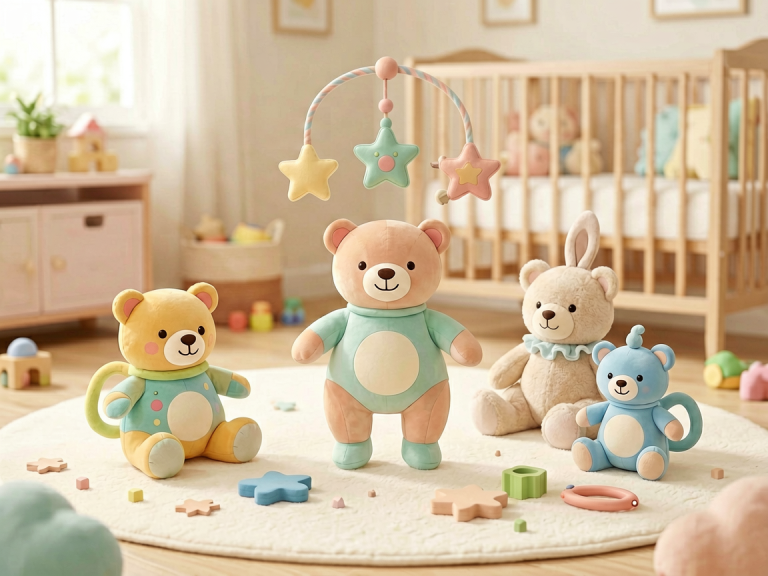
Wind-up musical mobiles that play a short tune at a regulated tempo are ideal. When the infant hears the same melody repeated every time the mobile is wound, they begin to anticipate the ending note. This expectation is a form of prediction—one of the highest-order cognitive skills. Over time, the infant may even exhibit excitement or calmness at the familiar pattern, demonstrating that they have successfully encoded the sequence.
Toys that allow the parent to vary the rhythm or add new elements take this a step further. For example, a set of soft, hand-held percussion instruments (like a mini maraca or a bell bracelet) lets the caregiver create simple rhythmic patterns—“shake, shake, pause, shake”—which the infant can follow with their eyes and eventually attempt to imitate. This is the neural equivalent of learning a simple loop structure. Additionally, some modern “smart” toys use light sequences that accompany music, teaching the infant to associate a visual pattern (lights blinking in order) with an auditory pattern (notes in a scale). This cross-modal pattern matching is a sophisticated cognitive achievement.
Recommended toy types: wind-up musical mobiles, soft musical toys with one-button playback, baby-safe shakers and bells, and musical activity centers with light-up buttons that follow a sequence.
—
4. Visual Tracking and Spatial Awareness: The Geometry of Code
Coding is not only about time-based sequences; it also involves spatial reasoning. When a programmer writes code, they must visualize how different blocks of logic fit together in space (e.g., nesting loops, placing functions in order). For a newborn, the foundation of spatial awareness begins with visual tracking—following an object as it moves across the visual field.
Toys that encourage this tracking are among the best coding toys for the earliest months. A slow-moving, high-contrast toy on a mobile or a parent slowly moving a colorful object side to side helps the infant’s eyes learn to coordinate and predict a trajectory. This predictive tracking is essentially the same mental process as following the flow of a program from one line to the next.
Another powerful tool is a “black-and-white track” toy, such as a simple wooden rod with contrasting beads that can be slid along a curved path. With adult guidance, the infant watches the bead travel along the track, reinforcing the concept that movement follows a defined path—like a variable traveling through a function. More advanced versions of these toys (for older infants but introduced as early as three months) include simple shape-sorters, where a block must be moved through a specific hole. The spatial constraint “this shape fits only this slot” is the physical equivalent of a type-check in programming.
Light-up toys that move in a consistent direction—such as a small, rolling ball with a glowing interior—are also excellent. The infant’s eyes follow the light as it rolls, and their brain begins to calculate speed and direction. This is the raw material of geometric reasoning, which later supports understanding of coordinate systems, vectors, and even 3D modeling.
Recommended toy types: slow-moving mobiles with high-contrast elements, black-and-white tracking cards (used by parents), rolling light-up balls, and simple bead-on-wire toys (with adult supervision).
—
5. Choosing the Right Toy: Safety and Developmental Milestones
When selecting coding-adjacent toys for a newborn, safety is paramount. The American Academy of Pediatrics recommends that toys for infants under three months should have no small parts, no sharp edges, and no strings longer than 12 inches that could pose a strangulation hazard. Additionally, electronic toys should be used sparingly; the World Health Organization advises that screen time for infants under one year should be zero, and even screen-free electronic toys should not substitute for human interaction.
The best approach is to choose toys that require active parental involvement. A high-contrast book is useless if simply placed in the crib; it becomes a powerful tool when a parent holds it 8–12 inches from the infant’s face and slowly turns the pages, narrating the patterns. A musical mobile is most effective when the parent winds it and observes the infant’s reactions, adjusting the tempo or position based on cues. In short, the parent is the true “coder”—the infant’s brain is the computer, and the parent’s interactions are the executable instructions.
It is also important to respect individual developmental differences. Some infants are highly visual and respond strongly to patterns; others are more kinesthetic and prefer textures and movement. The best coding toys are those that match the infant’s current interests while gently stretching their capabilities. Rotating toys every few days prevents habituation and keeps the novelty—a key driver of neural plasticity—alive.
Finally, remember that “coding” for a newborn is not about learning syntax or symbols. It is about developing a mindset that says, “I can make something happen,” “I can predict what comes next,” and “This pattern is familiar.” Every time an infant successfully tracks a moving toy or kicks to hear a jingle, they are reinforcing the very neural circuits that will later support logical reasoning, mathematical thinking, and—yes—coding.
—
Conclusion
The concept of “coding toys for newborns” may seem like a stretch, but it is in fact a profound recognition of how early learning works. The best toys for this age are not flashy or digital; they are simple, safe, and rich in pattern, cause-effect, and sequence. From high-contrast books that train the eye to predict visual shifts, to musical mobiles that turn rhythm into memory, these playthings lay the foundation for the computational thinking that will serve a child throughout life.
As parents and caregivers, we do not need to turn our newborns into programmers. What we need to do is provide an environment rich in predictable, patterned, and responsive experiences—because every time a newborn discovers that a kick produces a sound, they are writing the first line of code in their own mind. And that is the most beautiful algorithm of all.